
Unbiased headlines. Facts, not spin.
Unbiased Headlines is an independently owned news organization. We bring you the facts, not opinions, written fresh from 110+ named sources. Sources linked so you can verify it yourself.
 finance
Major Story (8/10)
Nasdaq Closes Down 2.6%, Its Worst Day Since June, as Meta, Amazon and Nvidia Fall and Brent Tops $114
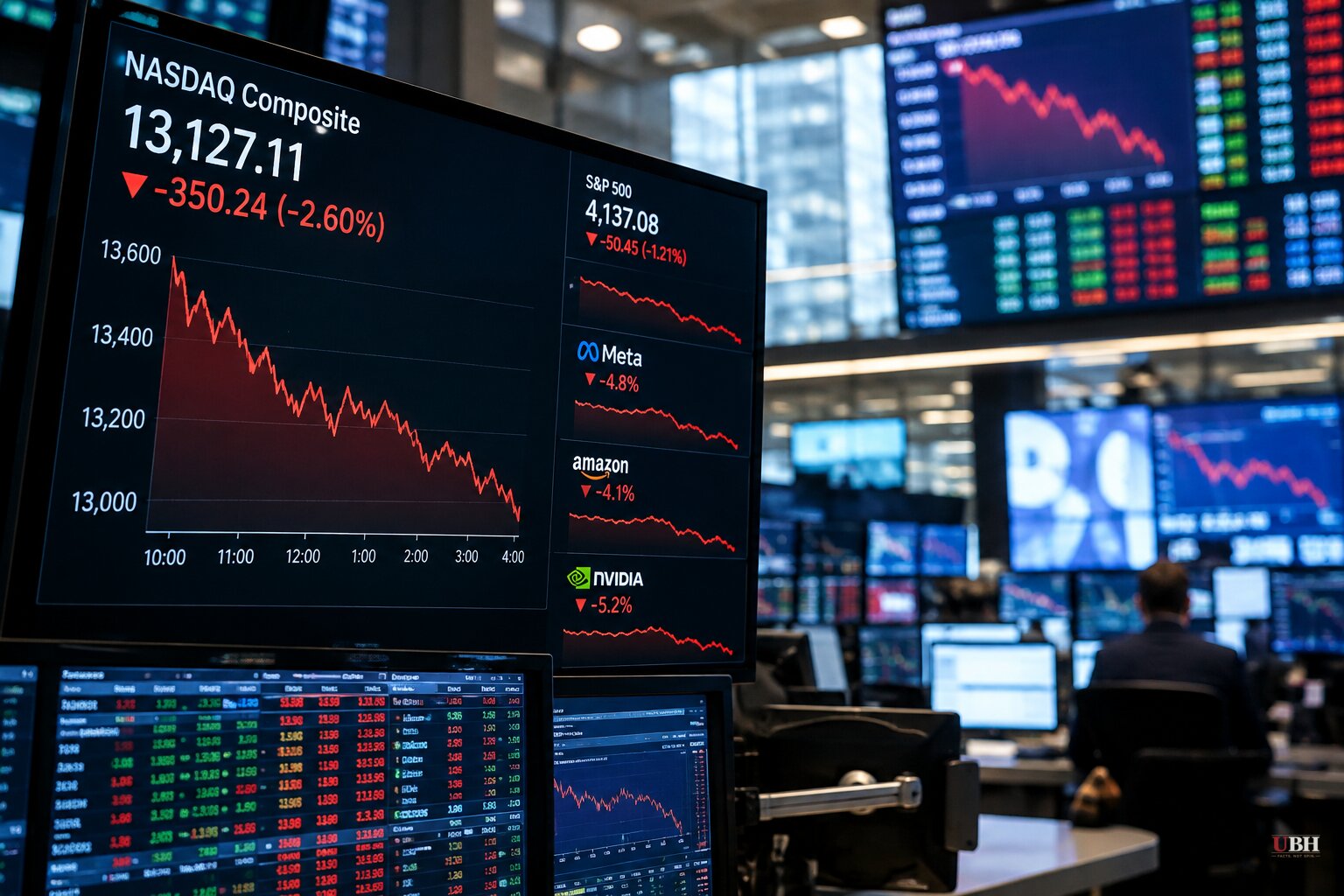
The Nasdaq was down more than 2% at midday Thursday, Oct. 22, and the index closed out its worst session in nearly five months. The selloff has spread to Asia.
The Nasdaq Composite finished down 2.6%, its steepest fall since a 4.2% drop on June 5. The S&P 500 lost 1.21%, its biggest decline since 1.52% on July 29. The Nasdaq now sits about 5.8% below its record high of Oct. 6.
The damage by name
Apart from Apple, every member of the "Magnificent 7" took a substantial hit. Those stocks make up more than a third of the overall market.
- Meta fell nearly 7% after raising its 2026 capital spending forecast to $135 billion to $145 billion. Its net profit also missed expectations.
- Amazon dropped 4.6% and Nvidia 4.4%.
- Tesla and Alphabet each fell 3.1%, and Microsoft fell 2.2%.
- Apple rose 1.2%.
- Intel and AMD each slid about 8%. Broadcom lost 4.3%.
CNBC's tally shows 20 of the most valuable global AI and semiconductor stocks have shed more than $1 trillion in value so far this week.
The losses reflect share prices falling, not a realized loss for any particular investor.
Forbes calculated that the world's six richest people, Elon Musk, Jeff Bezos, Larry Page, Sergey Brin, Michael Dell and Mark Zuckerberg, lost a combined $130 billion on paper Thursday. Musk's net worth fell $74 billion, to $914.7 billion, as SpaceX shares sank nearly 9% even after the company reported 161% year-over-year revenue growth. Musk has also confirmed SpaceX is weighing a merger with Tesla.
Tesla itself reported $1.5 billion in third-quarter free cash flow, against analyst expectations of a $4.9 billion cash burn. It cut its full-year capital spending guidance to $20 billion from more than $25 billion. The shares fell anyway.
Asia follows Wall Street down
Markets in Asia opened lower Friday. Japan's Nikkei 225 fell more than 2% in morning trading before recovering some ground. South Korea's KOSPI dropped as much as 3.5%. Hong Kong's Hang Seng slipped about 0.5%.
The Thursday damage abroad was heavier in chips. SK Hynix plunged more than 10% and Samsung Electronics fell 8.73%. In Japan, Advantest dropped almost 14%, SoftBank Group fell 7.9% and Tokyo Electron lost 6.45%.
The KOSPI had already fallen almost 8% on Oct. 15 and 18% over five sessions, according to Epoch Times figures, so Korean chip stocks were fragile before this week's leg down.
Oil and bonds
Brent crude futures rose 4% Thursday and kept climbing Friday morning, topping $114.20 a barrel, the highest since May. Further Houthi attacks in Saudi Arabia have raised the risk of wider conflict and supply disruption in the Middle East. Oil has been climbing since February in the wake of the U.S.-Israel war on Iran.
Investors also moved into government bonds. The 10-year Treasury yield fell seven basis points to 5.075%, dropping below the French 10-year yield for the first time in 13 years. French yields have pushed above 5% this month for the first time since 2002 as investors watch for signs the government can contain social unrest and rein in spending.
Why sellers say they are selling, and the counterargument
CNBC cited higher borrowing costs, worries that memory chips could be oversupplied as early as 2029, and Chinese competition. ChangXin Memory Technologies said over the weekend it had made a breakthrough in memory density, and Musk posted that China would make "a LOT of RAM in 2028."
Broadcom CEO Hock Tan and Intel's chief executive both warned Monday that financing could become a major headwind for the AI buildout. Tan said it could be a bigger obstacle than chip or power shortages.
Not everyone sees a change in the underlying business. Jay Goldberg, a senior analyst at Seaport Research Partners, said the swings look driven more by sentiment than fundamentals. "In short, nothing has changed. Investors have just decided to be afraid this week," he said.
Gabelli Funds portfolio manager Hendi Susanto made a similar point in an Oct. 15 note: "The biggest challenge in AI investing right now isn't the fundamentals. It is the expectations that are fragile." He said the infrastructure buildout should continue into the new year because suppliers are adding capacity against real orders.
Nvidia CEO Jensen Huang, speaking to Bloomberg in Stockholm, said he saw no need for Nvidia to backstop CoreWeave and that "their cost of capital is actually decreasing." The so-called neocloud stocks recovered after his comments. CoreWeave closed up 5.94% and Nebius gained 1.29%. IREN finished marginally lower.
What to watch at the open
U.S. regular trading begins at 9:30 a.m. ET today, Oct. 23. Brent above $114 and a 10-year yield near 5.1% are the backdrop.
Meta's $135 billion to $145 billion spending plan is the sharpest example of the question driving the week. Investors want to know when that money starts paying for itself.
No company has changed its AI spending outlook downward because of this week's moves. Tesla's capital spending cut is the exception, and it came with a 3.1% share drop anyway.
Sources used for this briefing
7 links from 7 independent newsrooms (syndicated copies of the same report count once)
These are the sources it draws on, linked so you can verify.


