
Unbiased headlines. Facts, not spin.
Unbiased Headlines is an independently owned news organization. We bring you the facts, not opinions, written fresh from 110+ named sources. Sources linked so you can verify it yourself.
 finance
Major Story (7/10)
Event date: October 19, 2026 ·
S&P 500 Posts Worst Day Since July as AI Stocks Slide; Asian Shares Mostly Lower Friday
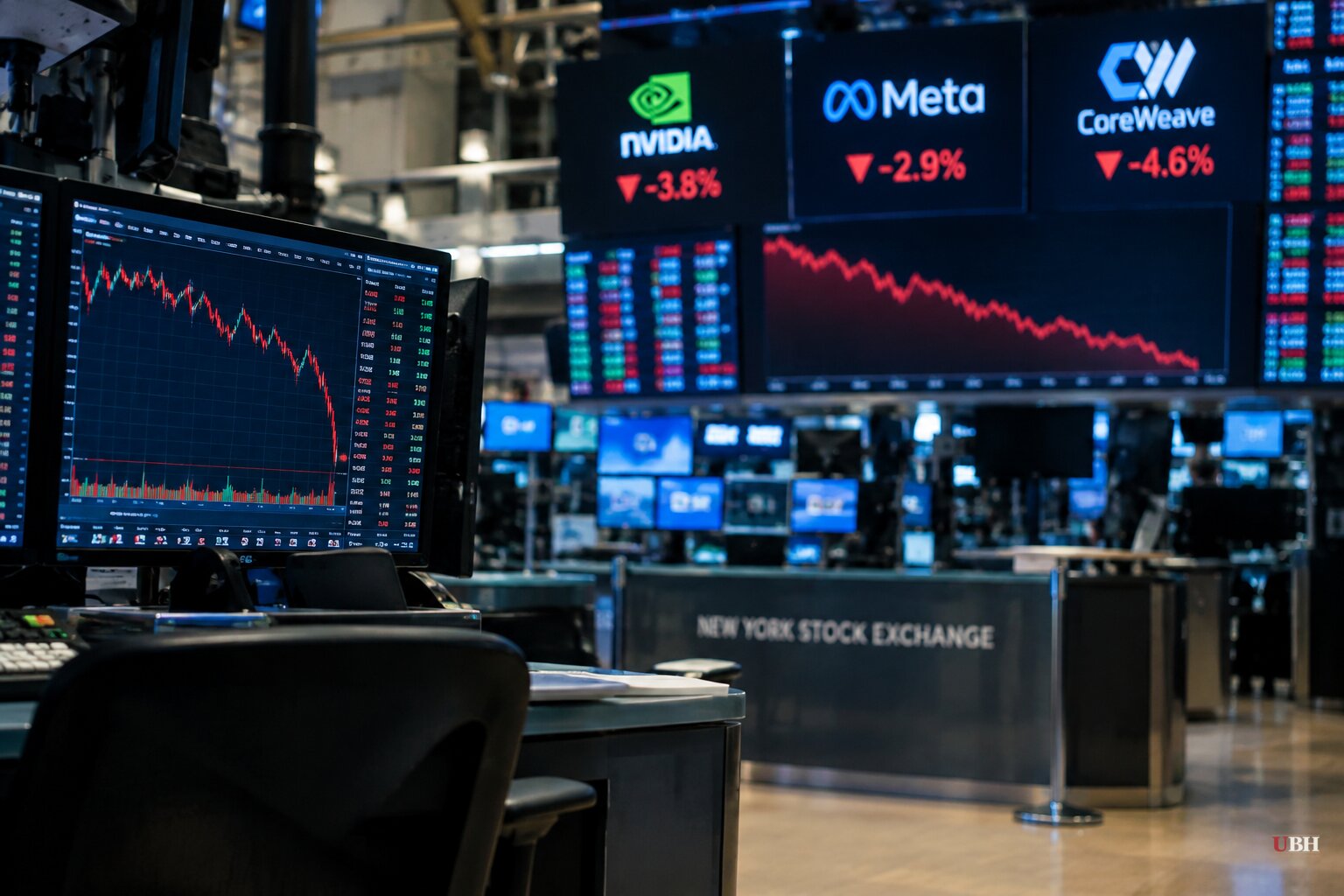
The AI selloff now has a clear scoreboard. The S&P 500 dropped 1.2% on Thursday, Oct. 22, its worst session since July, while the Nasdaq composite fell 2.6%.
The Dow Jones Industrial Average gained less than 0.1%. The tech weakness was heavy enough that it masked a rise in the majority of U.S. stocks.
The damage, name by name
Nvidia fell 4.4%. It is the largest company on Wall Street by total value, so its moves carry more weight on the S&P 500 than any other stock, and it was the single biggest drag on the index.
Meta Platforms lost 7% after reporting stronger quarterly revenue than analysts expected but weaker profit. The company also said it is creating a new class of stock to raise money for AI investments and other expenses.
Tesla fell 3.1%. Its profit beat analyst forecasts, but revenue came in below them.
CoreWeave dropped 10.1%. The company has borrowed money to buy Nvidia's AI chips and rents them out over the cloud. Its debt load of $50 billion has made it a focus of the worry, according to Fox Business.
Asia follows on Friday
Asian shares were mostly lower Friday, Oct. 23. Tokyo's Nikkei 225 lost 1.7% to 61,825.26, and South Korea's Kospi fell 2.4% to 5,403.32. The Shanghai Composite slipped 1.3% to 3,610.52 and Australia's S&P/ASX 200 shed 0.2% to 8,777.00. Hong Kong's Hang Seng rose 0.2% to 22,983.80.
The Kospi had already been hit hard. It plunged almost 8% on Oct. 15 and fell 18% over five sessions, though it was still up almost 30% for the year at that point. Adam Turnquist, chief cross-asset strategist at LPL Financial, attributed Korea's vulnerability to its concentrated exposure to memory chips, which he said is more sensitive to competitive threats, positioning unwinds and shifts in the memory cycle.
U.S. regular trading opens at 9:30 a.m. ET today, Oct. 23. Nothing has been confirmed about how it will start.
Why money is nervous
AI stocks have been swinging on fears that the boom is vulnerable because borrowing to build data centers and buy chips has become so expensive. Investors worry prices ran too high during a yearslong frenzy, even though AI companies keep reporting growth.
Oil is adding pressure. Brent crude jumped 4% Thursday and stood at $113.73 a barrel Friday, up 0.5%. It was below $97 at the start of October. U.S. crude was at $100.08. Prices are at their highest since May on uncertainty over when the war with Iran will let the global energy industry normalize.
Government debt is another overhang. Protests across France have raised pressure on the government to spend more, which could add to its deficit.
The selloff did not start this week. On Oct. 15, the PHLX Semiconductor Index fell about 2% and was down almost 10% over the prior week, though still up 61% on the year. That day followed hot wholesale inflation data, with core producer prices rising 0.7%, above estimates. Chip stocks later snapped an eight-day losing streak, their longest in 18 years, with a rebound Monday, according to Fox Business.
Is it a bubble or a reset?
Not everyone reads this as trouble. A Washington Post opinion piece argues the selloff is a chance to recalibrate financial risk and that the market, not government, should decide whether an AI bubble exists. It also argues the unnecessary burdens slowing data center development should be addressed.
Hendi Susanto, a portfolio manager at Gabelli Funds, said the fundamentals are not the problem. "The biggest challenge in AI investing right now isn't the fundamentals. It is the expectations that are fragile," he told The Epoch Times. He expects the infrastructure buildout to continue into the new year, with demand still high for accelerators, chipmaking equipment, memory chips and networking. "Companies don't commit billions to new fabs unless they see the orders coming," he said.
Wall Street's own stress tests
Axios reported Friday that America's largest banks are working to prevent worst-case AI scenarios but are also preparing for the day after a catastrophe. According to Axios, financial institutions have joined the biggest AI companies in scenario-planning for disaster.
The industry has plenty riding on the boom. New York State Comptroller Thomas DiNapoli reported that Wall Street earned $45.9 billion in profits in the first half of 2026, up 51% from a year earlier. That already tops the $45.3 billion his office forecast in May for the entire year. AI-related venture capital spending hit $407 billion in the first half, more than the $264 billion for all of 2025, according to the report.
DiNapoli also flagged the risk. He wrote that rising rates "may dampen profitability" if dealmaking slows or firms' interest liabilities climb significantly. Meta's new share class, a direct response to the cost of funding AI, is the clearest sign yet that the biggest spenders are changing how they pay for it.
Sources used for this briefing
6 links from 5 independent newsrooms (syndicated copies of the same report count once)
These are the sources it draws on, linked so you can verify.


