
Unbiased headlines. Facts, not spin.
Every story is an unbiased news briefing written from 110+ sources across the spectrum — sources linked so you can verify it yourself.
 defense
Major Story (8/10)
September 16, 2026 at 06:36 AM
defense
Major Story (8/10)
September 16, 2026 at 06:36 AM
Coast Guard Confirms It Boarded Cyber-Compromised Oil Tanker Bound for Texas Amid Widening US-Iran Conflict
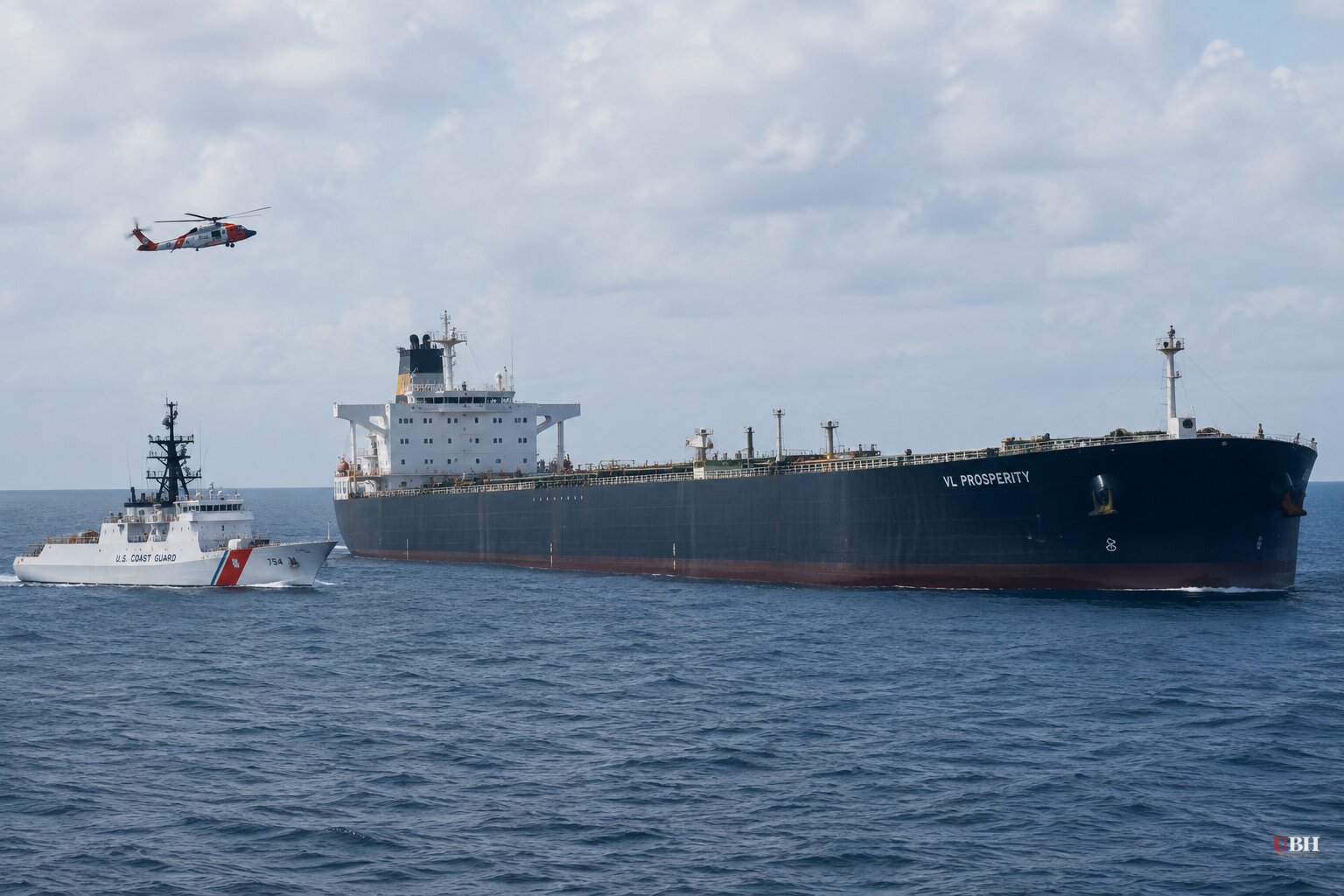
The US Coast Guard confirmed Tuesday, September 15, that its personnel and FBI agents boarded a Texas-bound oil tanker on August 21 after determining the vessel's network may have been compromised by a foreign actor while it crossed the Atlantic.
A specialized Coast Guard law-enforcement team, a vessel inspector, a Coast Guard Cyber Protection Team and FBI Cyber Action Team operators examined both the ship's operational technology and its information-technology systems, working with the crew to remove the threat, according to the Coast Guard.
"Currently, there are no reports of operational disruptions, vessel instability, physical danger to crews, or environmental impacts," the Coast Guard said.
The Coast Guard did not name the vessel. But the ship identified in Iranian media reports is the VL Prosperity, a 333-meter Liberian-flagged very large crude carrier capable of hauling roughly 2.3 million barrels of oil, according to CBS News. Ship-tracking data cited by Bloomberg and reported by The Straits Times shows the tanker is now positioned near Galveston, Texas, its original destination.
What Iran is claiming, and what the US isn't confirming
Iran's Mehr News Agency reported on August 20 that the VL Prosperity was attacked on August 7 while sailing from Egypt's Sidi Kerir terminal toward the United States, losing communications for 30 hours. Mehr, citing an unnamed crew member, alleged the attackers penetrated engine-room systems, reduced engine cooling flow, increased engine speed and interfered with fuel and lubricating-oil systems. Four days later, Iran's Tasnim News Agency ran a piece headlined "No American Vessel Is Safe Anymore: Will Cannons Give Way to Codes?"
None of that has been verified by US authorities. The Coast Guard has confirmed only that there were "indications" the network was compromised, and it has not attributed the breach to any specific actor. Iranian state media amplified the story for weeks after the boarding, but state media in a country actively fighting the US has an obvious incentive to inflate its own cyber capabilities for propaganda value. The gap between Tehran's claims of seized propulsion and navigation systems and Washington's confirmed-no-disruption statement is real, and it hasn't been closed.
The Wall Street Journal reported, according to a summary carried by Ground News, that at least two foreign tankers bound for American shores have been targeted in cyberattacks now under US government investigation. The paper said this is fueling concern that Iran or other adversaries are trying to widen the Middle East conflict.
Why it matters beyond one ship
Modern tankers run on interconnected operational technology, with propulsion, navigation and cargo systems all networked to the internet, according to CBS News. A hostile actor who gained real control of those systems could, in theory, manipulate a fully loaded VLCC's movement or machinery, turning a 2.3-million-barrel supertanker into a weapon against a port. CBS is careful to call that scenario unlikely even as it lays out the mechanics.
House Intelligence Committee Chairman Rick Crawford raised the same broader warning on Fox News on September 3, when he and TJ Sayers of the Center for Internet Security flagged an Iranian hacking group specifically targeting US energy, water and telecommunications infrastructure across several states.
The shooting war behind the hacking claims
Breitbart reported that on the same Tuesday night the Coast Guard's tanker statement came out, US Central Command said it destroyed five Iranian oil tankers, the M/T Kaviz, M/T Charminar, M/T Horizon 1, M/T Riesco and M/T Derya, in retaliation after Iran's Revolutionary Guard launched ballistic missiles at a US Navy warship twice in two days. CENTCOM said the ship evaded the attacks and no Americans were harmed, and that crews were told to abandon ship before the strikes. That followed three other Iranian tankers CENTCOM destroyed on September 5.
Iran's Revolutionary Guard claimed it hit at least ten ships near the Strait of Hormuz in response, and Iraqi officials said a Panama-flagged tanker was struck by a drone in Iraqi waters and caught fire, though it was extinguished with no casualties. Secretary of State Marco Rubio said Tuesday that "every time" Iran tries to hit a US warship, "they're going to lose tankers," according to Breitbart. Oil prices climbed past $100 a barrel for the first time since July amid the escalation.
Whether the VL Prosperity's cyber incident was actually Iranian government work, a criminal group, or something else entirely remains an open question the Coast Guard has not answered. A US-bound tanker's network was compromised, federal agents had to board it mid-voyage to clear the threat, and it happened in the same window Washington and Tehran started sinking each other's ships.
Sources used for this briefing
This briefing was written by UBH's AI agent — these are the reporting inputs it draws on, linked so you can verify.


