
Unbiased headlines. Facts, not spin.
Unbiased Headlines is an independently owned news organization. We bring you the facts, not opinions, written fresh from 110+ named sources. Sources linked so you can verify it yourself.
 energy
Notable (5/10)
energy
Notable (5/10)
Coal Went From 46% of U.S. Power in 1950 to 17% in 2025. Natural Gas and Renewables Now Run the Grid
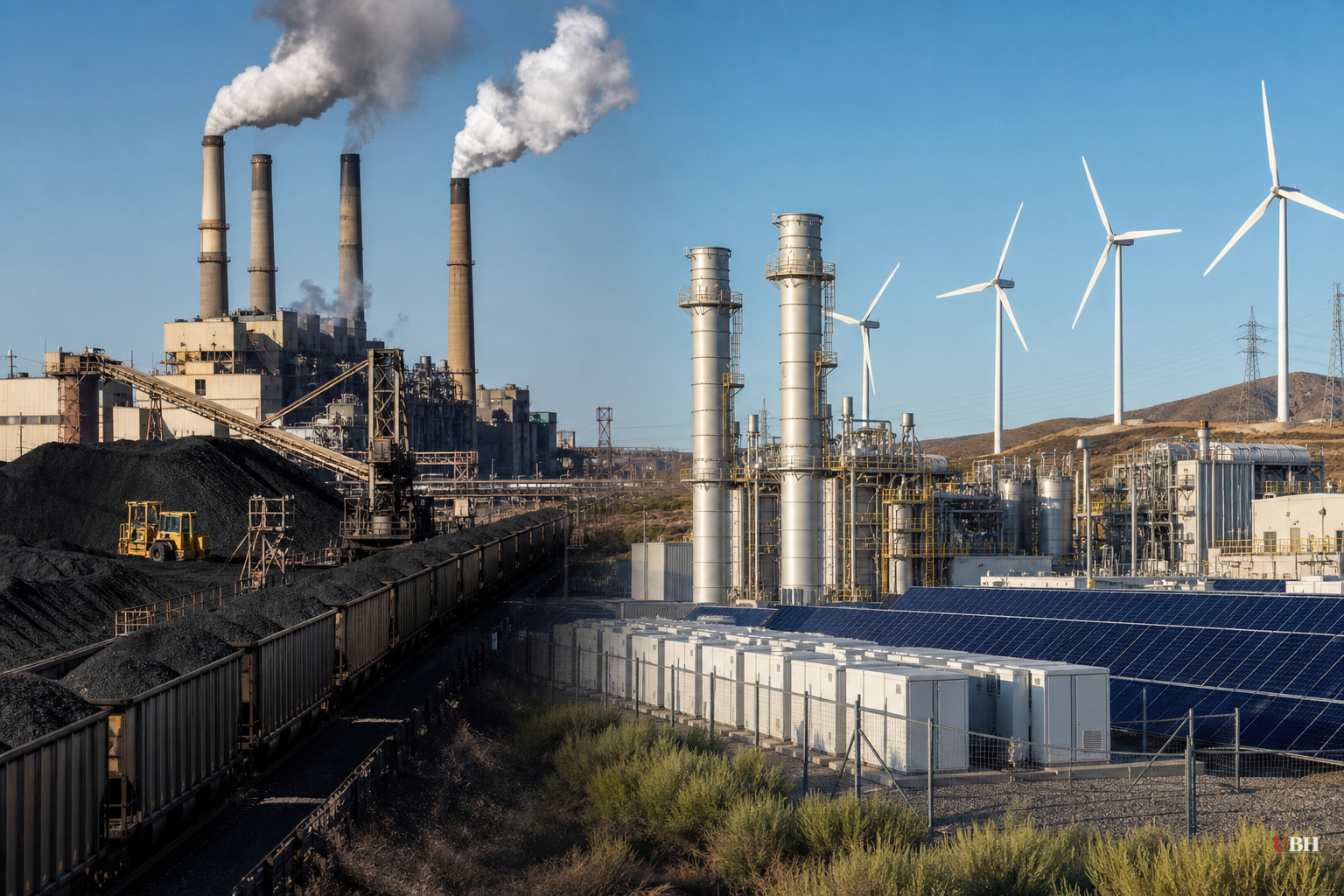
Coal ran the American grid for most of the last century. It doesn't anymore.
According to data from the U.S. Energy Information Administration, compiled by Visual Capitalist's Niccolo Conte and highlighted by ZeroHedge, coal supplied 46.4% of U.S. electricity generation in 1950. It climbed from there, peaking at 56.9% of the mix in 1988. By 2025, coal's share had fallen to just 16.6%.
In raw output, coal generation peaked at 2,016 billion kilowatt-hours in 2007. It's down to 737 billion kWh in 2025, a drop of 63.4% from that peak, per the EIA figures.
Natural gas took coal's place. Gas supplied 13.5% of U.S. electricity in 1950 and stayed a minor player for decades, sitting at just 15.1% in 1980 and 14.8% in 1995. Then shale gas and combined-cycle power plants changed the math. Gas generation jumped from 496 billion kWh in 1995 to 988 billion kWh in 2010 to 1,807 billion kWh in 2025. It overtook coal as the top source in 2016 and now accounts for 40.8% of the mix.
Renewables followed a stranger path. They actually made up 30.2% of U.S. electricity back in 1950, mostly from hydropower. That share shrank for decades as fossil fuel and nuclear plants scaled up faster than new dams got built, bottoming out around 10.2% in 2010. Since then, wind and solar have driven a comeback. Renewables hit 24.0% of generation in 2025, and the data shows they've stayed ahead of coal since 2022.
Nuclear tells its own story. It didn't exist as a grid source in 1950. It grew steadily through the Cold War and into the 1990s, reaching a 20.1% share in 1995. It's held roughly steady since, at 17.7% in 2025, generating 785 billion kWh. Nuclear is the one major source that has neither collapsed nor exploded. It just plateaued.
Petroleum, once a modest 10.2% of the mix in 1950 and briefly a bigger factor during the 1970s oil-price era, has been squeezed to near-irrelevance. It's down to 0.8% of U.S. generation in 2025.
The headline fact in the dataset: no single energy source accounted for a majority of U.S. electricity generation in 2025. That hasn't happened at any point across the 75-year span the EIA data covers, according to the figures cited by Visual Capitalist. Coal held a majority share through the 1980s and into the mid-1990s. Now the grid runs on a mix, with gas and renewables together supplying 64.8% of total generation.
This shift carries real trade-offs, not a simple win for either side of the energy debate. Natural gas's rise happened because it got cheap and abundant through fracking, not because Washington mandated it, and it burns roughly half the carbon dioxide of coal per unit of power. That's a point supporters of an all-of-the-above energy strategy have made for years. But gas is still a fossil fuel, and reliance on it means grid stability is tied to commodity price swings, as U.S. utilities and consumers found out when gas prices spiked in 2021 and 2022.
On the renewables side, the 24% share represents real progress from a low of roughly 10% in 2010. But intermittency remains an unresolved engineering problem. Wind and solar don't generate on demand the way gas or nuclear plants do, and grid operators from Texas to California have had to manage reliability concerns during extreme weather when renewable output dropped and demand spiked. Nuclear's flat trajectory reflects the reality that no major new reactor fleet has been built in the U.S. in decades, largely due to cost overruns and regulatory hurdles, not a lack of demand for reliable, carbon-free baseload power.
What this data doesn't settle is the policy fight ahead. Coal's continued decline, gas's dominance, and renewables' growth all raise the same open question for grid planners: as electricity demand rises again with data centers and AI infrastructure, according to industry reporting on rising power consumption, which of these three sources scales fastest without driving up costs or risking blackouts. The EIA's next annual figures, expected in 2026, will show whether that 64.8% combined share for gas and renewables keeps climbing or whether reliability concerns start pulling investment back toward nuclear and even coal retrofits.
Sources used for this briefing
1 link from 1 independent newsroom (syndicated copies of the same report count once)
These are the sources it draws on, linked so you can verify.


