
Unbiased headlines. Facts, not spin.
Unbiased Headlines is an independently owned news organization. We bring you the facts, not opinions, written fresh from 110+ named sources. Sources linked so you can verify it yourself.
 energy
Major Story (7/10)
Chinese Refiners Shift to Iraqi Crude as Iranian Exports Fall Below 100,000 Barrels a Day
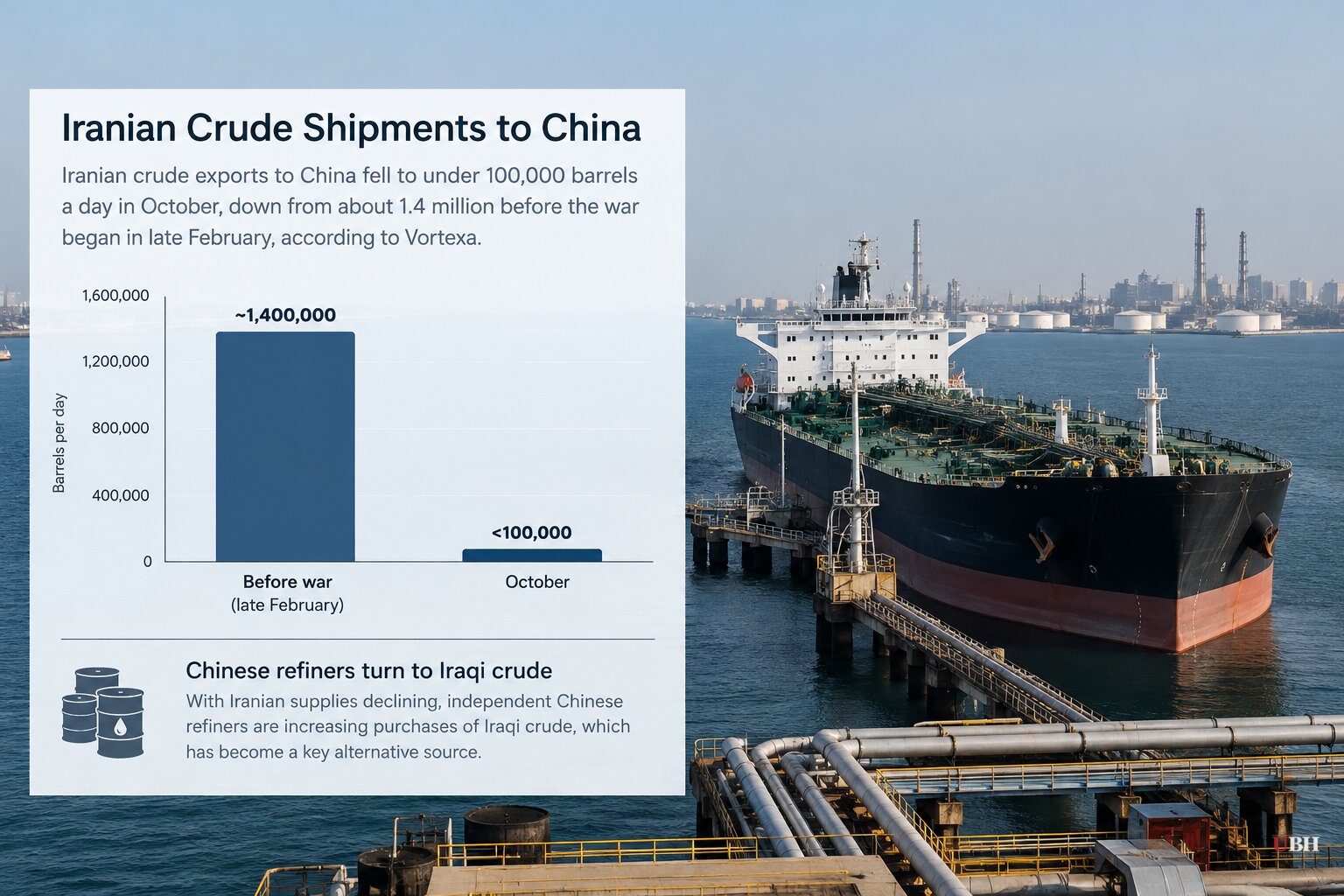
The U.S. naval blockade of Iranian ports is doing what its backers said it would: choking the oil that fed China's independent refiners. The money that used to flow to Tehran is now flowing to Baghdad and to Swiss trading houses.
Iranian crude exports to China dropped below 100,000 barrels per day in October, vessel-tracking firm Vortexa reported. Before the war broke out in late February, the figure was around 1.4 million barrels per day. The blockade on Iran's Gulf ports began in July.
Kpler data show Iran once supplied as much as 13% of China's seaborne crude imports. That is a big hole to fill.
Iran's stockpiles are running low
Vortexa says the crude Iran had loaded onto tankers and floating storage in the months before the war and the blockade is now close to depleted. That limits Tehran's ability to keep supplying Chinese buyers from reserves.
Chinese buyers have turned to Russian oil and other non-sanctioned grades, including Venezuelan crude, Vortexa said. Those alternatives have not fully replaced Iranian volumes, which Vortexa says leaves room for Saudi Arabia, Iraq and other Gulf producers to gain market share.
Iraq steps in
The main buyers of Iranian oil are China's independent refiners, the "teapots," most of them in Shandong province. They account for roughly a quarter of China's refining capacity and often run on thin margins. The state giants have mostly avoided Iranian crude since around 2018 and 2019.
Now those teapots are buying Iraqi barrels. Traders told Bloomberg that Mercuria Energy Group has sold up to 20 million barrels of Iraqi oil in recent weeks to at least eight independent refiners, including Shenghong Petrochemical, Hongrun and Chambroad. The traders spoke on condition of anonymity because the deals are not public. Mercuria declined to comment, and the three refiners did not immediately respond to requests for comment. Vitol is also facilitating deliveries, according to the same reporting.
Iraq is offering discounts to buyers willing to take on the risk of moving cargoes through the Strait of Hormuz. "Iraqi crude has emerged as a winner during this period," said Liao Na, founder of GL Consulting. She added that teapots remain "one of the few pockets of resilient demand in an oversupplied market."
Kpler analyst Muyu Xu said Iraqi crude is among the cheapest comparable grades delivered to China.
Cheap is relative. Traders say Basrah Medium and Basrah Heavy for December arrival traded last week at premiums of $13 and $11 a barrel over ICE Brent. Russia's ESPO blend, the other staple for teapots, was offered at $24 over Brent.
The limits of the swap
Iraqi crude has a high sulfur content. Jianan Sun, a London-based analyst at Energy Aspects, said that could create bottlenecks and limit intake at some Shandong refineries. Analysts also say it could push buyers toward West African and Latin American supply.
Leaks in the blockade
United Against Nuclear Iran, a Washington advocacy group that opposes Tehran's nuclear program, said at least nine small tankers carrying Iranian oil or LPG have evaded U.S. restrictions near the Strait of Hormuz since the blockade was reinstated in July. "Most vessels aren't" getting through, UANI senior analyst Jemima Shelley said, but some are.
UANI named one of them as the SOGL. The group alleges the tanker left Iran in early September carrying about 500,000 barrels of LPG loaded at Assaluyeh, then stopped at a Malaysian anchorage roughly 70 kilometers offshore known as the Eastern Outer Port Limits before delivering to China. UANI says it chartered a supply vessel and filmed the anchorage on Sept. 16. These are the group's allegations and its own footage. The cargo was LPG, not crude.
Beijing has long rejected unilateral U.S. sanctions and describes its trade with Iran as legitimate. Chinese customs data have shown no oil imports from Iran since July 2022, so volumes are estimated from tanker tracking.
Hormuz remains a hazard
The risk for anyone moving oil out of the Gulf is real. Iran's Islamic Revolutionary Guard Corps said Sunday that two oil tankers were struck by naval mines while trying to cross the Strait of Hormuz. On Monday, Nov. 16, the Iranian army's navy said a tanker caught fire and lost propulsion after hitting a sea mine in a restricted area east of the strait. It did not name the vessel or crew. The Iranian military has not provided evidence for either claim.
UN Secretary-General Antonio Guterres said Monday that the U.S. and Iran need a serious diplomatic process to end what he called a "neither peace nor war" situation.
It is unclear how long Iran can hold out. With floating stocks nearly drained, Vortexa's data point to a further squeeze on Tehran's China sales, while the sulfur problem will test how much Iraqi crude the Shandong refineries can absorb.
Sources used for this briefing
7 links from 7 independent newsrooms (syndicated copies of the same report count once)
These are the sources it draws on, linked so you can verify.


