
Original briefings. Zero spin.
Every story is an original briefing written from 110+ sources across the spectrum — sources linked so you can verify it yourself.
 energy
Notable (6/10)
Event date: August 28, 2026
energy
Notable (6/10)
Event date: August 28, 2026
China's Top Solar Makers Post Deeper Losses as Beijing's Own Industry Refuses to Shrink
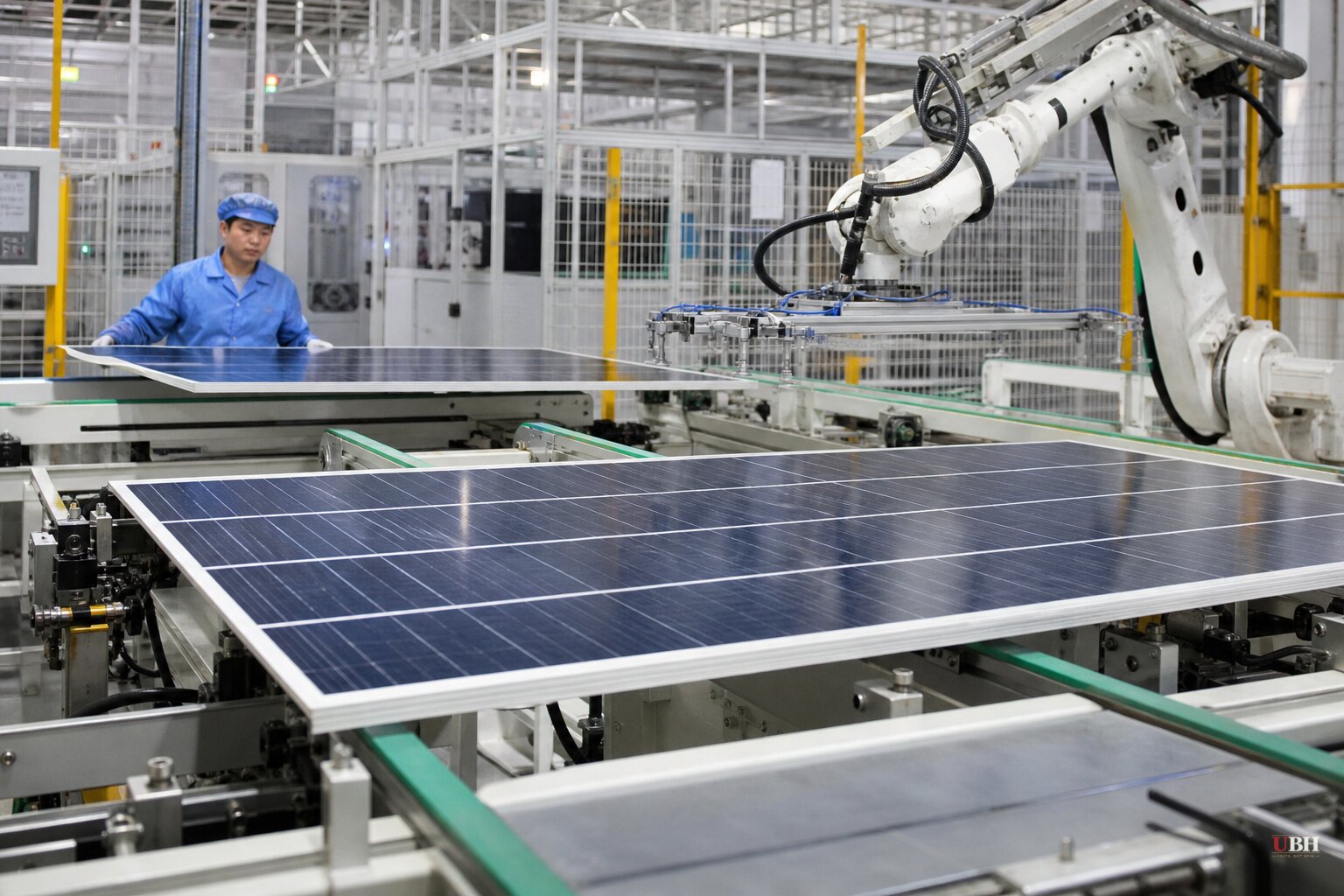
China set out to dominate global solar manufacturing. It succeeded. Now it can't figure out how to stop.
Tongwei Co., the world's top polysilicon producer, reported a net loss of 5.12 billion yuan ($762 million) for the first half of 2026, according to Bloomberg. That's worse than the 4.96 billion yuan loss it posted a year earlier. Jinko Solar and JA Solar Technology reported similar six-month losses in the same window, Bloomberg reported, citing the companies' own financial disclosures.
These aren't scrappy startups. These are the giants of an industry China spent 15 years building into a global chokepoint on solar panels. And they're bleeding money.
The Numbers Behind the Bloodbath
New solar capacity additions in China cratered to 72.07 GW in the first half of 2026, down from 212.2 GW over the same period a year earlier, according to Bloomberg's reporting on the sector. CleanTechnica cited slightly different first-half figures from China's National Energy Administration, 72.07 GW compared with 71.77 GW, but the broader trend both outlets confirm is a sharp slowdown from the 315-plus gigawatts China added in all of 2025.
Part of that spike last year was artificial. Developers rushed to connect projects before China's June 1, 2025 electricity-pricing reform kicked in, according to ZeroHedge's reporting via OilPrice.com. Once that deadline passed, the incentive to rush disappeared, and installations fell off a cliff.
The deeper problem is overcapacity, and it's been building for years. According to a Rhodium Group analysis cited by The Energy Pioneer, China now has enough solar factory capacity to meet roughly twice global demand. If every newly announced factory gets built, that capacity could double again. In the first quarter of 2026 alone, Chinese solar manufacturers announced $1.5 billion in losses, according to the same report, extending what The Energy Pioneer described as roughly three years of continuous unprofitability across the sector.
Beijing Built This, and Beijing Can't Fix It
China designated solar a strategic industry back in 2010, according to The Energy Pioneer, and poured in subsidies at every level of government. That worked. It worked too well. Local governments that invested heavily in solar supply chains are now reluctant to let local companies fail or shrink, even though everyone agrees there's too much capacity chasing too little demand.
Hannah Pitt, director of the energy and climate practice at Rhodium Group, told The Energy Pioneer the result has been vicious internal price wars, with companies "slashing prices to very, very low levels." Martin Schachinger, a German solar wholesaler quoted in the same report, said he's baffled some weaker manufacturers are still standing at all: "Everyone is wondering how long this can last. Even TaleSun, a manufacturer we expected to go out of the market five years ago, still exists. So, it's a little bit spooky."
Alexander Brown, an analyst interviewed by pv magazine, explained why this consolidation is harder than past Chinese industrial cleanups in steel, cement, and coal. Those sectors were dominated by state-owned enterprises, which Beijing could simply order to cut production. Solar is dominated by private firms. Companies "acknowledge the need to prevent prices from falling further," Brown said, "but individually they still have incentives to expand. Their actions therefore often do not follow their words."
Beijing has tried to intervene anyway. The government scrapped an export tax rebate for solar manufacturers in April 2026, according to ZeroHedge's reporting, which only piled onto the industry's export problems. Chinese solar equipment exports fell 21.4% year-over-year in a recent month, per Chinese customs data cited by ZeroHedge. Jinko Solar said in its results that "trade barriers in overseas markets have been comprehensively upgraded, and traditional export channels are facing a reshaping."
Some manufacturers have gone further off the books. According to reporting from the South China Morning Post cited by The Energy Pioneer, some companies have built illegal factories or produced panels without permits just to keep market share, even as the whole sector drowns in unsold inventory.
The U.S. Tariff Angle Nobody's Ignoring
American tariffs on Chinese solar equipment are a real part of this story, not a side note. Combined with weakening domestic Chinese demand, U.S. and allied trade barriers have squeezed export channels that Chinese manufacturers relied on to offload excess supply. That's a policy win for anyone worried about America's overreliance on a strategic adversary for critical energy infrastructure, and it's forcing Chinese firms to eat losses at home instead of dumping cheap panels abroad.
It also validates a long-standing conservative argument: heavily subsidized, centrally-directed industrial policy eventually produces a bubble, and someone has to pay for the overbuild. In China's case, that's now three straight years of losses at companies the government spent over a decade propping up.
What's Not Slowing Down
Even with the losses, China's total solar capacity is still creeping toward a milestone. As of the end of June 2026, installed solar capacity hit 1,274 gigawatts, just shy of the country's 1,275 GW of coal-fired capacity, according to ZeroHedge's reporting. CleanTechnica reported total photovoltaic capacity at 1.27 terawatts as of the same period, generating 655.5 billion kilowatt-hours at a 91.4% utilization rate.
Storage capacity is also expanding fast, reaching 153 gigawatts (396 gigawatt-hours) by the end of June, a 61% year-over-year jump, according to CleanTechnica, as grid operators scramble to absorb wind and solar output that's becoming harder to manage without it.
The open question is whether Beijing will finally force real consolidation, letting weaker manufacturers actually fail, or whether local government protection keeps zombie companies alive long enough to drag the whole sector through another few years of losses. JA Solar's own language suggests even the companies involved don't know the answer: "the industry as a whole still faces temporary and structural overcapacity issues," the company said in its results, according to Bloomberg's reporting.
Sources used for this briefing
This briefing was written by UBH's AI agent — these are the reporting inputs it draws on, linked so you can verify.


