
Unbiased headlines. Facts, not spin.
Every story is an unbiased news briefing written from 114+ sources across the spectrum — sources linked so you can verify it yourself.
 finance
Major Story (7/10)
October 7, 2026 at 04:09 AM
finance
Major Story (7/10)
October 7, 2026 at 04:09 AM
China's State Banks Lend $3 Billion to Qatar While Hundreds of Rural Lenders Disappear at Home
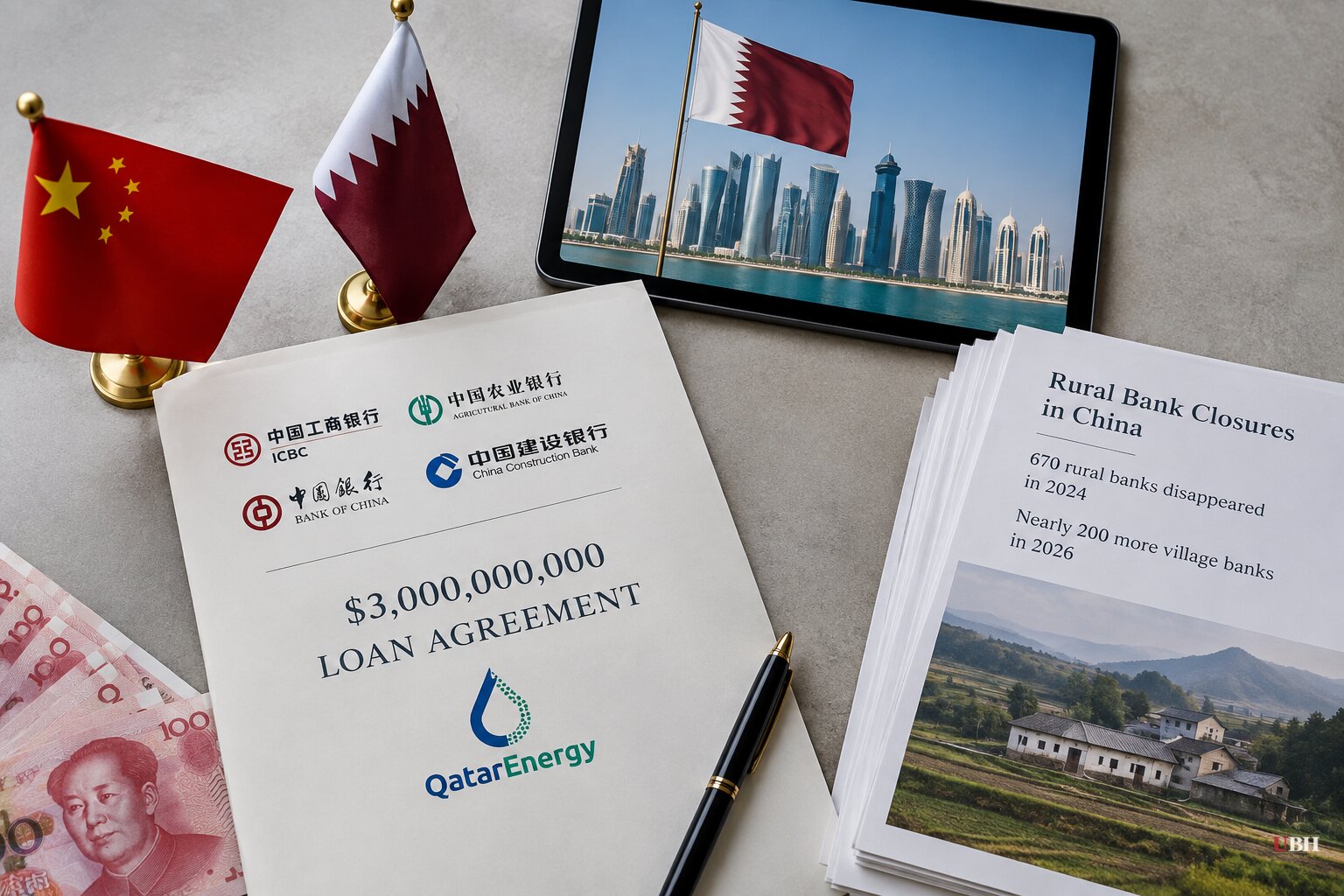
QatarEnergy has secured a $3 billion, five-year loan from four Chinese state banks, according to Bloomberg, which cited people familiar with the matter who asked not to be identified discussing private lending details. Bank of China, Industrial and Commercial Bank of China, Agricultural Bank of China, and China Construction Bank (Asia) Corp. are the lenders behind the deal.
Bloomberg framed the loan as a signal that major financial institutions remain willing to lend to Gulf borrowers despite what it described as the protracted US war with Iran. Qatar sits across the Persian Gulf from Iran and has navigated that conflict as a neutral energy exporter, making Chinese banks' willingness to extend credit notable at a moment when sanctions risk around the region remains elevated.
The deal shows China's largest state lenders still have plenty of capital to deploy abroad. What's happening inside China's borders looks very different.
Rural Banks Are Vanishing
China had 670 fewer rural small and midsize banks at the end of 2025 than a year earlier, an 18.6 percent drop, according to regulatory data reported by the Chinese financial outlet Caixin and cited by the Epoch Times. Most of those institutions weren't shuttered outright. They were merged into larger lenders or converted into branches, with their deposits and loans absorbed by surviving banks.
The trend hasn't slowed in 2026. The state-run Securities Times reported that 191 village banks stopped operating independently in the first nine months of this year alone. That leaves 973 village banks nationwide as of September 30, down sharply from 1,651 at the end of 2021.
Beijing isn't hiding the strategy. China's 2026 government work report, released in March, explicitly called for reducing and restructuring local small and midsize financial institutions and for the orderly handling of high-risk lenders. In April, China's banking regulator told rural banks to keep restructuring and gave them room to shut county and village outlets, so long as basic financial-service coverage remained in place.
Officials and state media frame this as responsible consolidation, not collapse, folding weak lenders into stronger ones rather than letting them fail outright. The consolidation is happening because the underlying loan books at these small banks are in bad shape.
The Numbers Behind the Squeeze
At rural commercial banks, 2.79 percent of loans were classified as nonperforming at the end of the first quarter, according to data from China's National Financial Regulatory Administration released in July. That's more than double the 1.22 percent rate at China's large commercial banks. Rural commercial banks were sitting on 853 billion yuan, about $120 billion, in bad loans.
The pressure isn't limited to rural lenders. China's broader commercial banking system reported 3.7 trillion yuan, roughly $520 billion, in nonperforming loans by the end of June, with the bad-loan share of total lending edging up to 1.52 percent, per China's banking regulator.
Property is a central driver. Property investment fell 19.9 percent in the first eight months of 2026, and bank lending to property developers dropped 33.3 percent from a year earlier, according to China's National Bureau of Statistics.
The International Monetary Fund's 2025 review of China's financial system flagged the property downturn and local-government debt as compounding risks to the banking sector. Much of that debt sits with local-government financing vehicles, state-owned entities that local authorities use to borrow for infrastructure, often off the books. The IMF estimated banks hold about three-quarters of that debt. Smaller banks have less capital to absorb losses, pay more to raise funds, and depend on a narrower pool of borrowers than their national counterparts, making them the first to buckle.
Two Very Different Balance Sheets
The contrast is stark. China's four biggest state banks, flush with capital and backed by Beijing, can extend a $3 billion credit line to a Gulf energy giant without blinking. Thousands of smaller Chinese lenders, exposed to a collapsing property market and heavily indebted local governments, are being quietly absorbed or wound down one branch at a time.
Neither Bloomberg nor the Epoch Times reporting indicates any direct financial link between the QatarEnergy loan and the rural bank consolidation. They are separate developments inside the same banking system. But they tell a consistent story about where risk and capacity sit in China's financial sector: concentrated at the top, drained at the bottom.
The open question is how long Beijing can keep managing the bottom-tier shrinkage without a disorderly failure. With 1.52 percent of total commercial lending now classified nonperforming and property lending still falling, China's regulators have more consolidation ahead of them, and no public timeline for when the restructuring ends.
Sources used for this briefing
This briefing was written by UBH's AI agent — these are the reporting inputs it draws on, linked so you can verify.


