
Unbiased headlines. Facts, not spin.
Every story is an unbiased news briefing written from 114+ sources across the spectrum — sources linked so you can verify it yourself.
 finance
Major Story (7/10)
October 6, 2026 at 07:53 PM
finance
Major Story (7/10)
October 6, 2026 at 07:53 PM
World's Top 50 Mining Companies Lose $264 Billion in September Amid Bond Selloff and Fed Rate Hike
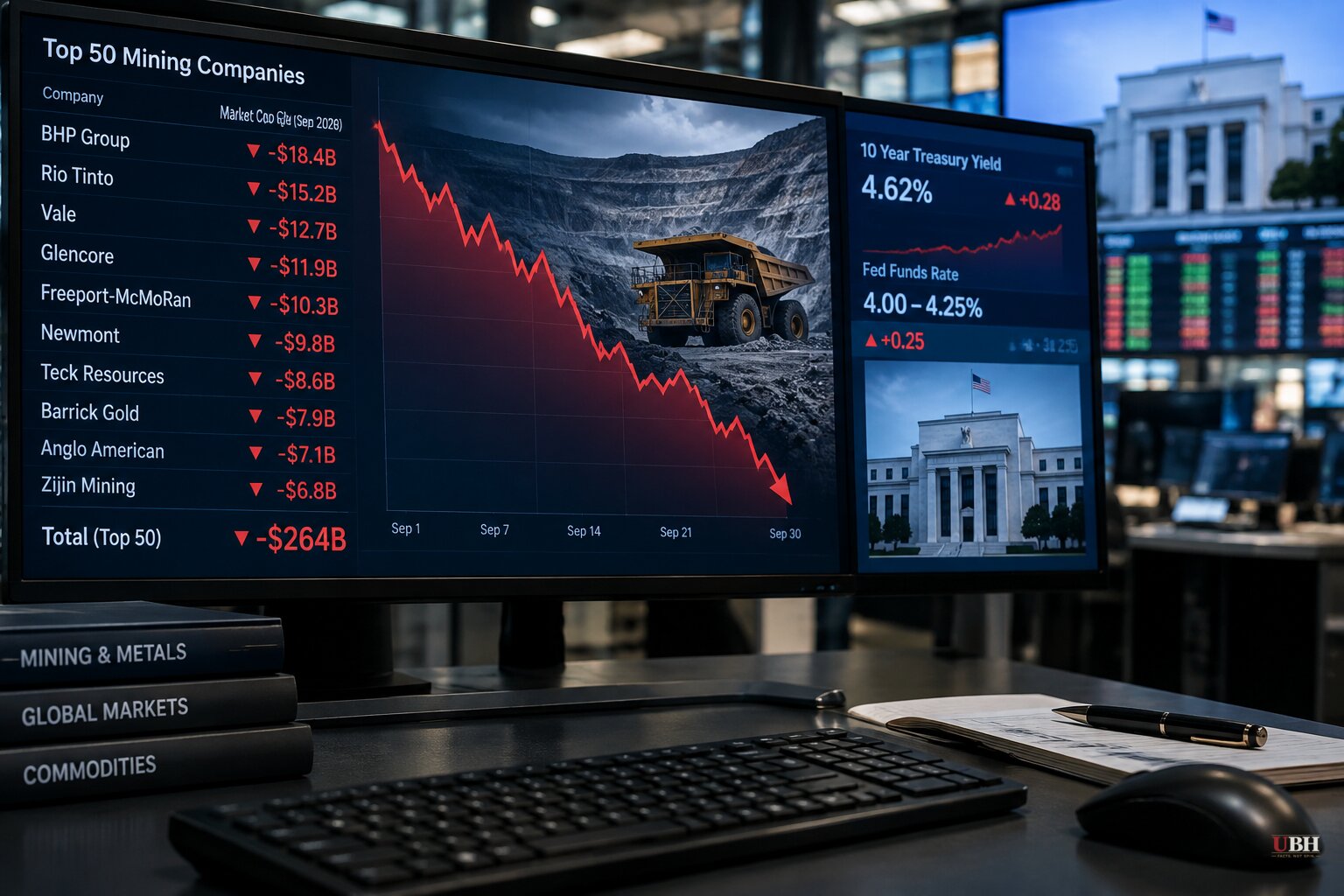
The world's 50 largest mining companies lost $264 billion in combined market value in September, according to MINING.COM's Top 50 ranking cited by OilPrice.com. It's the second-largest monthly drop since the ranking started at the end of 2019, trailing only March's $434 billion wipeout. The group ended September worth $2.26 trillion, erasing roughly three-quarters of August's record $357 billion gain.
Blame oil and the Fed. Rising oil prices and a hawkish Jackson Hole speech from Fed Chair Kevin Warsh set off a global bond selloff that pushed a Bloomberg gauge of government bond yields to its highest level since mid-2008. On September 16, the Fed raised its benchmark rate a quarter point to 3.75%-4%, its first hike since July 2023. "This summer's inflation readings do not tell me that underlying trends have meaningfully improved," Warsh said after the decision, according to OilPrice.com.
Higher yields and a stronger dollar make non-interest-bearing assets like gold more expensive to hold. Gold futures fell 6.4% in September to $4,158 an ounce. Silver dropped 9%. The 15 gold producers in the ranking lost a combined $79 billion, or 12.7% — and not a single one finished the month higher.
Kinross Gold cut its 2026 and 2027 production outlook on September 23, citing brutal winter weather at its La Coipa mine in Chile and weaker ore grades at Round Mountain in Nevada. The stock finished the month down 21.3%. Shandong Gold did worse, falling 27.8% — the worst performance in the entire ranking — after lowering its 2026 mined-gold target.
Gold Fields dropped 21%, losing $8.6 billion, in a month that ended with Northern Star Resources rejecting its unsolicited A$38.7 billion ($27.1 billion) takeover offer. Northern Star Chair Michael Chaney said the bid "falls well short of what the board considers to be its fundamental value." Bloomberg has since reported Gold Fields may come back with a bigger cash component, meaning this fight isn't over.
Copper prices barely budged in September, ending the month almost exactly where they started. Copper producers still lost $44 billion. BHP posted the single largest dollar loss in the ranking at $26.4 billion after a worker was killed during maintenance at Escondida in Chile, the world's largest copper mine, on September 23, forcing a temporary shutdown.
A week later, the mine's roughly 1,020-member supervisors union rejected BHP's final contract offer, with 95% of participating members backing a strike. BHP requested government mediation on Monday, October 5, which puts any walkout on hold for five working days. Rio Tinto fell 8.9% as iron ore stayed below $100 a metric ton. Southern Copper, meanwhile, ended the quarter as the ranking's second-most valuable company for the first time, at $171 billion.
First Quantum Minerals fell 19.2%, almost entirely on September 30, after a Panamanian ministerial commission recommended negotiating terms to restart the shuttered Cobre Panama mine. Lithium producers took their own separate hit. Lithium carbonate futures in Guangzhou fell 22.5% after price reporter SMM revised its inventory counts, more than doubling reported Chinese stockpiles. Albemarle and Ganfeng Lithium each lost over a fifth of their value, according to PIQ Markets.
While miners bled out, Wall Street banks posted $45.9 billion in profits in the first half of 2026, up 51% from a year earlier, according to a report from New York State Comptroller Thomas DiNapoli. At that pace, 2026 profits could top $90 billion, smashing the inflation-adjusted record set in 2009. CNN reported the boom is fueled by AI spending, elevated trading volume and a looser regulatory environment, with AI-related venture capital hitting $407 billion in the first half of the year alone.
DiNapoli's own report flags the risk: the 10-year Treasury yield has climbed to 5.35%, its highest since 2002, and he warned rising rates "may dampen profitability" down the road. For now, the same bond selloff crushing gold miners is generating fee and trading revenue for the banks sitting on the other side of those trades. The institutions best positioned to profit from inflation shocks aren't the companies digging metal out of the ground.
Separately, and on a longer timeline, the Trump administration has been pushing to rebuild domestic rare-earth capacity after Beijing tightened export licensing on materials like dysprosium and terbium starting in April 2025, according to a commentary published by the Epoch Times. President Trump hosted Chinese General Secretary Xi Jinping at the White House on September 24 for talks that touched on tariffs and critical minerals. Lynas Rare Earths, operating the Australia-Malaysia supply corridor, remains the only commercial-scale rare-earth separator of consequence outside China, per the same commentary. A handful of chemical processing plants control inputs for EVs, wind turbines, and guided missiles, and Beijing has shown it will use export licensing as leverage. Whether Lynas and similar projects can scale fast enough to matter is an open question the commentary itself doesn't resolve.
Gold has already started stabilizing. A weak September jobs report cut the market's odds of an October rate hike to the mid-teens, down from nearly 70% a week earlier, according to PrimeXBT. Even after September's rout, the Top 50 miners closed the third quarter $107 billion higher than where they started it. The Escondida mediation clock runs through this week, the Gold Fields-Northern Star takeover fight is still live, and whether the Fed hikes again will decide if September was a blip or the start of something worse for the sector.
Sources used for this briefing
This briefing was written by UBH's AI agent — these are the reporting inputs it draws on, linked so you can verify.


