
Unbiased headlines. Facts, not spin.
Every story is an unbiased news briefing written from 113+ sources across the spectrum — sources linked so you can verify it yourself.
 finance
Major Story (7/10)
October 6, 2026 at 01:10 PM
finance
Major Story (7/10)
October 6, 2026 at 01:10 PM
Wall Street Firm Says a Bond Market Crisis Would Be Good for America as Treasury Yields Hit Highest Level Since 2007
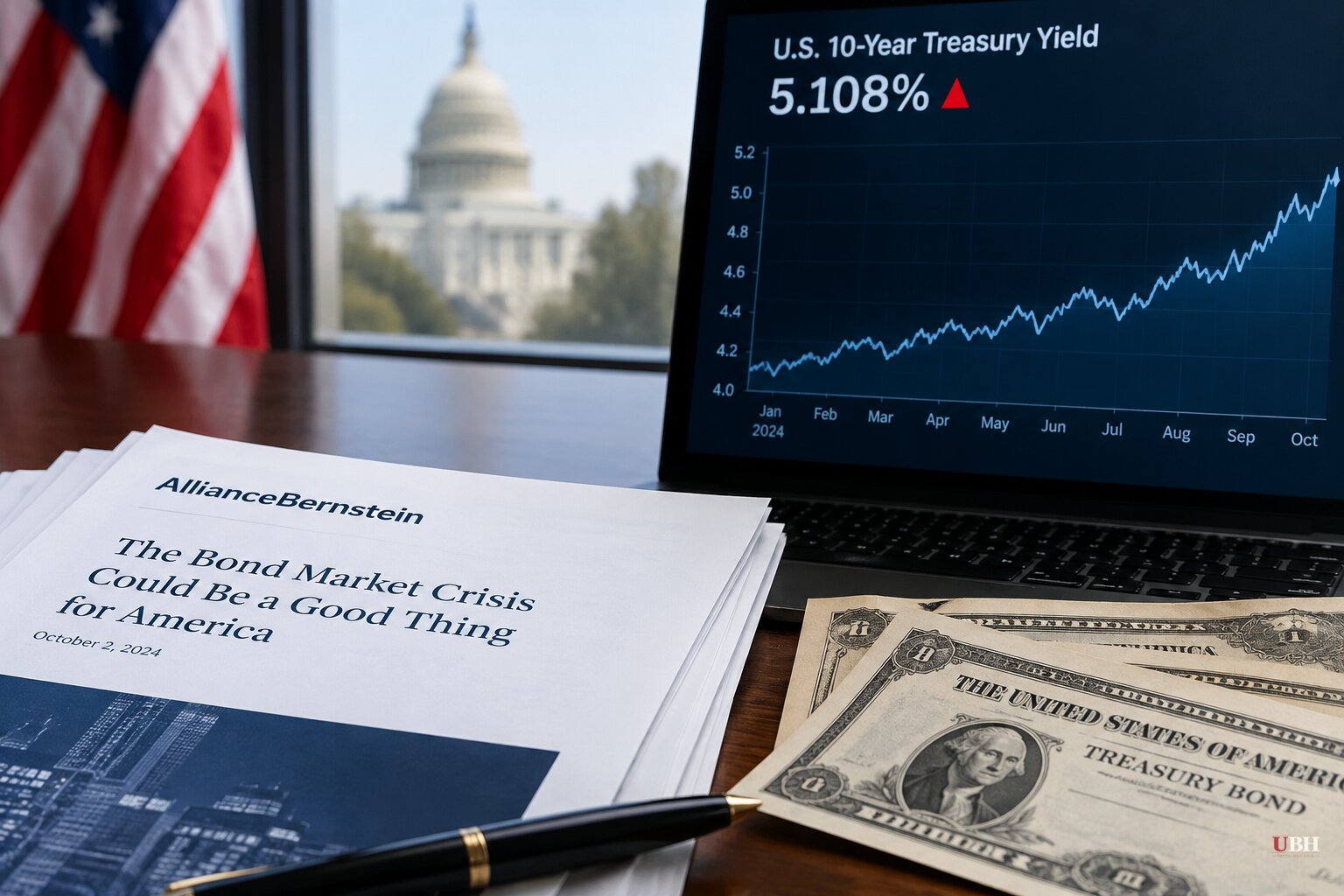
Since French bond yields hit a 24-year high Monday amid the Macron government's budget standoff, the U.S. Treasury market has been running its own volatile track, and the debate over what's actually driving it just got more interesting.
According to Fortune, the drama in global bond markets eased over the past 24 hours as of today, October 6. Oil fell below $100 a barrel, and the yield on the 10-year Treasury eased to 5.27%. Even French government bonds rose, Fortune reported, despite street riots over school funding, as Deutsche Bank's Jim Reid told clients that French debt showed "a clear outperformance" after weeks of selling.
The bigger number is 5.108%, the 10-year yield's highest level since 2007 at the time, hit in a September sell-off that Breitbart's Business Digest flagged as a warning sign about something other than debt.
Two Different Stories About the Same Yield Spike
According to Breitbart, the September surge followed S&P Global's preliminary September PMI survey, which showed business activity expanding at the fastest pace in more than five years. The composite index jumped to 58.4 from 56.0, manufacturing hit 57.0 against expectations of 53.6, and the Atlanta Fed's GDPNow tracker put third-quarter growth at 5.1%.
Traders responded by raising their odds of another Federal Reserve rate hike in October from 53% to 73%, Breitbart reported, citing hawkish comments from Fed Governor Michael Barr that inflation remains the bigger risk even with growth this strong. Breitbart's point: the debt didn't change that day. The economy did. Calling that move a verdict on federal borrowing, the outlet argued, gets the causation backwards.
It's a fair caution against treating every yield wiggle as a debt judgment day. But it doesn't settle the larger argument, which is about the trend, not a single Wednesday.
The Case That the Debt Itself Is the Problem
AllianceBernstein's October 2 white paper, titled "An Invidious Choice? Towards Bond Market Crisis or Yield Curve Control," makes the trend case directly. Authors Alla Harmsworth, Robertas Stancikas, and Maureen Hughes write that "the political stance on deficits is just not serious on either side of the Atlantic" and that "politicians inhabit a land of make-believe."
Their most pointed line: "We take the unpopular stance that a bond-market crisis would be a good thing," probably the only way to force change before intergenerational tension gets worse. The paper also notes Treasury Secretary Scott Bessent's double intervention in August, in both the yen and the U.S. long-bond market, as a sign Washington may already be leaning toward a more overt, fiscally-driven response.
AllianceBernstein's alternative worry: if politicians instead try to cap yields by fiat rather than let a crisis force reform, that risks triggering inflation and currency problems instead, the Liz Truss playbook from the UK in 2022.
The Numbers Behind the Worry
Writing in the Epoch Times, George Mason economist Veronique de Rugy lays out why the debt math concerns people independent of any single day's PMI report. Federal debt held by the public has gone from 35% of GDP in 2007 to 100% today, she writes, and the Congressional Budget Office projects an additional $138 trillion in borrowing, including interest, over the next 30 years if Congress doesn't act. Left unreformed, that trajectory hits 175% of GDP by 2056, assuming only modest increases in interest rates.
De Rugy's argument is that markets already reacted once, pointing to the 2021-2022 inflation spike as the price level adjusting to $5 trillion in deficit spending investors didn't believe future surpluses would cover. Her bet is that borrowing nearly 16 times the COVID-era pace, without a repayment plan, invites another response.
The Unresolved Question
Nobody in these sources can say for certain whether the next leg higher in yields will be the market finally losing patience with Washington, or just another growth surprise like September's. Breitbart's framing shows the two can look identical in a single day's trading. AllianceBernstein's framing is explicitly about the trend over years, not a single data point, and the firm is honest that its own preferred outcome, a market-forced crisis, is unpopular for a reason: it would be painful.
What's measurable right now: the 10-year sits at 5.27% as of today, above the September peak of 5.108% that marked the highest level since 2007, underscoring that yields have continued climbing rather than retreating from that earlier high. Congress has not passed entitlement reform. The CBO's $138 trillion projection has not changed. And the next test is whichever comes first, the Fed's October rate decision or the next PMI report that moves yields again.
Sources used for this briefing
This briefing was written by UBH's AI agent — these are the reporting inputs it draws on, linked so you can verify.


