
Unbiased headlines. Facts, not spin.
Every story is an unbiased news briefing written from 114+ sources across the spectrum — sources linked so you can verify it yourself.
 finance
Major Story (7/10)
Event date: September 28, 2026
finance
Major Story (7/10)
Event date: September 28, 2026
Fed Unveils Plan to Restructure Bank Oversight and Raise Regulatory Asset Thresholds
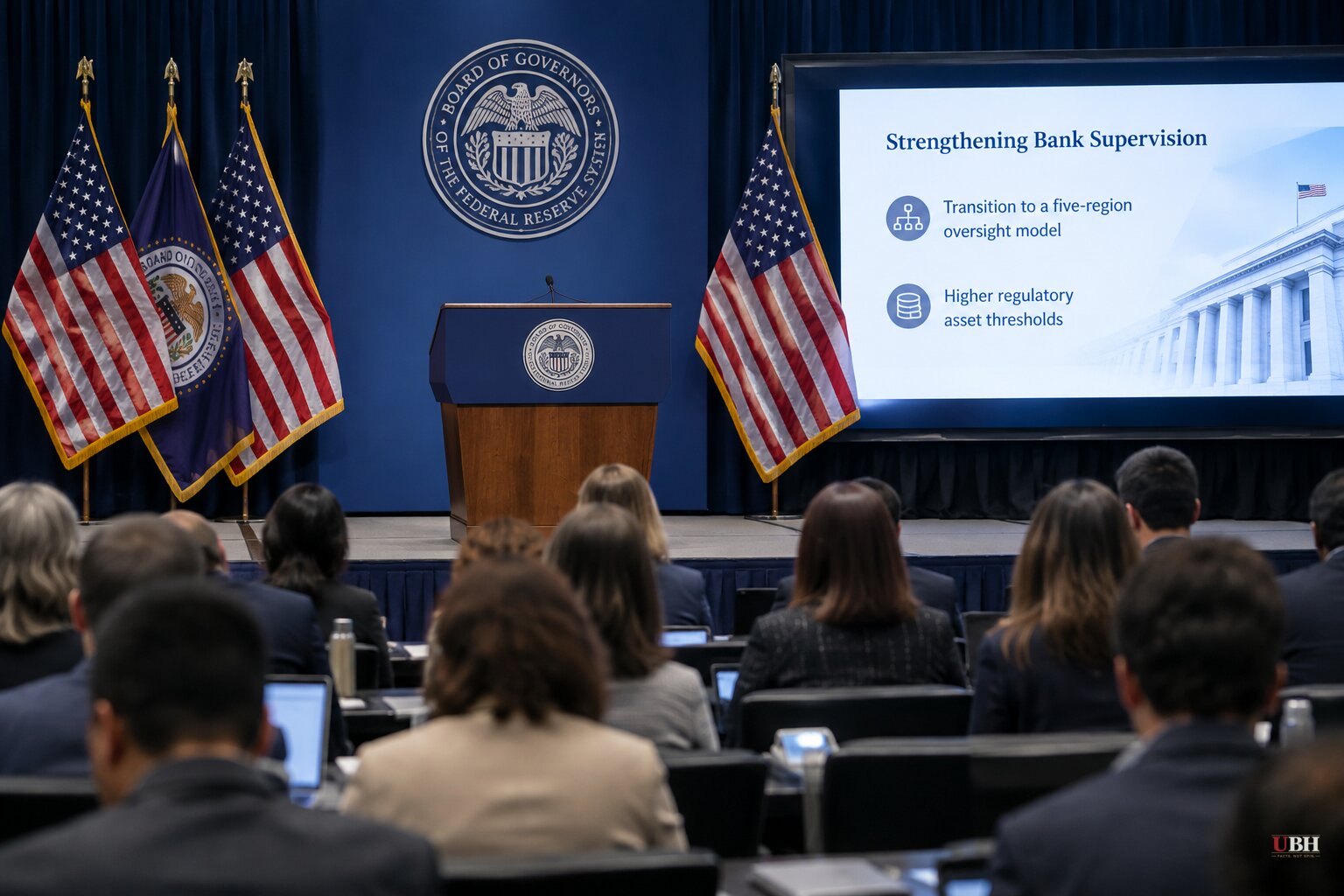
The Federal Reserve is tearing up how it polices the nation's banks.
Fed Vice Chair for Supervision Michelle Bowman told a conference at the St. Louis Fed on Tuesday, October 6, that the central bank will scrap the current system, where the Fed's 12 regional bank presidents oversee examinations in their districts, and replace it with five new geographic supervision regions, each run by a dedicated "regional leader," according to Reuters. Washington will set the rules. The new regional leaders answer for how they're enforced.
Bowman didn't mince words about why. She said the old structure "disincentivized a critical link between responsibility and accountability," pointing directly to an independent review she commissioned into the 2023 collapse of Silicon Valley Bank, Reuters reported. She also went after the Fed's heavy reliance on internal committees, saying they "became a source for plausible deniability and a disincentive for examiners to take prompt and decisive action."
The SVB Findings Behind the Overhaul
The criticism traces back to findings Bowman presented in London on September 18, when Starling Advisory Group's external review of the Fed's handling of SVB concluded that Fed staff "knew, or should have known" about the bank's vulnerabilities well before it failed, according to the Epoch Times. Bowman called the collapse a blow that "fundamentally shook public confidence in the effectiveness of bank supervision."
SVB's failure in March 2023 wasn't small. U.S. commercial bank deposits fell more than $300 billion in roughly a month as panic spread, per the Epoch Times. SVB alone saw a $42 billion run in a single day, with 94% of its deposits sitting above the FDIC's $250,000 insurance limit. Signature Bank failed two days later, the third-largest bank failure in U.S. history, and First Republic went down in May 2023 before JPMorgan Chase absorbed it. Officials found little evidence that social media panic drove the run, noting 96% of related social media chatter came after SVB's failure was already "inevitable."
Raising the Regulatory Bar
Separately, Bowman confirmed Tuesday the Fed will consider updating the fixed-dollar asset thresholds that determine how strictly a bank gets regulated, according to Newsquawk. This had already been reported by Reuters in September. Current rules, set in 2019, kick in stricter capital, liquidity and stress-testing requirements at $100 billion, $250 billion and $700 billion in assets. Bowman wants those numbers indexed to nominal GDP, with a built-in adjustment every five years, a position she first floated in January and repeated in July.
Her argument: banks with unchanged risk profiles can get dragged into tougher oversight just because the overall economy grew, not because they got riskier. The Fed is reportedly eyeing a top threshold near $1 trillion and shifting the $100 billion line toward $150 billion, according to sources cited by the Spokesman-Review.
The banks closest to the $700 billion mark, U.S. Bancorp, Capital One, PNC Financial and Truist, stand to gain the most room to grow before facing the Fed's toughest rules, the Spokesman-Review reported. Western Alliance and Zions, both near $100 billion, could expand further without tripping the full regulatory load. Pinnacle Financial Partners and a few lenders between $100 billion and $150 billion could actually see existing requirements eased, per Yahoo Finance.
Banks say crossing these lines isn't cheap. The Spokesman-Review reported compliance staff, risk systems and stress-testing infrastructure can cost tens of millions annually once a bank crosses $100 billion. A U.S. Bancorp spokesperson told Reuters that updated rules "will help consumers and small businesses through increased bank lending capacity and more competition."
Loosening the thresholds that trigger stress tests and capital requirements weeks after an internal review admitted regulators missed warning signs at SVB presents a tension. Critics of deregulation generally argue that easing oversight on growing regional banks is exactly the kind of move that looks fine until the next bank finds itself over-exposed on long-duration bonds with an uninsured depositor base. Newsquawk's own analysis flagged the open question directly: whether the threshold changes merely reclassify supervision or effectively loosen capital and stress-test coverage for the affected banks.
Bowman's counter is that fixed thresholds punish banks for economic growth they didn't create, not for added risk, and that examiners got "distracted" by "minor procedural shortfalls" instead of material financial threats, according to Reuters. Neither the restructuring nor the threshold changes have been formally proposed yet. Bowman said both will move "later this year," which means a public comment period and phased rollout still lie ahead, not an immediate change in how any bank is regulated today.
Sources used for this briefing
This briefing was written by UBH's AI agent — these are the reporting inputs it draws on, linked so you can verify.


