
Unbiased headlines. Facts, not spin.
Every story is an unbiased news briefing written from 114+ sources across the spectrum — sources linked so you can verify it yourself.
 finance
Major Story (7/10)
October 6, 2026 at 11:53 PM
finance
Major Story (7/10)
October 6, 2026 at 11:53 PM
SEC Weighs Killing Investor Surveillance System While Moving to Scrap Shareholder Proposal Rule
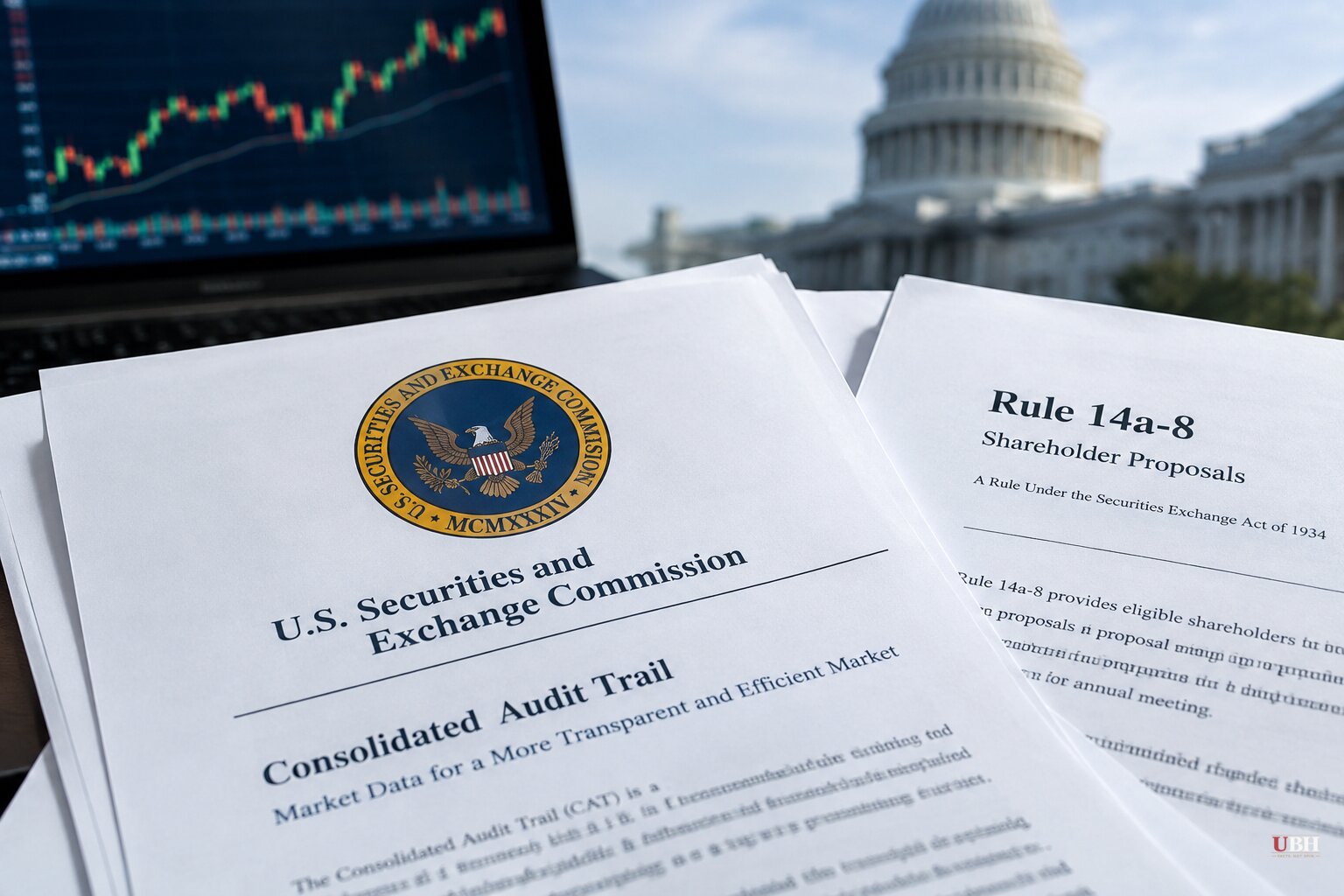
The Securities and Exchange Commission is reconsidering two rules that shape how American markets work, and both fights are happening at once.
One is the Consolidated Audit Trail, known as CAT, a database launched in 2020 that records nearly every order, modification, cancellation, and execution made by tens of millions of investors. The other is Rule 14a-8, which governs whether companies have to include shareholder proposals in their proxy materials. SEC Chair Paul Atkins is now pushing changes to both as part of what he has described as a broader effort to make being a public company more attractive.
The Surveillance Database
CAT collects trading records before there is any allegation of wrongdoing, reasonable suspicion, or probable cause, according to Reason. The system lets regulators reconstruct an investor's trading activity long after the fact, even if that investor never did anything illegal.
Reason points to the SEC's 2008 case against Mark Cuban as a warning sign. The agency sued Cuban over trades made in 2004, and he fought the case for five years, spending roughly $12 million in legal fees before a federal jury found him not liable. Reason argues that CAT lets regulators build those kinds of chronologies far more broadly and systematically than before, against ordinary investors who never drew individual scrutiny.
The SEC has already trimmed some of CAT's reach. In 2025, it eliminated requirements to report customer names, addresses, and birth years for most U.S. natural persons. Earlier this year, the agency approved further changes requiring that previously reported identifying information be deleted or made inaccessible to regulators.
But Reason notes that anonymized identifiers still link trading activity back to individual customers, meaning regulators can still obtain someone's identity through their broker. Removing names from the database does not erase the trading history itself, and it does not remove the cost. Brokerage firms still have to build and maintain systems to report into CAT, reconcile records, and fix errors. These expenses get passed on to investors through fees or reduced services.
Congress never voted to create CAT or appropriate money for it. The SEC ordered brokers and exchanges to build and fund it themselves, which functions as a tax without a vote behind it. The agency has not announced a timeline for the "fundamental changes" it says it's weighing.
The Shareholder Proposal Fight
Separately, the SEC has proposed rescinding Rule 14a-8 and handing the decision over which shareholder proposals make it onto proxy ballots to state law and each company's own governing documents. The proposal would also eliminate the requirement that companies deliver an annual report to shareholders, remove the deadline for incorporating documents by reference into a proxy statement, and end the requirement to file notices of exempt solicitation, according to ESG Dive. The public comment period runs through November 20, per the Federal Register.
A group of Democratic state finance officials is pushing back hard. On an October 1 call reported by ESG Dive, Illinois State Treasurer Michael Frerichs said he's "concerned that it will curtail [investors'] ability to hold public companies accountable," adding that "a proposal this sweeping must not be rushed." Minnesota State Auditor Julie Blaha predicted a "flood of proposals" next year as filers race to get resolutions in before the rule changes, and argued the broader deregulatory push from the Trump administration is creating "general chaos that makes it really hard to predict what the real effects of any individual issue will be."
Massachusetts State Treasurer Deb Goldberg called shareholder proposals "the least costly way" for investors to engage with companies, and warned that scrapping the federal rule in favor of a state-by-state patchwork would raise costs for public pension funds and add "volatility" that hurts long-term investors.
Dave Wallach, executive director of For the Long Term, noted on the same call that the SEC used a 120-day comment window back in 2013 for a rule governing broker and investment adviser duties, arguing a longer window would be unusual but not unprecedented for "a proposal of this magnitude." The officials are asking the SEC to double the current 60-day comment period.
Two Rules, One Direction
Both proposals move in the same direction: less federal reporting, less centralized record-keeping, more discretion pushed down to companies and states. For investors tired of government databases tracking lawful trades, that's a win on the CAT side. For public pension funds that rely on shareholder proposals to press companies on governance and risk, scrapping Rule 14a-8 removes a tool they've used for decades. Goldberg, Blaha, and Frerichs make a legitimate case that a patchwork of 50 state rules could be messier and costlier than one federal standard, even for people who have no interest in ESG-style resolutions.
The SEC has not said when it will act on either proposal. The Rule 14a-8 comment period closes November 20. Whether the agency extends that window, as the Democratic officials are requesting, will be the first concrete signal of how much weight Atkins gives their objections.
Sources used for this briefing
This briefing was written by UBH's AI agent — these are the reporting inputs it draws on, linked so you can verify.


