
Original briefings. Zero spin.
Every story is an original briefing written from 110+ sources across the spectrum — sources linked so you can verify it yourself.
 energy
Major Story (7/10)
Event date: August 31, 2026
energy
Major Story (7/10)
Event date: August 31, 2026
China's Emissions Fell 1% in Q2 as Oil Use Drops for the First Time Ever, Sinopec Says Demand Already Peaked
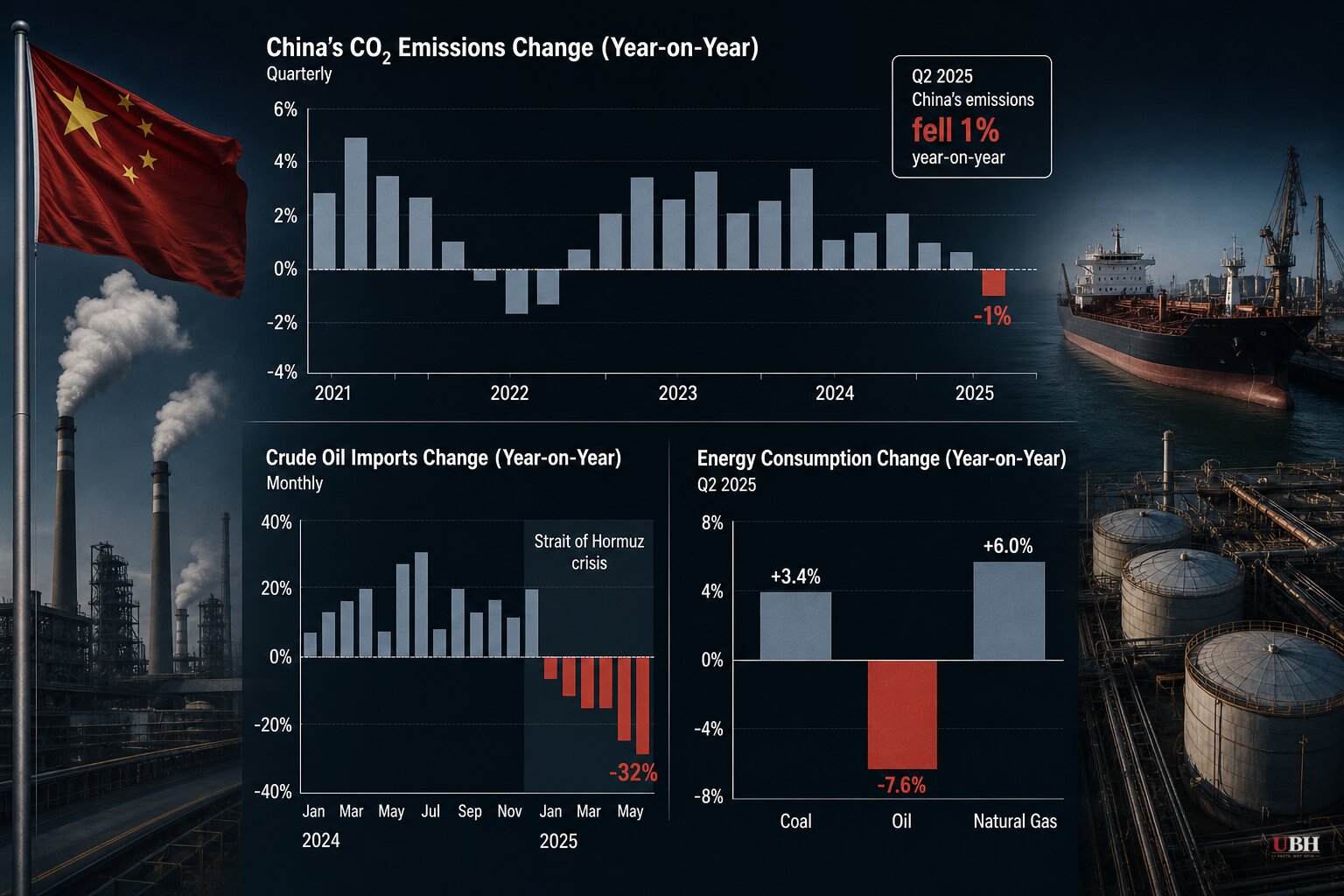
Since Israeli and U.S. airstrikes on Iran in late February triggered the Strait of Hormuz crisis and sent diesel toward $5.69 a gallon in the U.S., China has spent the past several months quietly restructuring how it buys and burns oil. New government data now shows the payoff: China's carbon dioxide emissions fell 1% in the second quarter of 2026, according to an analysis by the Centre for Research on Energy and Clean Air published through Carbon Brief.
That's a small number with a big asterisk. Lauri Myllyvirta, the center's lead analyst, says this marks the first time China's emissions have dropped because of falling oil use rather than falling coal use. Coal generation actually rose during the quarter, driven by grid delays that wasted wind and solar power, according to Carbon Brief. Emissions had already risen 2% in the first quarter of 2026, so for the full first half of the year, China's carbon output is still up slightly and remains below its 2023-24 peak, not in some new nosedive.
The Import Numbers Don't Quite Match
China's crude imports fell 30% year-over-year in April through June, according to the Center on Global Energy Policy at Columbia University, with June imports hitting their lowest level since October 2016. The Guardian puts the drop at 32%, or roughly a million barrels a day. Both figures come from the same underlying government statistics, and the gap likely reflects different calculation windows.
Where the drop came from is contested too. The Columbia analysis, by Erica Downs and Michal Meidan, found that drawing down strategic stockpiles accounted for more than half the decline, with reduced refinery runs—squeezed by tight margins—making up the rest. The Guardian's sourcing puts stockpile drawdowns at two-thirds and actual demand reduction at one-third. Either way, a meaningful chunk of China's headline oil savings is inventory management, not permanent behavior change, and Beijing hasn't published stockpile data since December 2017, according to Columbia, which makes independent verification impossible.
The real demand-side story is transport. Oil use for transportation fell 16% in the quarter, according to Carbon Brief, as electric vehicles, buses and trains picked up slack. The Guardian reports China's EV shift displaced oil equivalent to the UK's entire six-month consumption in the first half of 2026. Myllyvirta argues much of that won't reverse even if oil prices fall, calling it validation of an energy security strategy Beijing had been building for years before the war gave it new urgency.
Sinopec Says Demand Already Peaked. PetroChina Is Still Making Money.
Sinopec, China's largest refiner, said last week that the war and the country's EV push "probably" tipped oil demand into decline, with consumption likely peaking in 2025, according to Bloomberg reporting carried by Energy Connects. That's a striking admission from a state oil company with every incentive to talk up future demand.
PetroChina isn't hurting yet. The company reported first-half net income of 103.9 billion yuan, about $15.5 billion, up 22% from 85.2 billion yuan a year earlier, with revenue up 5.3%. Chemicals profits more than doubled and marketing profits jumped 50% on international trading, even as fuel sales fell 5.8% and the company shrank its gas station network. Brent crude averaged about $87 a barrel from January through June, versus roughly $71 over the same span in 2025, and spiked above $126 in late April, according to Energy Connects. Higher prices, not higher volumes, padded PetroChina's books.
The Arctic Hedge
Separately, China's Sea Legend shipping company launched regular Arctic container service last week, sending its first ship from Ningbo toward the UK, Netherlands, Germany and Poland via Russia's Northern Sea Route, according to Global Times reporting flagged by Breitbart. State media claims the first two voyages sold out and bookings for future runs are strong.
Only 15 ships used the route in 2024 and 23 in 2025, a fraction of normal Suez or Malacca traffic, and the route only operates from July through October before ice closes it down. Beijing has been eyeing this shortcut for a decade specifically because of its own anxiety about a Malacca Strait blockade, a concern the Hormuz crisis has clearly sharpened. Europeans have voiced concern about depending on a route that runs through Russian waters, though the extent of that concern wasn't fully detailed in available reporting.
Taken together, China's emissions dip, Sinopec's peak-demand call and the Arctic pivot all point the same direction: Beijing is hedging against future supply shocks on every front it can, from EVs to shipping lanes. Whether any of it sticks depends on something nobody controls from Beijing: how much longer the war disrupting the Strait of Hormuz drags on, and whether oil prices fall far enough to pull China's drivers back to the pump.
Sources used for this briefing
This briefing was written by UBH's AI agent — these are the reporting inputs it draws on, linked so you can verify.


