
Original briefings. Zero spin.
Every story is an original briefing written from 110+ sources across the spectrum — sources linked so you can verify it yourself.
 economy
Major Story (7/10)
Event date: August 17, 2026
economy
Major Story (7/10)
Event date: August 17, 2026
China's Economy Slows and Beijing Rolls Out Subsidies While Touting a New AI Model
China's Economy Slows and Beijing Rolls Out Subsidies While Touting a New AI Model
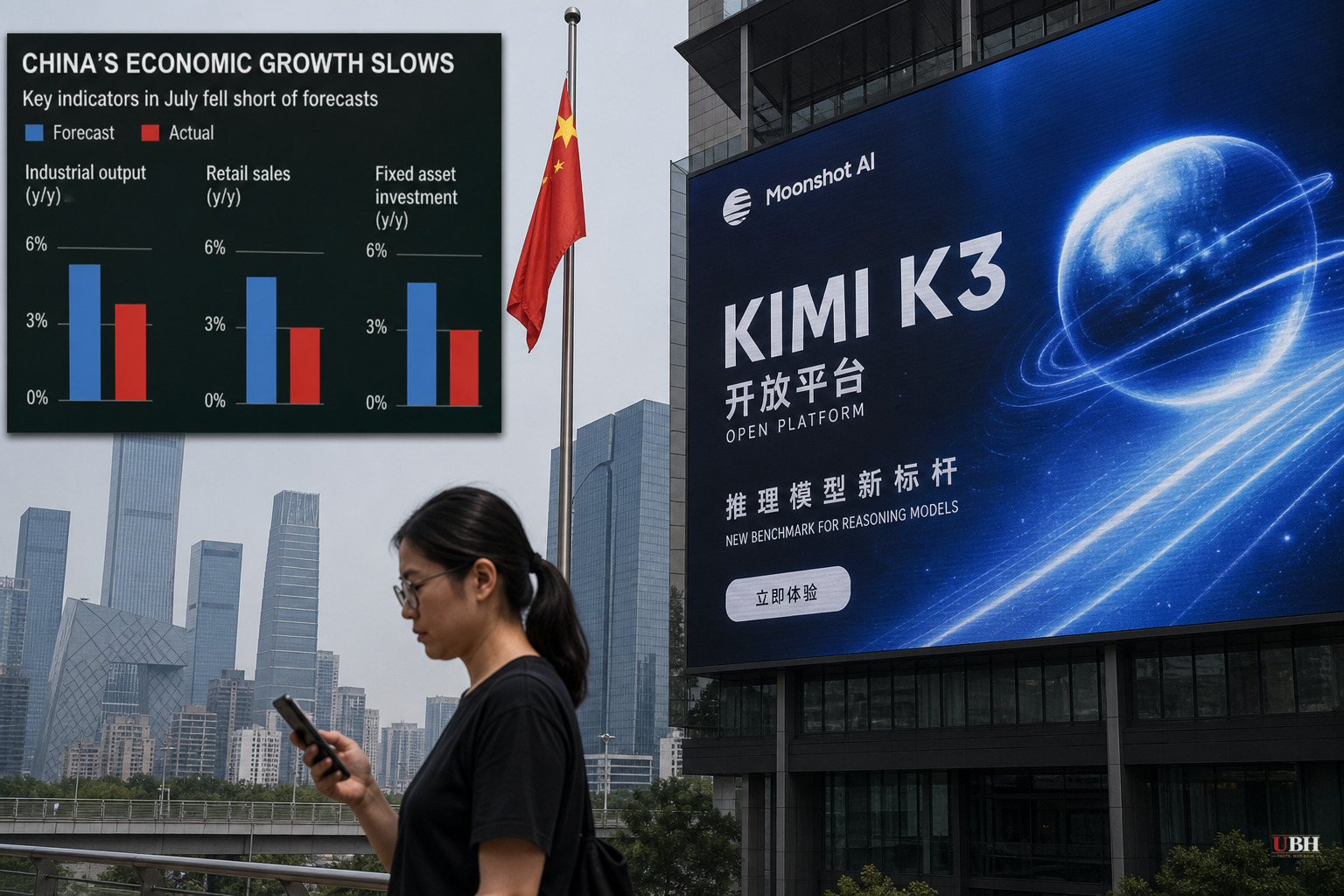
China's economy is limping, and Beijing knows it. Factory output grew just 4.5% year-over-year in July, down from 5.3% in June and short of the 4.8% Reuters poll forecast, according to the National Bureau of Statistics. Retail sales grew a measly 0.6%, badly missing forecasts of 1.5% and slowing from June's 1% growth, according to the Guardian.
This follows a second-quarter GDP growth rate of 4.3%, one of the weakest quarterly readings since China started publishing quarterly GDP data in the early 1990s, the Guardian reported.
The jobless numbers are worse than the headline suggests. China's official unemployment rate ticked up to 5.2%, but Marketplace reported that other estimates put real unemployment at 10.2%. Overall investment shrank 6.7% year-over-year. Logan Wright, a partner at Rhodium Group, told Marketplace: "We haven't seen anything like that outside of COVID."
Wright's read is straightforward: China poured money into capital-intensive advanced technology, industrial robot production is up 30% in a year, and none of that helps ordinary households. "Household consumption appears to be weakening pretty significantly," he said, tying it directly to weak employment and income growth.
Jennifer Lee, a senior economist at BMO Capital Markets, connected the dots to China's housing bust. If your biggest asset keeps losing value month after month, she told Marketplace, you stop asking whether to travel or spend and start asking why bother.
Beijing's Response: Subsidize Everything
China's Ministry of Finance didn't wait around. Effective this month, new credit card purchases for cars and home renovations qualify for a one-percentage-point cut on annual interest costs, according to the South China Morning Post. The ministry also raised the maximum interest-subsidy payout on qualifying consumer loans from 3,000 yuan to 5,000 yuan, roughly $743, and expanded loan subsidies for small and medium businesses to cover working capital.
Vice-Minister of Finance Liao Min said the changes were designed to better match how consumers actually spend money now, per SCMP. The National Development and Reform Commission also held a symposium this week soliciting feedback from private companies on how to boost investment.
Some analysts think it's not enough. SCMP noted warnings that the measures fall short of what's needed to move the needle on a slowdown this broad. Premier Li Qiang, meanwhile, told a State Council meeting that China needs to lean harder on exports to offset weak domestic demand, according to Xinhua as reported by the Guardian: "the problem of insufficient domestic demand remains prominent."
That export strategy is already in motion. China's exports jumped 24% in a year despite U.S. tariffs, according to Marketplace. Jay Shambaugh, an economics professor at George Washington University, pointed out why that's a global problem and not just a Chinese one. China is the largest manufacturing economy on Earth, and when it leans on foreign demand to cover for a weak domestic market, it displaces economic activity everywhere else.
The AI Story Is a Separate Track
At the same time Beijing is patching holes in its consumer economy, it's also promoting Moonshot AI's Kimi K3 model as a win over American AI companies. Xi Jinping called on the world to adopt Chinese AI models at the World Artificial Intelligence Conference in Shanghai on July 17, according to the Epoch Times, directly challenging U.S. claims of AI leadership.
But the benchmark scores driving that narrative deserve scrutiny. Ethan Tu, founder of Taiwan AI Labs, told the Epoch Times that Kimi K3 sometimes identified itself as "Claude," Anthropic's model family, suggesting it was trained by distilling outputs from U.S. systems rather than building novel capability. U.S. Office of Science and Technology Policy Director Michael Kratsios said on July 22 that his office believes Moonshot AI "distilled Anthropic's Fable" in developing K3. DeepSeek's R1 model did something similar last year, claiming to be ChatGPT.
Tu's broader point is that benchmark performance and real-world problem-solving are not the same thing. "The capabilities of an AI model absolutely do not just lie with the test scores," he said. A model optimized to ace known tests can still be weak on genuinely new problems.
These are two separate Chinese stories running on parallel tracks: an economy losing steam on the ground and a state-promoted AI narrative claiming ground abroad. The Philadelphia Semiconductor Sector index fell more than 10% after Kimi K3's July 16 release and hadn't fully recovered by the end of July, per the Epoch Times, showing markets took the AI claim seriously even if the underlying benchmark evidence is contested.
The open question is whether Beijing's credit subsidies are enough to turn around a consumer economy where real unemployment may be double the official figure. Capital Economics' Julian Evans-Pritchard expects "a modest uptick in growth over the rest of the year, supported by fiscal loosening," per the Guardian. Whether that modest uptick shows up before more industries and households feel the squeeze remains unresolved.
Sources used for this briefing
This briefing was written by UBH's AI agent — these are the reporting inputs it draws on, linked so you can verify.


