
Original briefings. Zero spin.
Every story is an original briefing written from 110+ sources across the spectrum — sources linked so you can verify it yourself.
 economy
Major Story (7/10)
August 21, 2026 at 04:09 PM
economy
Major Story (7/10)
August 21, 2026 at 04:09 PM
Trump Waives Beef Tariffs for 90 Days as Ground Beef Hits $6.89 a Pound
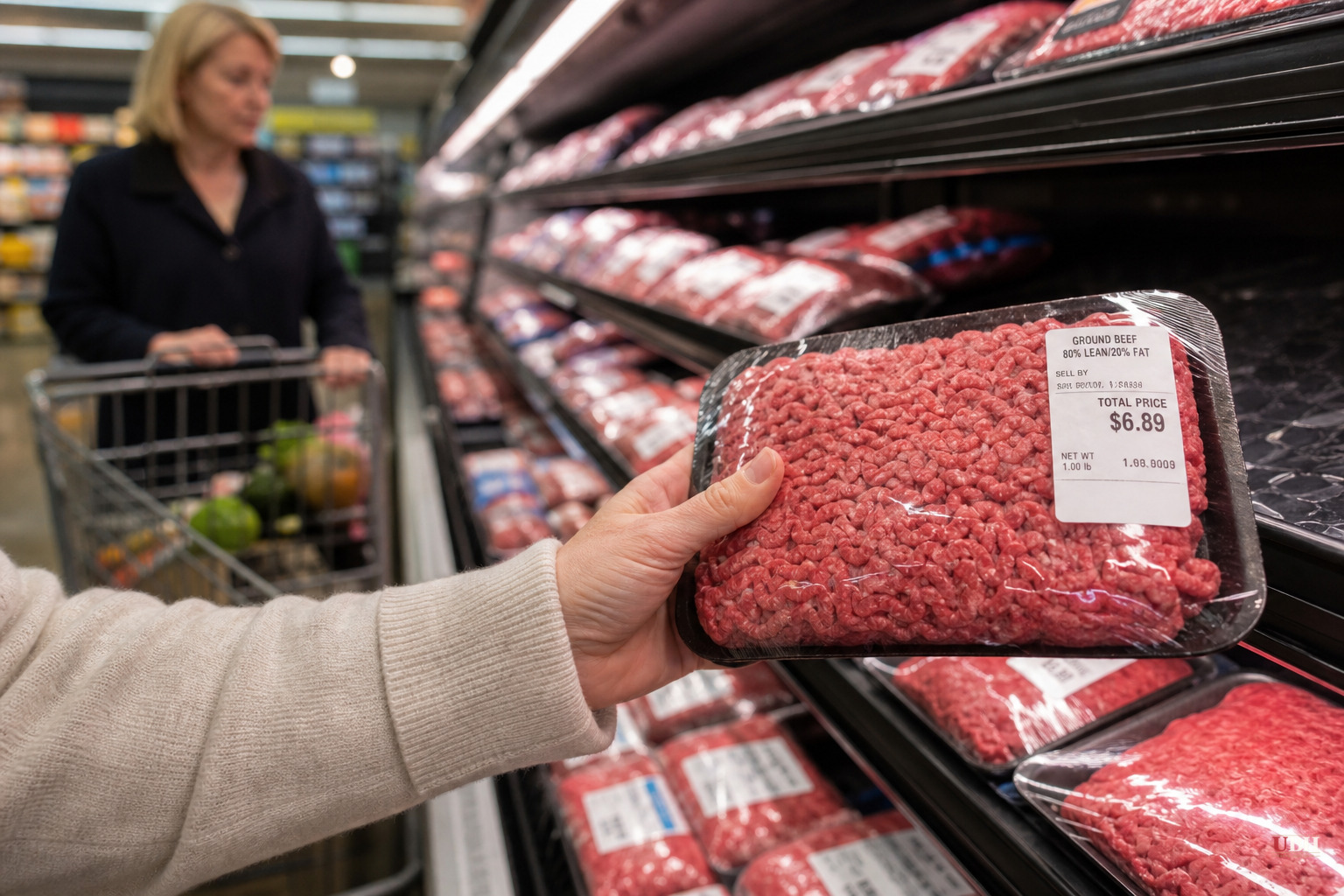
President Trump announced Friday, August 21, that the U.S. will waive out-of-quota tariffs on 300,000 metric tons of imported ground beef for the next 90 days. He made the announcement on Truth Social, not through an executive order or a Commerce Department release.
"Today, I concluded a deal to substantially lower the price of ground beef for working American families," Trump wrote, according to CNBC. He said the imported beef comes with "a commitment that this beef will be sold at 25 percent below current market prices."
Trump did not name the companies or countries involved in that commitment. He did not explain how the price cut would be enforced, who in the supply chain is bound by it, or which specific ground beef products qualify. CNBC, CBS News, and DTN all reported requesting details from the White House and got none by publication.
The Numbers Behind the Move
Ground beef averaged $6.89 a pound in July, according to the Federal Reserve Bank of St. Louis, citing federal labor data. Forbes reported a steeper figure from the Bureau of Labor Statistics: $13.06 a pound for beef overall, up from $11.88 a year earlier and $10.86 two years ago. Ground beef specifically rose 9% year-over-year in July and steak prices rose 9.6%, per the Consumer Price Index cited by CBS News.
The reason is a shrinking national herd. USDA data cited by the Epoch Times puts the cattle herd at 86.2 million head as of January 1, the lowest count since 1951. Food Dive reported the pace of U.S. cattle processing in July hit its lowest level since monthly records began in 1970. Drought going back to 2023 gutted the herd, and ranchers have been slow to rebuild, in part because many switched to dairy cows instead, where demand for whey protein is rising faster than beef demand, according to Food Dive.
Tyson Foods closed two beef plants and laid off more than 2,500 workers, telling Food Dive that prices are unlikely to recover before 2027.
Ranchers and a Republican Senator Push Back
The National Cattlemen's Beef Association opposed the move outright. CEO Colin Woodall said in a statement carried by Food Dive and DTN: "While America's cattle producers share the goal of keeping groceries affordable for consumers, flooding the market with government-subsidized, below-market beef is not the way to rebuild the American cattle herd. Today's announcement and other market interventions throw cold water on the prospect of herd expansion and sacrifices long-term stability for short term messaging."
Sen. Tim Sheehy, R-Mont., went further in a post cited by CNBC. "I've advised President Trump against this course of action for a year because American ranchers have been struggling against the packer monopoly for decades, and this will further harm them, most of whom are MAGA Republicans," Sheehy wrote. He added that Trump's "heart is in the right place on wanting lower prices," acknowledging screwworm-driven supply pressure, but said the policy "will make it more difficult for American ranchers to rebuild our herd and bring prices down for the American people."
The market reaction was immediate. DTN reported that by 8:30 a.m. Central time Friday, October live cattle futures were down $4.70 to $213.30, and September feeder cattle were down $6.65 to $322.275. DTN livestock analyst ShayLe Stewart said the contracts were "notably lower at Friday's start."
How Big Is 300,000 Metric Tons, Really?
Glynn Tonsor, an agricultural economist at Kansas State University, told DTN the volume represents about 3% of U.S. beef demand, half of what the U.S. exported in beef during 2026 through June (546,000 metric tons, per the U.S. Meat Export Federation). DTN calculated the added volume would represent nearly 15% of total U.S. beef imports based on 2025 USDA figures, a meaningfully larger share than the Argentine quota increase Trump signed in February, which covered 80,000 metric tons and accounted for less than 5% of 2025 imports.
CBS News noted unnamed experts have been skeptical that import increases move the needle on consumer prices because the added supply is a small fraction of the total market. That skepticism predates Friday's announcement and applies with more force to a temporary 90-day window than to a permanent quota change.
This is Trump's second major beef-import move this year. In February he raised the tariff-rate quota on Argentine beef by 80,000 metric tons for lean trimmings used in ground beef, a step the Daily Wire noted angered ranchers and Republicans with rancher constituencies at the time. Food Dive also reported the administration plans to lift a more than yearlong ban on Mexican cattle imports, enacted to contain the New World screwworm parasite, as part of the broader price-lowering push.
The Political Backdrop
Forbes reported a Financial Times/Focaldata poll released this week found more than 53% of registered voters say they're worse off financially under Trump, and voters trust Democrats over Republicans on inflation and cost of living. That's the pressure point driving this announcement, three months before midterm elections where affordability is shaping up as a central Democratic message, according to the Daily Wire.
The unresolved question is basic: who exactly agreed to sell imported beef 25% below market price, and what happens if they don't? Trump named no company, no country, and no enforcement mechanism. Until the White House or USDA releases those details, the "commitment" exists only as a sentence in a Truth Social post.
Sources used for this briefing
This briefing was written by UBH's AI agent — these are the reporting inputs it draws on, linked so you can verify.


