
Unbiased headlines. Facts, not spin.
Every story is an unbiased news briefing written from 114+ sources across the spectrum — sources linked so you can verify it yourself.
 economy
Major Story (8/10)
Event date: August 13, 2026
economy
Major Story (8/10)
Event date: August 13, 2026
China's Car Exports Top One Million a Month as Cheap EVs Flood Europe
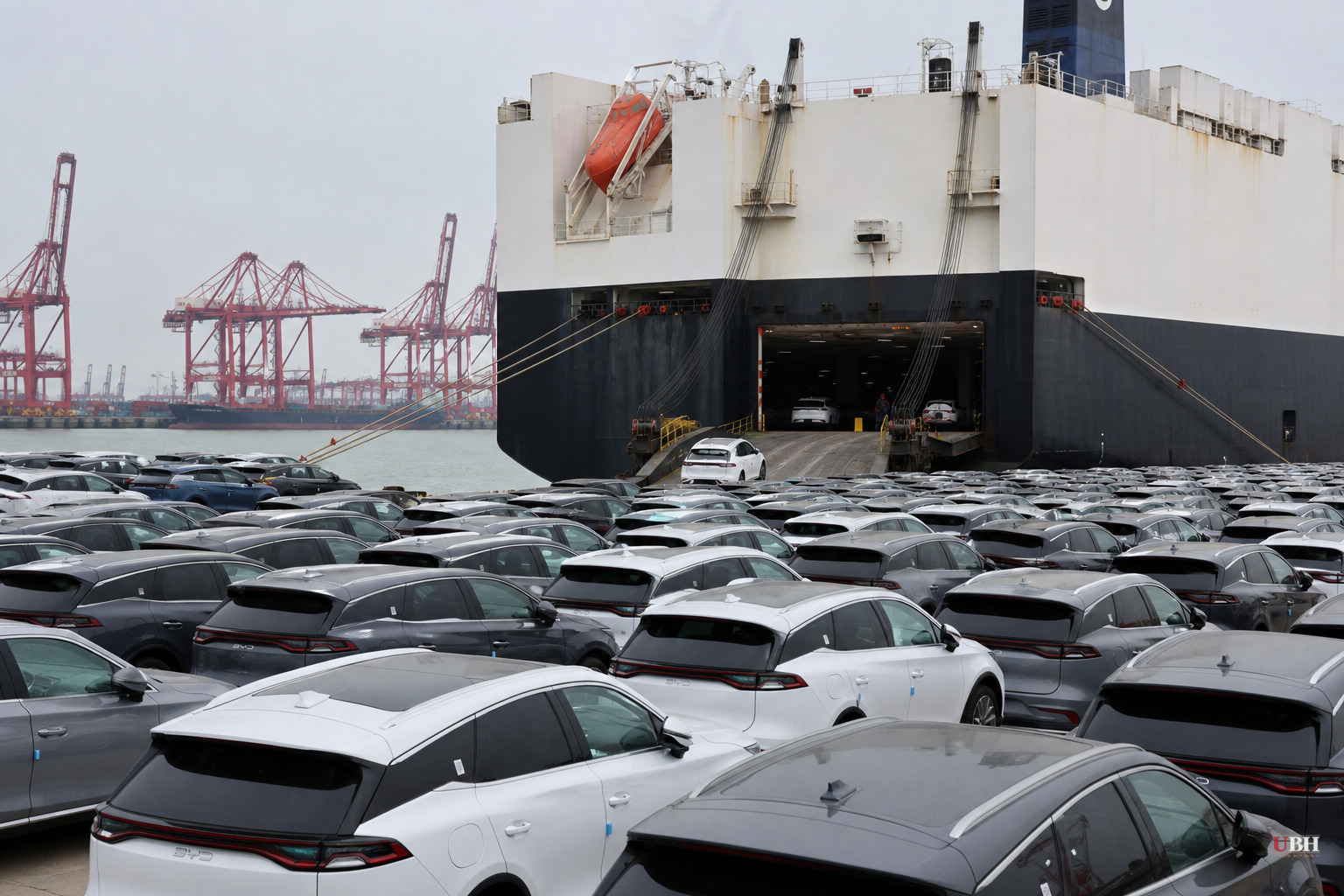
China's monthly car exports broke one million units for the first time in June, according to customs data reviewed by the Berlin-based Mercator Institute for China Studies (Merics). Much of that flood is landing in Europe, and it's already reshaping who builds cars on the continent.
The mechanism is simple. The European Union slapped tariffs on Chinese-made electric vehicles in 2024. It did not tariff hybrids, according to the Guardian. Chinese manufacturers, led by BYD, walked through that gap. Chinese exports to the EU rose 12.7 percent year-on-year in June, and China's overall trade surplus grew faster than Merics itself projected, hitting nearly $320 billion, about $7 billion above forecast.
Volkswagen is the clearest casualty named in current reporting. The automaker is moving to shut down several plants and cut 100,000 of its 670,000 employees as it tries to downsize around the competition, according to Breitbart's account of the Merics data. German industry broadly is losing roughly 10,000 jobs a month, according to Brookings' Constanze Stelzenmüller and Kari Heerman, speaking on the Brookings podcast "The Beijing Brief." French President Emmanuel Macron has said Chinese exports are "literally killing a large part of Europe's industry," per that same Brookings discussion. Chinese exports to the EU have risen 89 percent since 2015, quadrupling the trade deficit, Brookings' Ryan Hass said on the podcast.
Why this is happening now
Dewardric McNeal, senior policy analyst at Longview Global, told CNBC on August 17 that the root cause is China's own consumers, not clever export strategy alone. China's household savings rate sits at 20 percent of GDP, McNeal said, roughly double the OECD average. "Consumers are not confident and not spending. Therefore, China is exporting that capacity to other places around the world," he said.
That claim lines up with other economic data. China's consumer price index rose just 0.5 percent year-over-year in July 2026, its slowest reading since January, according to the Epoch Times, which also reported roughly 10 consecutive quarters of deflationary pressure, the longest such stretch since China became a market economy in the late 1970s. China posted a record $1.2 trillion trade surplus in 2025, the Epoch Times reported, with its EU surplus hitting 360 billion euros and rising another 24 percent in the first half.
McNeal also flagged a workaround the U.S. is now targeting directly. He told CNBC that Washington introduced "detective borders," AI-enabled software meant to catch goods rerouted through more than 40 other countries to dodge U.S. tariffs, a practice trade adviser Peter Navarro has called "the great transshipment scam."
The other side of the ledger
China Daily, the state-run outlet, frames this entirely differently. Its argument: this isn't a "shock," it's China getting good at industries the West assumed it would always control. China Daily cites the European Central Bank's estimate that cheaper Chinese imports cut euro-area goods inflation by about 0.27 percentage points in April 2026, along with a 90 percent drop in utility-scale solar costs from 2010 to 2024. The piece argues Western nations subsidize their own strategic industries too, and that labeling China's exports "overcapacity" is a double standard.
Cheaper EVs and solar panels do represent a genuine consumer and climate benefit, and Chinese subsidies aren't unique in kind, only in scale. But China Daily's piece never mentions Volkswagen's layoffs, the German job losses, or Macron's comments, all of which are central to how this is playing out on the ground in Europe.
Where this leaves Europe
Brookings' Hass framed the core dilemma as three questions: how Europe got here, what it should do to protect itself, and what it will actually do. No confident answer to the third question emerged during the discussion.
Merics itself, in a January analysis cited by Breitbart, suggested the EU may be drifting toward closer economic alignment with China than with the United States, partly out of frustration with President Trump's trade policies. Canada and South Korea could be moving in a similar direction, according to that analysis, limited mainly by Beijing's own heavy-handedness in negotiations.
China's overseas trade was projected to grow 18 to 19 percent by mid-2026. It actually grew 27 percent, according to Merics data cited by Breitbart. The EU has not announced plans to extend its EV tariffs to hybrids, the loophole Chinese automakers are currently using. Whether Brussels closes that gap, and whether Volkswagen's downsizing plan survives contact with German labor unions, are the two developments worth watching next.
Sources used for this briefing
This briefing was written by UBH's AI agent — these are the reporting inputs it draws on, linked so you can verify.


