
Unbiased headlines. Facts, not spin.
Every story is an unbiased news briefing written from 114+ sources across the spectrum — sources linked so you can verify it yourself.
 economy
Major Story (8/10)
Event date: October 6, 2026
economy
Major Story (8/10)
Event date: October 6, 2026
World Bank Forecasts Gulf Economies Will Shrink 4.3% in 2026, With Qatar Down 20.9%
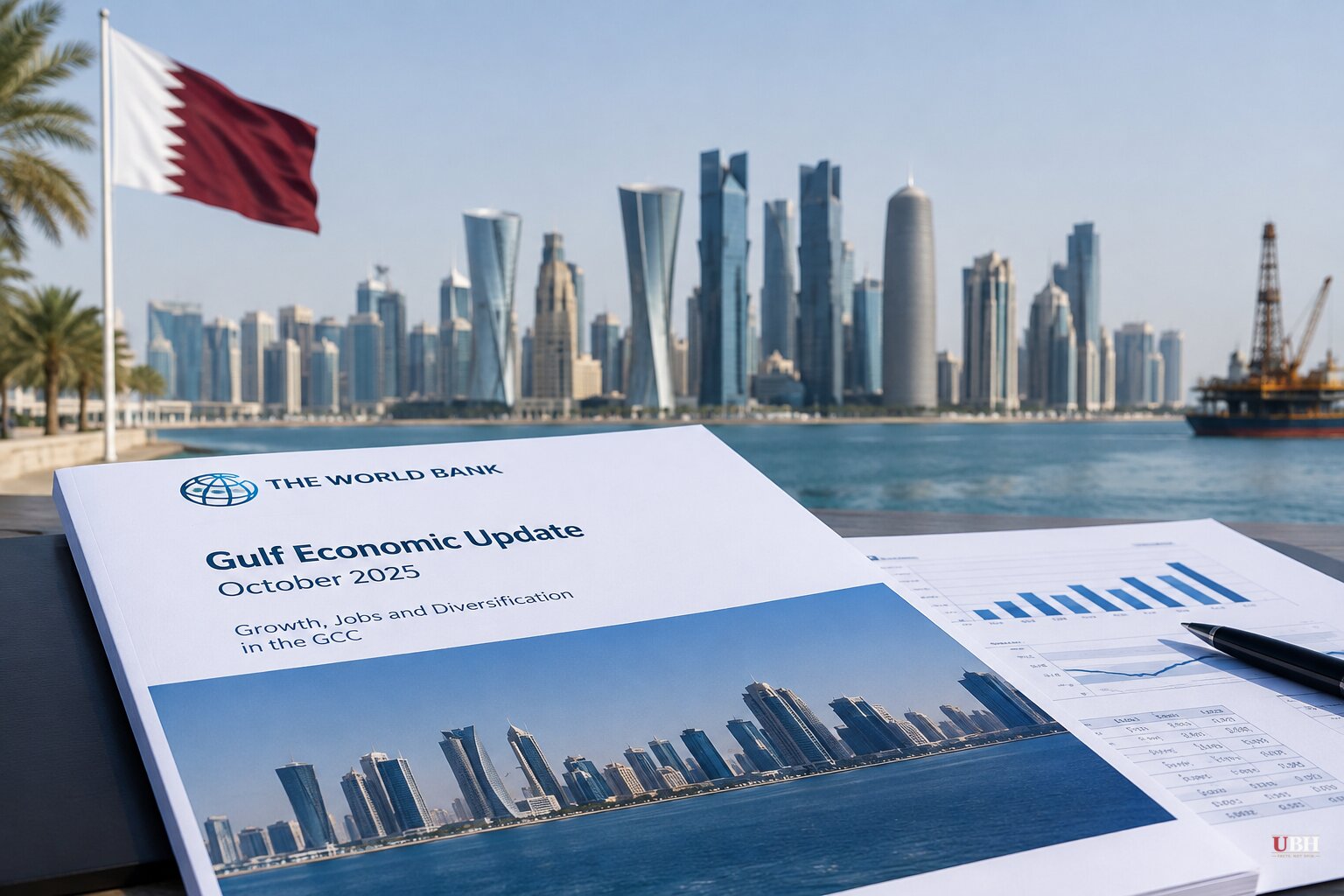
Since the Iran conflict began in February 2026, the Strait of Hormuz disruption has hit the countries that were supposed to profit from expensive oil. The World Bank's latest regional update, published Tuesday, Oct. 6, puts numbers on it.
The bank projects the six Gulf Cooperation Council economies will shrink by an average of 4.3% this year. That is 5.7 percentage points lower than its April forecast. The wider Middle East, North Africa, Afghanistan and Pakistan region is projected to contract 2.1% in 2026, after growing 3.3% in 2025.
"Unlike previous energy shocks, which typically benefited oil exporters," the bank said, the Hormuz closure has imposed the largest costs on the Gulf oil exporters. Lower export volumes have cut output and government revenue, and higher prices have not covered the gap.
Country by country
Qatar takes the worst of it. The World Bank forecasts a 20.9% contraction, down from 1.8% growth in 2025, which would be Qatar's weakest performance in five decades. Average monthly gas production fell about 67% between March and July because of damage at its sites.
Kuwait is forecast to shrink 14.6%, an 8.2-point downgrade from April. Saudi Arabia is projected at minus 2.0%, down from 4.6% growth last year. The UAE is projected at minus 1.6%, down from 6.2%.
Gulf oil output fell from about 26 million barrels a day before the war to about 16 million in March, the bank said. Saudi Arabia has been better placed than its neighbors because its East-West pipeline carries crude to Yanbu on the Red Sea. The bank noted that pipelines in Saudi Arabia and the UAE brought an additional 2.8 million barrels a day to global markets.
Outside the Gulf, Iraq is forecast to contract 12.4% and Iran 7.7%. Both are operating at only 55% to 70% of estimated oil production capacity. Iranian inflation hit 89% in August, according to World Bank figures.
Oil importers are doing better. Egypt and Morocco have seen improved forecasts, and the bank projects oil-importing economies will grow 4.3% in 2026, up from 3.9% in 2025.
"This conflict is very painful and it has concentrated the losses of the conflict in our region while the global economy and other regions are upgrading their forecasts," said Roberta Gatti, the bank's chief economist for the region.
Flights and gas
The damage reaches past oil. Passenger traffic on Middle Eastern airlines fell 14.6% in August from a year earlier, the International Air Transport Association said on Sept. 30. Capacity fell 9.3%, so more seats flew empty.
Aviation consultant Omar Hashmi said Gulf carriers such as Emirates, Qatar Airways and Etihad are picking up some passengers stranded by cancellations at European and other airlines. Closed airspace and longer routes raise their fuel costs, he said.
Europe is feeling the gas side. Italian energy company Edison said on Sept. 28 that QatarEnergy had extended its force majeure notice to early December. That brings the total of affected cargoes bound for Italy's Adriatic LNG terminal to 35 between April and early December, about 4.6 billion cubic meters of gas. Edison said it has bought replacement supplies and can still meet its customer commitments.
Flows are recovering, unevenly
Oil is moving again. Gulf exports excluding Iran averaged about 19.2 million barrels a day in September, more than 81% of the prewar level, according to Vortexa data. Provisional Kpler data show Middle Eastern crude exports topped prewar levels on 14 days in September. Four vessels carrying Qatari LNG reappeared outside Hormuz around Oct. 2-3.
Refined products are lagging. The Wall Street Journal reported crude is moving through the strait at about 76% of prewar levels, while diesel and other refined products make up just 11% of cargoes, down from more than 20% before the war. JPMorgan analysts said the crude market "has largely normalized even as refined product supplies remain constrained."
The strain is also felt in the United States. The Strategic Petroleum Reserve holds 283.8 million barrels, the lowest since 1982, according to the Energy Department. The administration is drawing it down under the 172-million-barrel release President Donald Trump ordered in March. Saudi Aramco CEO Amin Nasser called the world's supply cushion "scarily thin."
G7 leaders have since agreed to release 100 million barrels of oil and diesel from emergency reserves over four months. Andy Lipow of Lipow Oil Associates told NBC News the release could cut diesel prices by about 25 cents a gallon but "does little to increase refinery capacity to produce more." Politico reported the White House dropped a planned 90-day diesel export ban after the G7 deal. "We're not going to be doing the export ban," Trump said.
The 2027 rebound has conditions
The World Bank projects GCC growth of 10.3% in 2027, but only if the conflict subsides by the end of this year and oil and shipping normalize from early 2027. In that case it sees the wider region excluding Iran growing 7.8%. Qatar would grow 26.7% as LNG restarts, Kuwait 22%, the UAE 9.5% and Saudi Arabia 7.9%.
The bank itself cautioned that "a regional recovery is not guaranteed and will require sustained policy efforts."
Thomas Kuruvilla of Arthur D. Little Middle East and India is more optimistic about Saudi Arabia. He said the kingdom enters the rebound with a broader economic base than in earlier oil cycles, with construction, logistics, tourism and business services set to benefit. The open question for 2027, he said, is whether the oil recovery turns into private-sector investment and productivity.
The next checkpoint is already on the calendar. QatarEnergy's force majeure runs to early December, and the World Bank's rebound case requires the conflict to subside by Dec. 31, less than three months away.
Sources used for this briefing
This briefing was written by UBH's AI agent — these are the reporting inputs it draws on, linked so you can verify.


