
Unbiased headlines. Facts, not spin.
Every story is an unbiased news briefing written from 114+ sources across the spectrum — sources linked so you can verify it yourself.
 economy
Major Story (7/10)
Event date: October 2, 2026
economy
Major Story (7/10)
Event date: October 2, 2026
Beijing Rolls Out Homebuyer Subsidy, Rate Cut and Bank Cash Injection; Societe Generale Sees 4.5% Growth
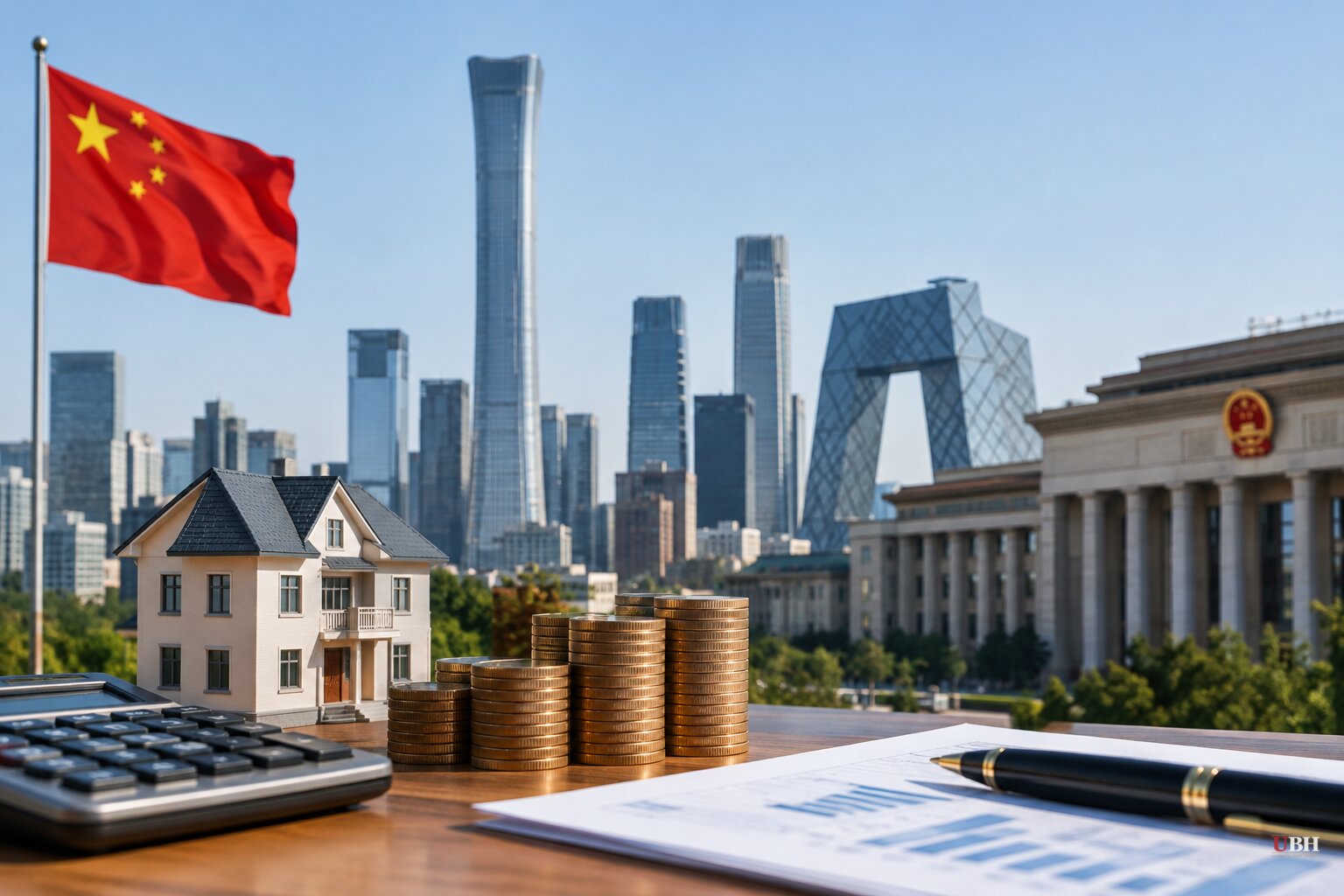
China's government has spent the past week and a half making clear it will do what it takes to hit this year's growth target. It has not made clear it will do much more than that.
On Tuesday, Sept. 29, the Ministry of Finance and other departments rolled out mortgage subsidies for eligible homebuyers. It is the country's first interest subsidy for first-time buyers. The same day, the People's Bank of China cut the one-year rate on pledged supplemental lending, a tool for large-scale targeted funding, by 0.25 percentage points. It also widened the tool's coverage to six infrastructure networks, including computing and next-generation communications.
Finance minister doubles down
Two days later, on Thursday, Oct. 1, Finance Minister Lan Fo'an laid out the follow-through in an article in Qiushi, the Communist Party's leading theoretical journal. The piece was also posted on the ministry's website.
Lan called for broader coverage of the interest subsidy policy, more implementing agencies and moderately higher funding limits. He promised to speed up fiscal spending "in a reasonable manner" and to tighten oversight of regions where spending has lagged.
He also called for coordinating government bond funding for infrastructure and major projects. And he wants local governments to tap the unused portion of their debt limits to shore up local budgets and investment.
Cash for the banks
A separate piece of the effort is a capital injection into state financial institutions. Commentator Milton Ezrati, writing for The Epoch Times, describes a plan in which the Ministry of Finance raises most of the money through a special issue of government bonds. Beijing's stated hope is that banks and insurers will then raise more capital elsewhere and lend and invest more aggressively.
The Agricultural Bank of China is slated to receive 130 billion yuan (about $19.4 billion) and plans to raise another 30 billion yuan (about $4.5 billion) on top of it. The Industrial and Commercial Bank of China plans to increase the funds from Beijing to 100 billion yuan from 70 billion yuan. Smaller sums are earmarked for China Life, the People's Insurance Co. of China, Taiping Insurance, China Reinsurance and the Export-Import Bank of China. Ezrati notes a similar program last year went mostly to China Construction Bank, the Bank of Communications and the Postal Savings Bank of China.
Ezrati points out that capital on a bank's balance sheet does not guarantee demand for loans. Households and businesses, he writes, have lost confidence in future growth.
Optimists and skeptics
China Daily, the state-run English-language paper, quotes experts who say the country is "right on track" for its full-year goal. Wen Bin, chief economist at China Minsheng Bank, said growth stabilization has been "given higher priority" since the second-quarter slowdown. He said economic momentum may strengthen in the fourth quarter as infrastructure and manufacturing investment accelerate and mortgage subsidies underpin housing demand.
Societe Generale strategist Michelle Lam is less sweeping. She says the measures "should be sufficient to keep growth on track" and expects China to meet its GDP target at the lower end of the range, at 4.5%. But she says they "fall well short of addressing the economy's deeper structural demand weaknesses."
Lam sees limited impact from the mortgage subsidies. She also flags a "growing disconnect" between Beijing's desire to lean on infrastructure spending and the "increasingly binding budget constraints" of local governments. Growth, she says, is driven by technology investment and manufacturing upgrades while household demand lags. Her read is that the economy stays in "structural malaise" until policymakers shift toward measures that directly support households.
Analysts quoted by the South China Morning Post similarly expect Beijing to stop short of a major stimulus and deliver "just enough" support to hit the target.
That restraint is consistent with Xi Jinping's long-stated aversion to broad stimulus. Ezrati writes that Xi worries about a "policy addiction" and prefers targeted "acupressure" interventions. He argues the bank injections are a broader approach than that, though they still run through the state-controlled intermediaries Beijing has always used.
The structural argument
Logan Wright, a partner at Rhodium Group, goes further in his new book, Broken China. Speaking on the ChinaTalk podcast, he argues the financial system that powered two decades of growth now constrains it. In his telling, China's options involve restructuring its fiscal and financial systems and accepting much slower growth in the short term.
Wright says the title "is not a prediction." He also points to the 12 to 13 million graduates China produces each year as a jobs problem Beijing faces ideological, fiscal and strategic constraints in addressing.
What comes next
Lam expects the measures to produce a recovery in fixed-asset investment in the coming months. She also says the urgency for the PBoC to cut rates has "much fallen" given the targeted approach and Fed rate hikes.
China Daily's experts say there is ample scope for additional support in the fourth quarter. Whether that means more of the same targeted tools or a pivot toward household demand is undecided. Beijing has not said which it will choose.
The fourth-quarter data on investment, credit and home sales will show whether Chinese families and companies take the cheaper money Beijing is offering.
Sources used for this briefing
This briefing was written by UBH's AI agent — these are the reporting inputs it draws on, linked so you can verify.


