
Unbiased headlines. Facts, not spin.
Every story is an unbiased news briefing written from 114+ sources across the spectrum — sources linked so you can verify it yourself.
 economy
Major Story (8/10)
Event date: October 2, 2026
economy
Major Story (8/10)
Event date: October 2, 2026
SNAP Enrollment Is Down About 5 Million Since Trump Signed the 2025 Tax Law
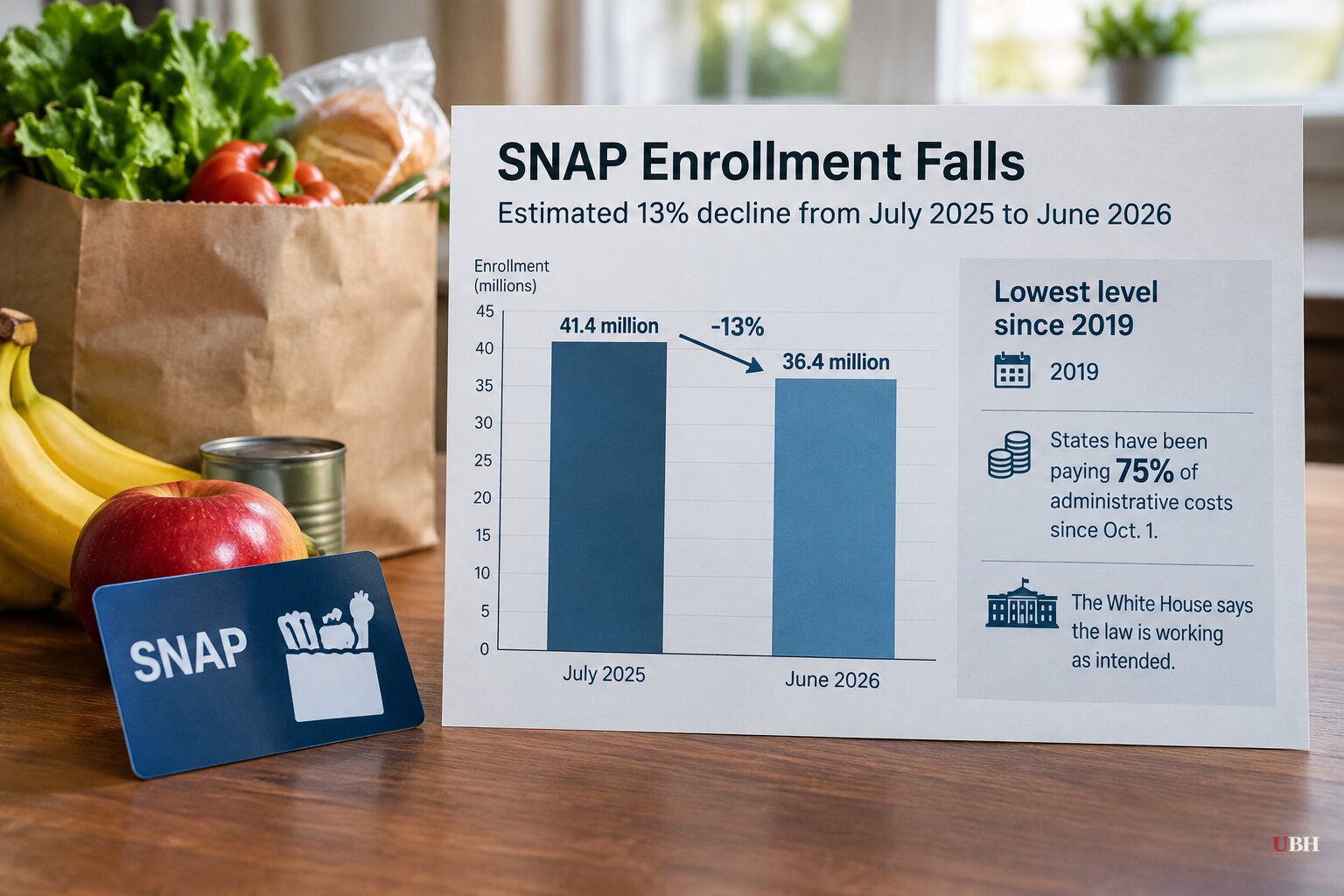
About 5 million fewer Americans were on SNAP in June 2026 than in July 2025, a 13% drop, according to an analysis by the Center on Budget and Policy Priorities. The Food Research & Action Center, using USDA data, puts the figure at 5.2 million. Enrollment is now at its lowest level since 2019.
The timing tracks the One Big Beautiful Bill Act, which President Trump signed July 4, 2025. The law widened SNAP work requirements and shifted costs to states.
What the law changed
The work requirement now covers adults 18 through 64. Parents whose youngest child is 14 to 17 no longer get the exemption they once had. Covered recipients generally must log 80 hours a month of work, volunteering or approved training, or they are limited to three months of benefits in a three-year period.
Exemptions remain for pregnancy, physical or mental conditions that prevent work, and responsibility for a child under 14. Applying for jobs alone does not count.
Certain noncitizens, including refugees, asylum seekers and some humanitarian parolees, are no longer eligible, according to FRAC. States are using the federal SAVE system to verify status.
The bill lands on the states
On Oct. 1, states began paying 75% of SNAP's administrative costs, up from 50%. Starting in October 2027, states with high payment error rates will also have to cover up to 15% of benefit costs, which the federal government has paid in full.
Maryland estimates its administrative costs will rise by $57.5 million this fiscal year, bringing its annual share to $172.5 million, according to FRAC. D.C. expects to spend about $39.3 million in local funds, roughly $10 million more than before.
Louisiana shows what the incentive looks like in practice. Its enrollment fell by about 170,000 people, or 21%, per federal data. Its payment error rate rose from 6.62% in fiscal 2024 to 8.14% in fiscal 2025, and FRAC estimates the state could owe up to $199 million in benefit costs.
"It's been a race to drive down those error rates," said Joseph Llobrera, CBPP's senior director of research on food assistance. He said states are demanding more documentation from applicants more often. "We haven't seen a decline of this magnitude in about three decades," he said. CBPP has been described as left-leaning, and FRAC is an anti-hunger advocacy group. Both are interested parties.
Aaranika Macon of LaPlace, Louisiana, told Verite News it took two months to get benefits after she applied. Two weeks used to be normal, she said.
The White House position
The administration rejects the idea that this is a cut for its own sake. White House spokesperson Anna Kelly said Trump is "strengthening SNAP for the Americans who need it by ensuring these programs are sustainable for future generations."
"The Working Families Tax Cuts bill restores basic work requirements, prioritizes American citizens, and implements reasonable cost-sharing measures with states to crack down on waste, fraud and abuse," Kelly said in an email.
In May, Trump said millions of people had been "lifted off" SNAP because of a stronger economy.
That last claim is contested. CBPP says unemployment has stayed relatively stable since the law took effect, which it argues means the enrollment drop does not reflect a sharply better job market. Enrollment counts show how many people left, not why each one did. Nobody has published a breakdown of how many found work, how many were disqualified and how many dropped off over paperwork.
The work requirement itself is a mainstream idea. Asking able-bodied adults without young children to work, train or volunteer for benefits is not extreme. The open question is whether states are administering it cleanly.
Faces behind the numbers
Lori Covelli, 53, an unemployed social worker in Kenosha, Wisconsin, used to receive $760 a month. She lost all of it after failing to find a job. She says she applies to about 10 jobs a week.
She had been told to hold on until she turned 54, when she would age out of the requirement. A letter this summer told her the cutoff is now 64. "It feels as though people are being punished," she told CBS News.
New York City's Department of Social Services says about 26,500 people lost SNAP under the new work rules. Brooklyn residents account for 40% of those cases and Bronx residents 26%. Slightly more than half were single adults ages 18 to 35, and men made up nearly 6 in 10 closures. The requirements took effect March 1, and the first benefits ended in June. As of Oct. 1, those people can reapply.
The losses reach retailers. Francisco Marte, president of the Bodega and Small Business Group, says SNAP makes up 15% to 20% of a typical bodega's revenue. Yomary Pichardo, who runs a store in the Bronx's Tremont neighborhood, says it is as much as 30% for her. "If I didn't accept EBT, I'd be forced to close the store," she said.
Prices and politics
Food prices rose nearly 3% from August 2025 to August 2026, according to the USDA. Lee Bowes, CEO of America Works, said the shift of administrative costs to states "suddenly thrust upon the program" is something states did not budget for.
HR consultant Bryan Driscoll said the message is "get a job or go hungry," and argued that finding work takes transportation, childcare and stability. His view is an opinion, not a finding.
Elected officials, policy analysts and anti-hunger advocates are pressing Congress to delay the cost-shifting provisions. They want the delay written into the Farm Bill, which is pending in the Senate. No vote on that change has been announced.
The next hard date is October 2027. That is when error-rate penalties begin, and Louisiana's potential $199 million bill is the first concrete number on what they could cost a state.
Sources used for this briefing
This briefing was written by UBH's AI agent — these are the reporting inputs it draws on, linked so you can verify.


