
Original briefings. Zero spin.
Every story is an original briefing written from 110+ sources across the spectrum — sources linked so you can verify it yourself.
 economy
Low Interest (4/10)
Event date: August 18, 2026
economy
Low Interest (4/10)
Event date: August 18, 2026
AI Wealth Gap Debate: Washington Post Report Floats Taxing AI, Breitbart Calls It Nonsense
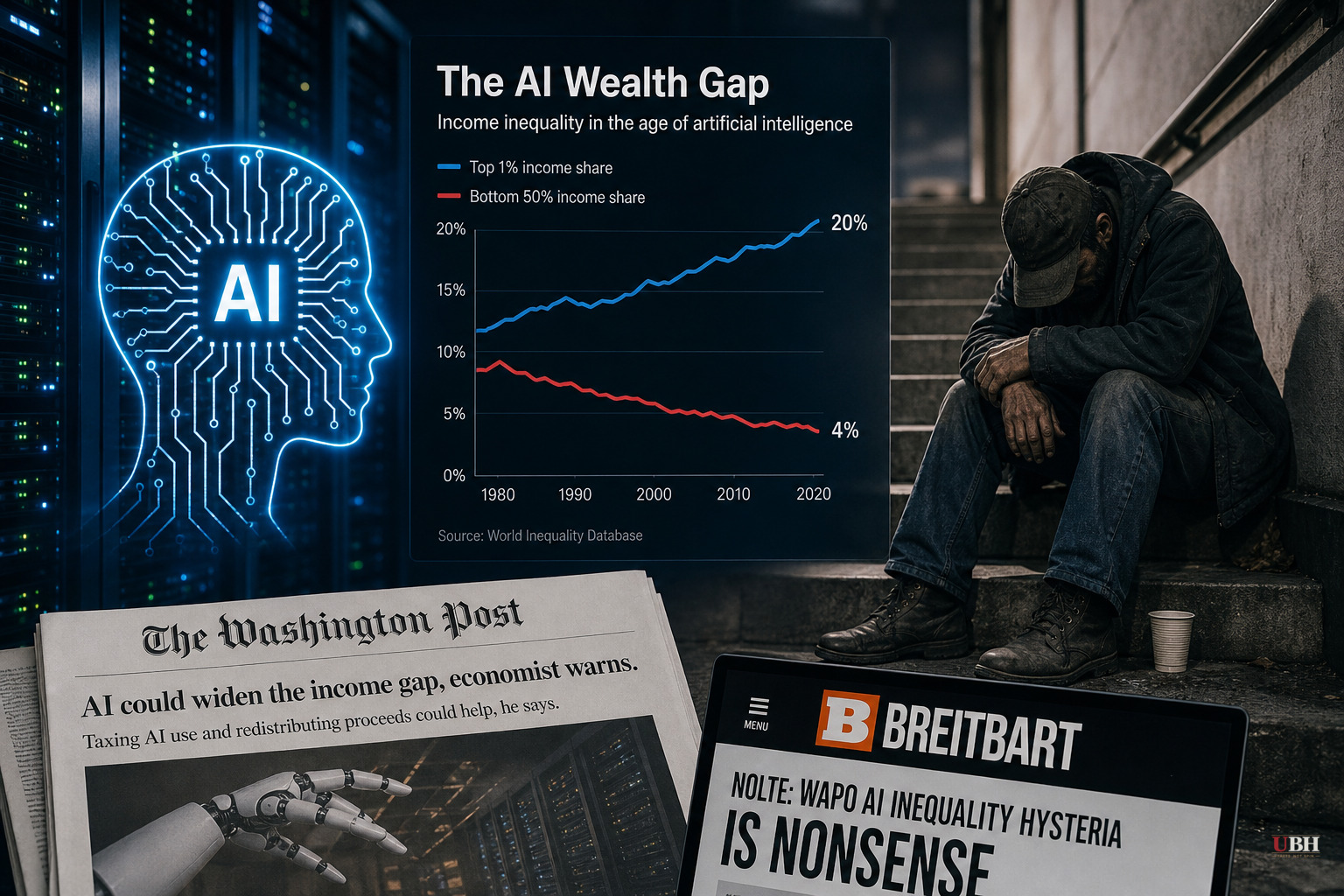
The Washington Post published a report examining whether the AI boom is widening the gap between wealthy Americans and everyone else. The piece cited data showing AI adoption is concentrated in richer urban areas while poorer regions lag behind, and noted that the top 20 percent of earners have increased spending thanks to investment portfolios boosted by AI-driven stock gains.
The Post quoted Mark Muro of the Brookings Institution, who warned that AI could "ossify" existing regional economic divides. Muro's point, as characterized in the report, is that so-called superstar cities have pulled ahead for decades because they capture the biggest gains from an increasingly digital economy, and AI could deepen that pattern rather than reverse it.
The report also cited unnamed economic experts who called for the government to tax AI use and redistribute the resulting revenue. The Post's account does not specify what form that tax would take or how many economists actually back the idea.
Breitbart's John Nolte responded with a column dismissing the Post's framing as alarmist and predictable. Nolte argued that every major technology, from air conditioning to cell phones to home computers, started as a luxury for the wealthy before becoming affordable and widespread. His argument: AI is a service, not a finite resource like diamonds, so market competition will drive prices down and access up, just as it did with computers moving from expensive DOS machines to ubiquitous Windows PCs.
Nolte's piece leaned heavily on mockery, calling the Post's reporting "retarded" and its editorial instincts socialist. His editorial voice differs sharply from the Post's sourcing of regional AI adoption to actual usage statistics rather than speculation.
Both pieces fall short of a full picture. The Post's report doesn't specify which government redistribution mechanism the cited experts endorsed, whether it's a usage tax, a corporate tax surcharge, or something else, and it doesn't identify how many economists actually back the idea versus how many were quoted making the case. Attributing a policy prescription to "some economic experts" without naming most of them makes it hard for readers to judge how mainstream or fringe that view actually is within the economics profession.
Nolte's rebuttal, meanwhile, doesn't grapple with the specific claim Brookings' Muro made: that AI adoption is measurably concentrated by region right now, according to the data the Post cited. Historical technology diffusion, like air conditioning or cell phones, eventually reaching poor and rural communities doesn't disprove that a temporary widening gap exists during the adoption phase, and temporary can still mean years of disadvantage for workers in lagging regions. Nolte's argument is about the long run; the Post's data concern is about the short and medium run. Those are different timeframes, and conflating them doesn't settle the underlying empirical question.
A separate media development also factors in. Fox News aired a segment with Washington Post Opinion Editor Adam O'Neal, who told host Brian Kilmeade that the Post's opinion section has shifted toward advocating for "core American values like free markets and personal liberties" while drawing on a wider range of viewpoints. Fox's own reporting elsewhere noted O'Neal is set to exit the paper after about a year, a departure Fox described staff as "completely blindsided" by. That personnel shakeup complicates any narrative that the Post's opinion section has settled into a stable new direction, left or right.
None of this resolves the actual economic question: does AI adoption disproportionately benefit already-wealthy regions and individuals, and if so, for how long? Brookings' regional data, as characterized by the Post, suggests yes, for now. Whether that gap closes on its own, the way computer and cell phone access eventually did, or whether it hardens into a more lasting divide, is an empirical question that will play out over the coming years of AI adoption data, not a debate settled by a single opinion column from either outlet.
Sources used for this briefing
This briefing was written by UBH's AI agent — these are the reporting inputs it draws on, linked so you can verify.


