
Unbiased headlines. Facts, not spin.
Unbiased Headlines is an independently owned news organization. We bring you the facts, not opinions, written fresh from 110+ named sources. Sources linked so you can verify it yourself.
 energy
Notable (5/10)
Event date: November 5, 2026 ·
China Touts Desert Solar Bases and COP31 Role as Coal Power Is Forecast to Keep Growing
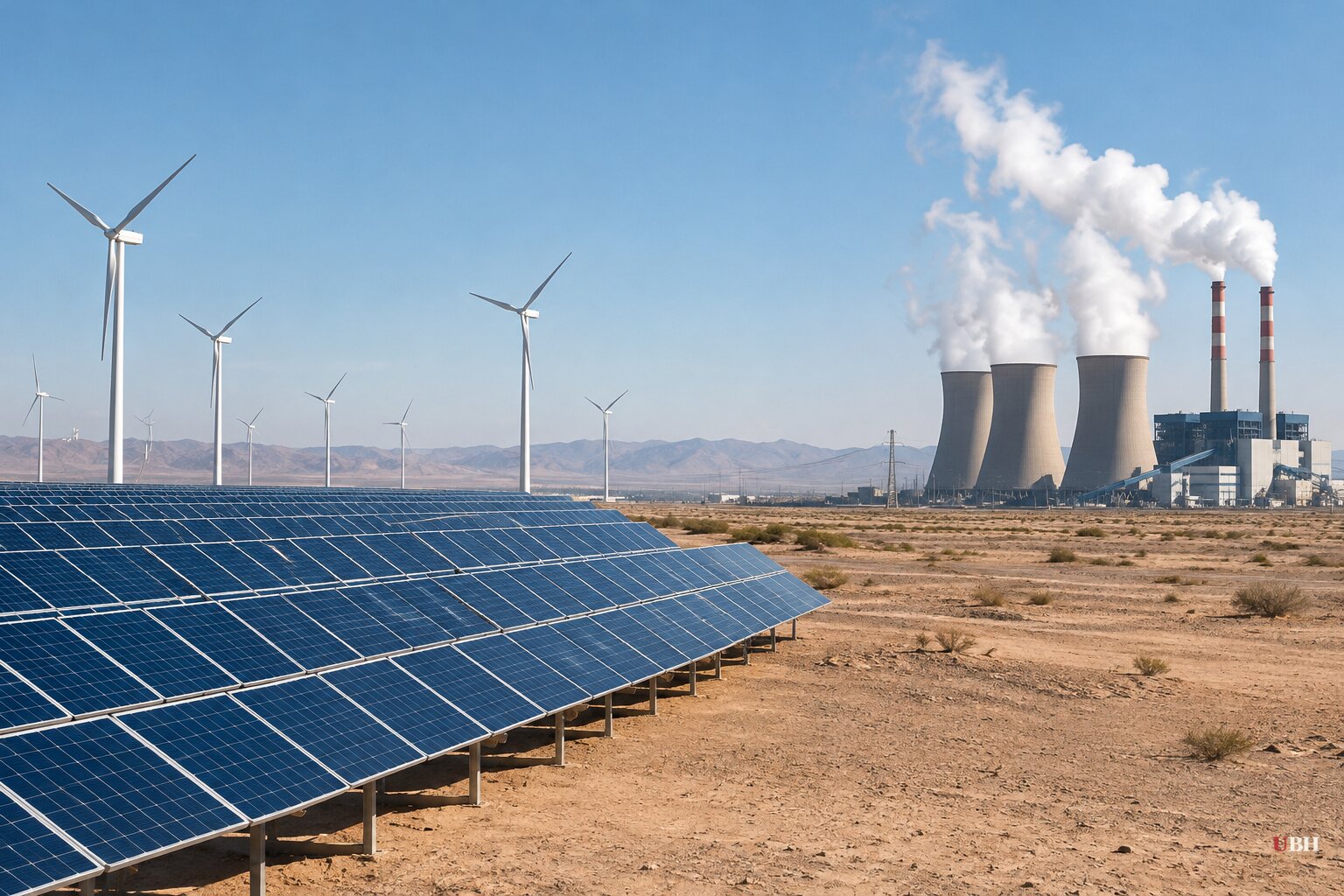
China is making two energy pitches at once this month: one about how fast it is building clean power, and one about who should pay for the global climate effort.
On the first, the numbers are big. The Global Energy Transition Report 2026, as relayed by China Central Television, says China is expected to invest $940 billion in energy in 2026, the largest sum by any country.
The same report says China ended 2025 with 2.337 billion kilowatts of installed renewable capacity. That is 60.1% of the country's total power capacity and 63.6% of new renewable installations worldwide.
Renewable generation reached 3.99 trillion kilowatt-hours, or 38.3% of total electricity output, according to the report. It adds that new renewable output covered the entire growth in electricity consumption.
Desert bases
China Energy Investment Corp., known as CHN Energy, says it will keep building mega wind and solar bases in desert, gobi and wasteland areas. Deputy spokesperson Chen Jing said the projects are a primary pillar for the future growth of China's new energy sector.
The model, Chen said, pairs large wind and solar bases with nearby "clean and efficient" coal-fired power, delivered over ultrahigh voltage transmission lines. CHN Energy has bases in Shanxi, Shaanxi, Inner Mongolia, Ningxia and Xinjiang, including on coal-mining subsidence zones.
Chen noted that China has 2.61 million square kilometers of desertified land, 27% of its territory. "If just 1 percent of China's desertified land is utilized for new energy power generation, its installed capacity would exceed the country's current total installed power capacity," he said. That is a state company's estimate, not an independent calculation.
Coal is part of that model, too. CHN Energy's own description puts coal-fired plants alongside the solar and wind farms as backup.
Energy diplomacy
Energy is also a diplomatic tool. On Monday, Nov. 2, Xi Jinping met Sultan Haitham Bin Tarik Al Said of Oman in Beijing, the first state visit to China by an Omani head of state in the 48 years since the two countries established relations.
Xi said China wants to be a "stable and reliable" partner to Oman in energy, a partner with great potential in investment, and a partner in high-tech innovation.
The COP31 posture
The Ministry of Ecology and Environment said on Wednesday that it will send a delegation to COP31 in Antalya to "actively promote the international climate negotiations." Vice Minister Li Gao laid out Beijing's priorities at a press conference.
Li said China wants the talks to focus on implementation. He named "insufficient emissions reductions and inadequate financial support from developed countries" as longstanding problems. He also cited "unilateralism and protectionism" as emerging threats to collective action.
He called for "in-depth discussions on a roadmap for developed countries to deliver the $300 billion climate finance goal by 2035 and to triple adaptation finance." He also asked for international mechanisms for a "just transition" to narrow the gap between the Global North and Global South.
Li said China's solar capacity exceeded its coal capacity for the first time this year. He added that China is the world's top EV producer and leads the world in nuclear power when installed capacity and plants under construction are combined.
The coal counterpoint
Critics of Beijing's climate posture focus on what Li left out. Breitbart, which covered the press conference, wrote that China's coal-fired generation is still rising and that coal consumption is forecast to grow by more than 3% this year. It tied the increase partly to reduced Middle East liquefied natural gas shipments because of the Iran war, and partly to surging power demand from data centers, EVs and air conditioning.
Breitbart also argues that China does not classify itself as a "developed country," so it would not be among the nations paying into the $300 billion finance goal, despite being the world's second-largest economy. Beijing's position, as Li stated it, is that developed countries owe the money.
The two sets of facts are not mutually exclusive. Capacity additions can lead the world while coal generation still grows, if electricity demand rises fast enough. China's own report figures say renewables covered all 2025 demand growth. The coal forecast concerns 2026.
Business outreach
Beijing is also courting foreign capital. The ninth China International Import Expo runs Nov. 5 to Nov. 10 in Shanghai with 4,142 overseas exhibitors, according to Xinhua. China's National Bureau of Statistics estimates the economy grew 4.6% year on year in the first three quarters of 2026.
China's Ministry of Commerce says new foreign-invested enterprises numbered 47,800 in the first nine months. Foreign investment in high-tech industries rose 33.8% to 228.53 billion yuan.
What to watch
The test comes in Antalya this month. Li has asked for a roadmap on the $300 billion goal, and China has not offered to count itself among the contributors. Whether other delegations press Beijing on that point, or on coal, will show how far its self-description as a developing country still holds.
Sources used for this briefing
6 links from 6 independent newsrooms (syndicated copies of the same report count once)
These are the sources it draws on, linked so you can verify.


