
Unbiased headlines. Facts, not spin.
Unbiased Headlines is an independently owned news organization. We bring you the facts, not opinions, written fresh from 110+ named sources. Sources linked so you can verify it yourself.
 energy
Notable (5/10)
Event date: November 5, 2026 ·
IEA Says Renewables Saved India $100 Billion in Coal and Gas Imports, Projects Nearly $240 Billion by 2030
India has spent the past 15 years cutting what it pays foreign suppliers for fuel, and the International Energy Agency has now put a number on it.
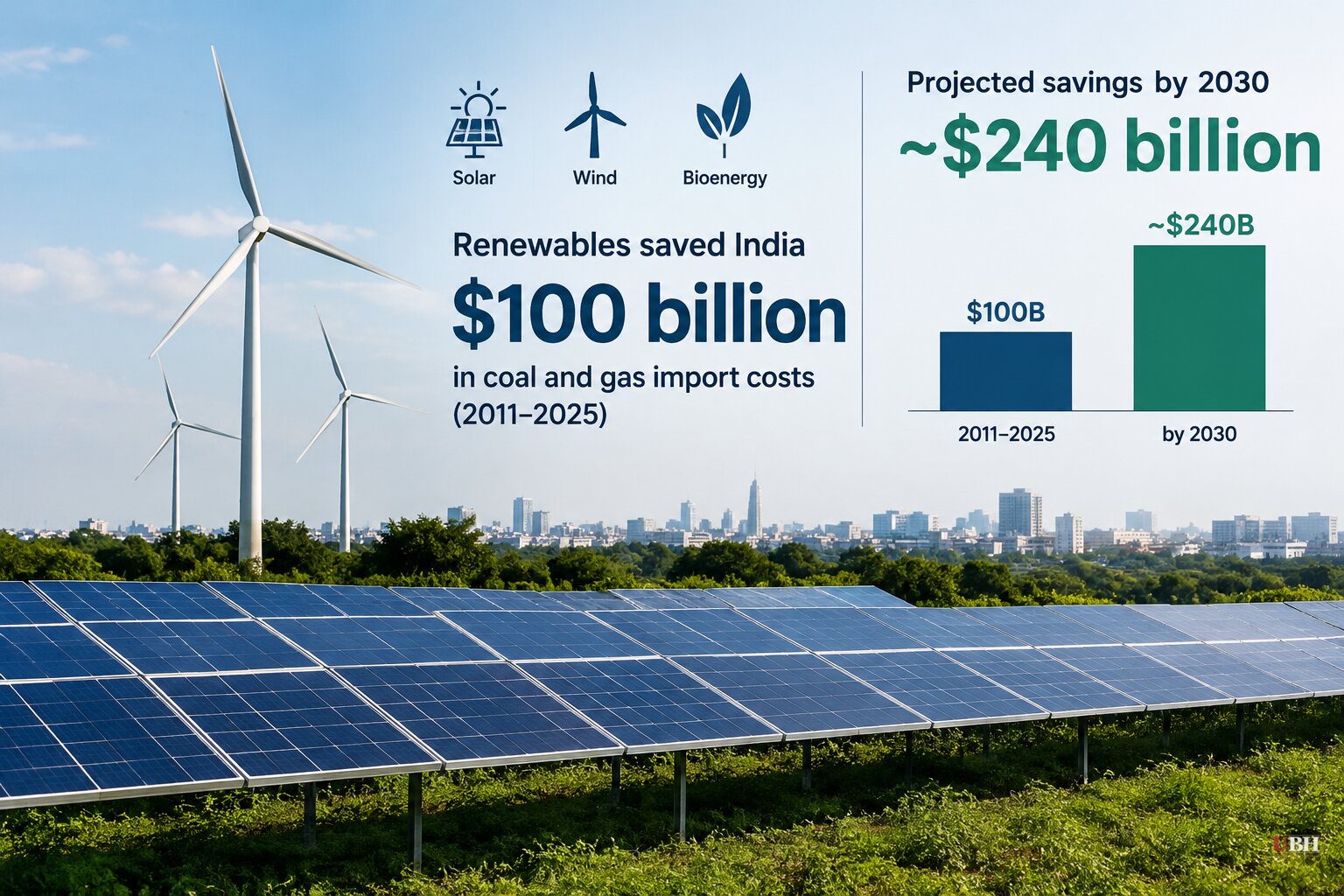
In its India Renewable Energy Market Report 2026, the IEA said renewable electricity saved India more than $100 billion in coal and natural gas import costs between 2011 and 2025. The agency projects cumulative savings could approach $240 billion by 2030.
That $240 billion is a forecast. The IEA built it on the assumption that fuel prices remain broadly consistent with the average levels observed during 2024-2025.
What the IEA actually found
The agency estimates annual fossil fuel import savings will reach about $35 billion by 2030. That would exceed India's actual non-coking coal and natural gas import bill in fiscal 2024-25.
Solar PV is expected to deliver roughly 60% of the projected savings. Wind should deliver almost 30%.
The IEA also ran a counterfactual for 2025. Without the solar PV, wind and bioenergy capacity added since 2010, India's coal imports would have been around 110 million tonnes higher. The import dependence of its electricity generation would have exceeded 30%, approximately twice the actual level, the agency said.
That 110 million tonnes is a modelled estimate of a world that did not happen, not a measured import volume.
The 2030 build-out
The IEA expects India's renewable capacity to reach around 530 GW by 2030. Solar PV would account for more than 350 GW, wind would approach 90 GW and hydropower could reach 75 GW.
Renewables would then supply 35% of India's electricity generation, with output approaching 950 terawatt-hours, nearly double current levels.
The report was released on 3 November 2026 at the Bharat Renewable Energy Summit, according to analysis published by Discovery Alert. IEA Executive Director Fatih Birol amplified the findings on X, replying to a post by Union Minister for New and Renewable Energy Prahlad Joshi. Coverage by ANI is dated Nov. 8.
"India's renewables expansion is delivering major energy security benefits amid heightened uncertainty in global energy markets," Birol wrote. He added that India's experience shows "how consistent policies can help drive down renewable energy costs & attract investment, offering valuable lessons for other emerging economies."
Joshi said the transition is about more than cleaner power. He said it strengthens energy security and economic resilience by reducing import dependence and conserving foreign exchange.
The pressure from global fuel markets
The timing matters. Analysis published by OilPrice ties this year's price spikes to the U.S. and Israeli war with Iran and Iran's closure of the Strait of Hormuz. It says Asia was hit hardest and that India's earlier diversification cushioned the blow.
The IEA report makes a similar point in general terms. It says the buffers renewables provide become "particularly valuable when supply disruptions and price spikes put fossil fuel markets under strain."
There is also a trade-and-industry angle. OilPrice describes India as the world's second-largest producer of solar panels, behind China.
Where the numbers get harder
The headline savings depend on the grid delivering the power. The IEA itself says continued investment in transmission, energy storage and power system flexibility is needed to absorb a growing share of variable renewable electricity. It adds that sustaining the expansion will require faster investment in electricity grids, storage and system flexibility, alongside stronger utility finances and fewer project delays.
The Institute for Energy Economics and Financial Analysis (IEEFA) has found that more than 50 GW of renewable capacity is already stranded by transmission delays. That figure is cited in analysis by Discovery Alert.
The same analysis points to a gap between capacity and output. Solar and wind held about 37% of installed capacity but only about 13% of generation. Gigawatts on paper are not the same as coal or gas displaced.
The $240 billion projection also depends on prices. Discovery Alert's analysis notes that cheaper fuel would shrink the nominal saving, while pricier fuel would enlarge it.
What comes next
The IEA says India is on track to double the share of renewables in its national energy mix by 2030, reaching 35%. Whether the $35 billion annual saving materializes will depend on whether transmission lines and storage capacity keep pace with new solar and wind farms. The more than 50 GW already stranded is the first test.
Sources used for this briefing
7 links from 7 independent newsrooms (syndicated copies of the same report count once)
These are the sources it draws on, linked so you can verify.


