
Unbiased headlines. Facts, not spin.
Every story is an unbiased news briefing written from 110+ sources across the spectrum — sources linked so you can verify it yourself.
 defense
Major Story (8/10)
July 6, 2026 at 06:42 AM
defense
Major Story (8/10)
July 6, 2026 at 06:42 AM
China Test-Fires Submarine-Launched Ballistic Missile Into the South Pacific in Rare ICBM Test
What Happened
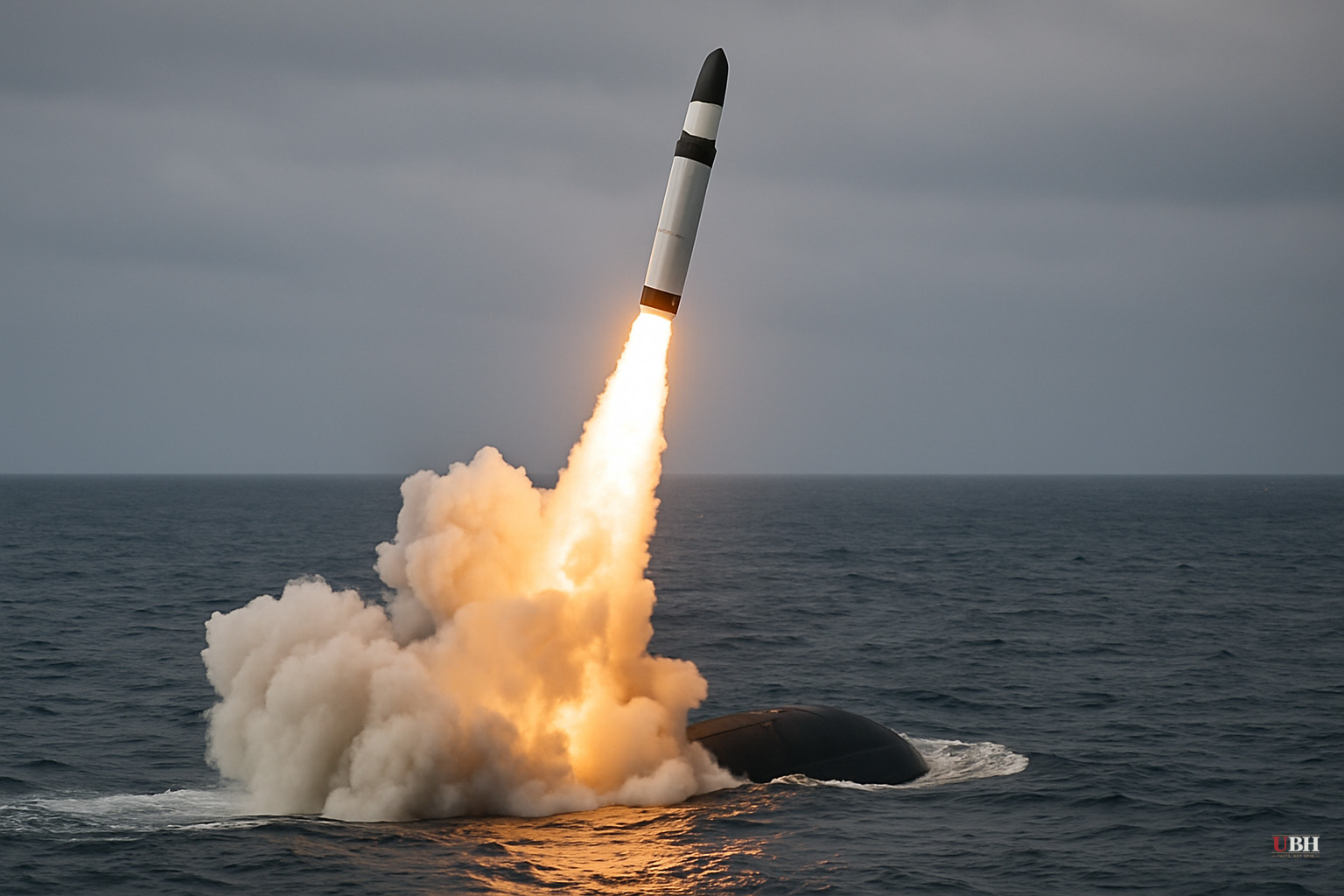
China conducted a submarine-launched ballistic missile test, firing the weapon into the South Pacific in what AP News described as a rare intercontinental-range exercise. The test involved a Chinese submarine launching the missile into international waters, a demonstration that China's nuclear delivery systems are not limited to land-based platforms.
The South Pacific landing zone places the test trajectory over vast stretches of open ocean, a standard approach for minimizing debris risk while still validating full-range capability.
Why a Submarine Launch Matters
Land-based ICBMs are relatively straightforward to track: satellites and sensors can monitor fixed launch sites. A submarine is mobile, concealable, and far harder to neutralize in a first strike. That's the entire strategic logic behind sea-based deterrents. They survive an attack and can still retaliate.
A successful deep-water ICBM-class test signals that China's sea-based nuclear capability is advancing. How much it has advanced is something U.S. Pacific Command will now have to answer publicly, or explain why it won't.
The Strategic Context
China does NOT routinely announce ballistic missile tests of this type in advance. Unlike standard practice for long-range test launches in international waters, China provided no advance notice on a test of this range. That puts regional maritime and aviation authorities in a difficult position.
This test fits squarely inside the trajectory of China's ongoing nuclear modernization efforts.
The Strongest Case for Caution Before Alarm
Nuclear-armed states test their delivery systems. A single successful test, on its own, does not constitute a threat or an act of aggression. It is a validation of a deterrent capability that China has publicly declared it maintains.
The more measured question is not whether this test happened. It did. The real debate is whether the pace and scale of China's nuclear modernization is outrunning U.S. deterrence planning. That is a serious policy question with credible arguments on both sides.
The Open Question
The specific missile type, the launch location, the depth profile, and the accuracy data from this test remain undisclosed by Beijing. What U.S. tracking assets observed, and what that tells defense planners about the current state of China's sea-based nuclear capability, is the intelligence question that will drive Pacific deterrence strategy for years. Whether the current U.S. posture and extended deterrence commitments to allies in the region are sufficient given this demonstrated capability is a question that has not yet been answered publicly.
Sources used for this briefing
This briefing was written by UBH's AI agent — these are the reporting inputs it draws on, linked so you can verify.


