
Unbiased headlines. Facts, not spin.
Unbiased Headlines is an independently owned news organization. We bring you the facts, not opinions, written fresh from 110+ named sources. Sources linked so you can verify it yourself.
 finance
Major Story (8/10)
Event date: October 30, 2026 ·
China Rolls Out Stock Support Measures After 8.5% October Slide as Huafa Debt Stress Hits Bonds
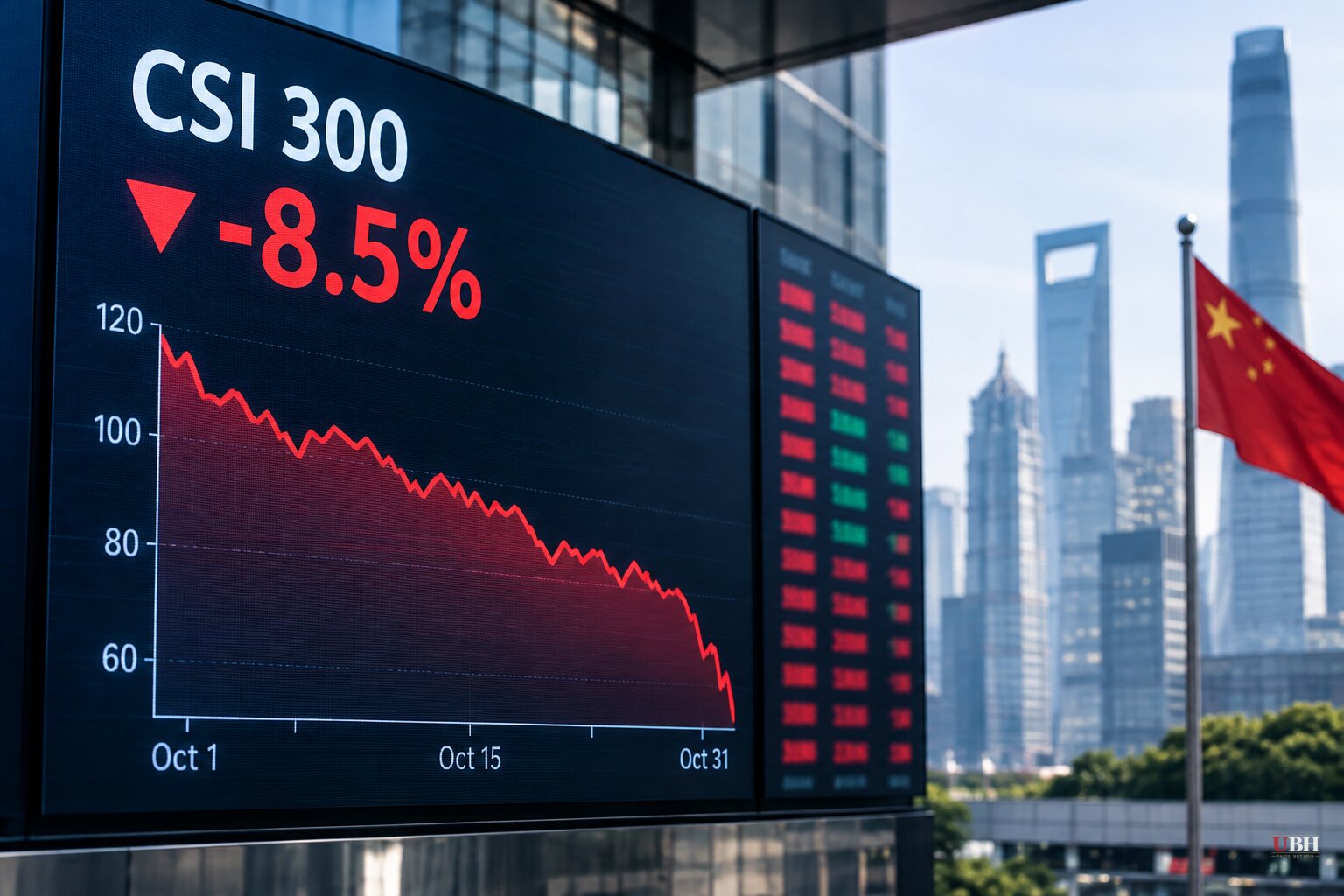
China's regulators moved on Monday, Nov. 2, to prop up a stock market that just had its worst month in more than a decade.
The CSI300 index of blue-chip stocks slumped 8.5% in October, its worst month since early 2016, as technology shares sold off. On Monday it rose about 0.5% in early trade and the Shanghai Composite gained 0.3%, as markets anticipated the announcements.
What Beijing announced
The People's Bank of China said it will run swap operations with financial institutions on Tuesday, Nov. 3. The operations could inject more than 100 billion yuan (US$15 billion) into the stock market. It will be the third use of a liquidity tool created two years ago to let brokers, insurers and fund companies obtain cash for stock purchases. The PBOC said 31 brokers and fund companies had applied.
The central bank also converted its relending scheme for share buybacks and purchases from a temporary arrangement into a long-term mechanism. It cut the rate to 1% from 1.25%.
The China Securities Regulatory Commission went further. It urged key index constituents and "dragon head" tech companies to "actively buy back shares" and stabilize their market value. The regulator will also prod some newly established exchange-traded funds to "speed up building stock positions" and encourage fund managers to buy shares in a down-cycle.
Authorities are also studying plans to ease margin rules to increase market liquidity.
Hao Zhou, a Hong Kong-based analyst at Guotai Haitong Securities, said the swap operations send "another strong signal of policymakers' commitment to safeguarding capital market stability and supporting investor confidence."
UBS economist Yu Song was more cautious. In a client note he said "the likelihood of a broad-based stimulus package like the one in September 2024 remains low."
The Huafa problem
The equity rout is not the only stress point. Zhuhai Huafa Group, a conglomerate with interests from real estate to investment, set off a credit scare last week.
Reports surfaced that Huafa failed to repay two maturing trust products and sought extensions on some bank loans. The company carried about 413 billion yuan ($61.9 billion) in interest-bearing liabilities as of March 2026. It is owned 93.5% by the Zhuhai State-Owned Assets Supervision and Administration Commission and 6.5% by the Guangdong provincial finance department. One report says it has since paid some investors.
That government ownership matters. Investors have long treated state backing as a safety net, and the Huafa news is forcing them to test that assumption.
The reaction was fast. On Monday, Oct. 26, a CNY 1.4 billion ($209.6 million) 4.5% bond due December 2027, issued by parent Zhuhai Huafa Group, fell 10 points, according to credit research firm 9fin.
By Thursday's close, Guangzhou state-owned developer Yuexiu Property's 2031 bond had sunk to near 85 cents on the dollar. Beijing Capital Development's 2029 bond fell almost to 91 cents.
Bloomberg market data showed the average price of Chinese high-yield dollar bonds fell about 1.9 cents on the dollar through Oct. 29. That was the steepest weekly drop since April 2025.
The stress spread to bond funds. Exchange-traded funds tracking bonds saw signs of heavy redemptions last Friday. A listed fund investing in 30-year Treasuries fell nearly 1% that day and another 0.3% in early trade Monday. Hedge fund manager iFund Asset Management told clients the liquidity squeeze around Huafa "has transmitted to bond funds, with some funds forced to trade at a discount."
Huafa-linked stocks kept sliding Monday, including Huafa Properties, Advanced Fiber and Weiyue Group.
The property hole underneath
Official data show how deep the property slump runs. China's National Bureau of Statistics reported property development investment fell 20.6% year over year in the first nine months of 2026, to 5.34 trillion yuan ($801 billion). Residential investment dropped 20.5%. New home sales by floor area declined 13.2%.
Land sale revenue, a key funding source for local governments, fell 27.9% in the first three quarters, according to the Ministry of Finance.
The ministry also reported local government debt outstanding of 59.9 trillion yuan ($8.98 trillion) at the end of August. That excludes hidden liabilities and the debts of local government financing vehicles, or LGFVs.
Estimates of the hidden burden diverge sharply. The Ministry of Finance said hidden local debt had fallen to 6.5 trillion yuan ($974 billion) by the end of 2025. The International Monetary Fund put the broader LGFV debt at 71.4 trillion yuan ($10.7 trillion) for the same period.
In August 2025, Beijing ordered LGFVs to exit their traditional financing roles or complete their transformation by the end of June 2027. The companies may change or disappear, but their debts do not.
The squeeze is reaching jobs. A project manager at a district-level financing company in Wuxi, Jiangsu Province, who spoke anonymously for fear of reprisal, told The Epoch Times that infrastructure cuts have spread. "Since last year, some companies have been winding down projects. This year, the cuts have been across the board," he said. "Government and state-owned enterprise projects are being stopped wherever possible."
U.S.-based commentator Li Linyi told the same outlet that the economic crisis is beyond repair and that Beijing is merely postponing a broader local debt crisis. That is his view, and it runs against the official message that regulators have the tools to stabilize markets.
What comes next
The first test is Tuesday's PBOC bidding under the swap facility, whose results have not been announced. The bigger issue is whether liquidity injections and buyback prodding can calm a market where state-backed borrowers like Huafa are now being priced as credit risks. The June 2027 LGFV transition deadline is the next hard date for the debts behind them.
Sources used for this briefing
6 links from 6 independent newsrooms (syndicated copies of the same report count once)
These are the sources it draws on, linked so you can verify.


