
Unbiased headlines. Facts, not spin.
Unbiased Headlines is an independently owned news organization. We bring you the facts, not opinions, written fresh from 110+ named sources. Sources linked so you can verify it yourself.
 finance
Major Story (8/10)
Intel Slides Another 8% Monday After Record 45% October Drop as Foundry Doubts Grow
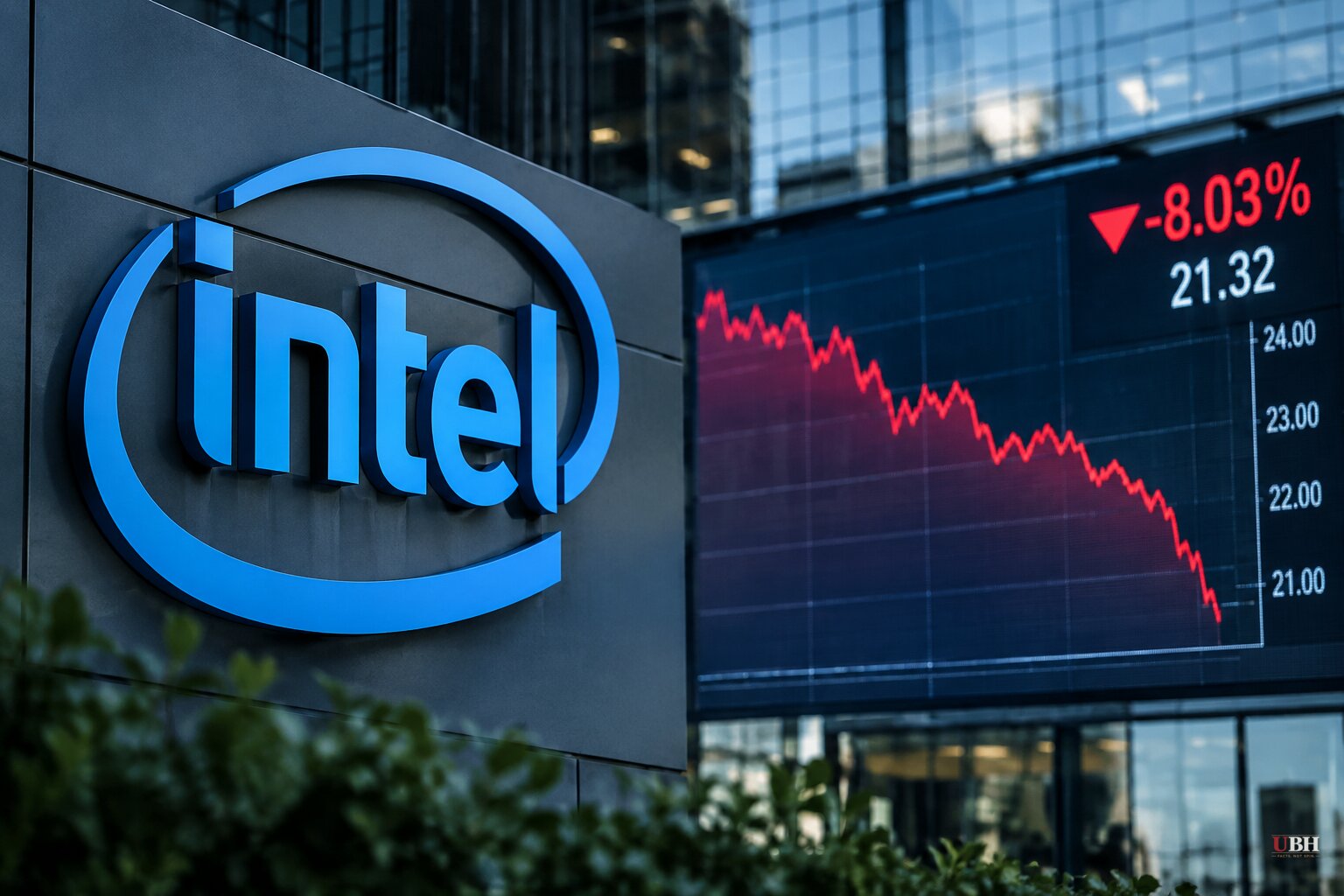
Since Intel's weak fourth-quarter forecast on Thursday, Oct. 29, and Friday's 29% plunge, the stock has kept sliding. CNBC reported it was down another 8% in Monday trading, Nov. 2.
That comes on top of a 45% drop in October, the steepest monthly decline on record, according to FactSet. Friday was the stock's worst day since the 1970s.
Public.com's market data listed Intel's market capitalization at $347.62 billion as of today, Nov. 2. The 52-week range it shows runs from a low of $32.89 to a high of $142.35. The average analyst price target it lists is $95.46.
What triggered the drop
The quarter itself was not the problem. Intel reported third-quarter revenue of $16.5 billion, up 21% from a year earlier, and adjusted earnings of 52 cents a share, ahead of Wall Street estimates. Data center revenue rose 78% to $7.3 billion.
The forecast was the problem. Intel guided fourth-quarter revenue to between $15 billion and $16 billion, against analyst estimates of roughly $17 billion. It guided adjusted earnings to 25 cents a share, against expectations of 43 cents. Its projected gross margin of 38% compares with 43% in the third quarter.
Chief Financial Officer David Zinsner said Intel expects global PC shipments to fall about 12% this year and another 10% in 2027. "We see the PC slowdown continuing at least through the first half of next year," he said.
Intel blames soaring memory and component costs. PCs still account for roughly half its revenue, and the PC chip business slipped 5% to $8.1 billion last quarter.
A deadly accident at Intel's Israel manufacturing facility earlier in October forced the plant to suspend operations. Intel expects the shutdown to cut fourth-quarter revenue by about $300 million.
The foundry problem
The sharper question is Intel's contract manufacturing business. CNBC reports the company has spent half a decade and a good share of $108 billion in capital expenditures trying to take on Taiwan Semiconductor Manufacturing Co. It still has no marquee customer for its most advanced chips and mostly makes chips for its own products.
Intel says it cannot make enough chips to meet demand, citing industrywide shortages of wafers, substrates and memory. CEO Lip-Bu Tan said on the earnings call: "I'm disappointed that we were not able to meet strong customer demand in this quarter."
In response, Intel is moving some Oregon factory capacity off wafers for its advanced 18A chips and onto the older Intel 3 node used for data center products. Intel is counting on 18A to attract outside customers.
David Yoffie, a Harvard Business School professor who spent almost three decades on Intel's board, said the move is hardly welcoming to prospective customers. "They're concerned that if Intel doesn't actually have excess capacity beyond its own demand, that they're just not a very credible supplier," he said.
The case Intel is making
Intel's argument is that demand is not the issue. Tan sees the global server processor market growing as much as fivefold over the next five years, to about $200 billion. Server chips for agentic AI are where Intel's growth is showing up now, and the company says supply, not orders, is holding it back.
That pitch drove the rally that preceded the collapse. The U.S. government took a 10% stake in Intel in August 2025, and Nvidia followed with a $5 billion investment. The stock rose sixfold over 10 months before peaking in June, per CNBC.
The selloff reaches well beyond Intel. Yahoo Finance has put the broader chip-sector rout at $3.5 trillion.
What comes next
Intel's next earnings report is scheduled for Jan. 21, 2027. Public.com's data lists an earnings estimate of 26 cents a share for that quarter.
By then, the company has to show it can add capacity without starving 18A, the process that outside customers would need. Intel has not announced a large-scale foundry customer.
Sources used for this briefing
7 links from 7 independent newsrooms (syndicated copies of the same report count once)
These are the sources it draws on, linked so you can verify.


