
Unbiased headlines. Facts, not spin.
Unbiased Headlines is an independently owned news organization. We bring you the facts, not opinions, written fresh from 110+ named sources. Sources linked so you can verify it yourself.
 finance
Major Story (8/10)
Event date: November 1, 2026 ·
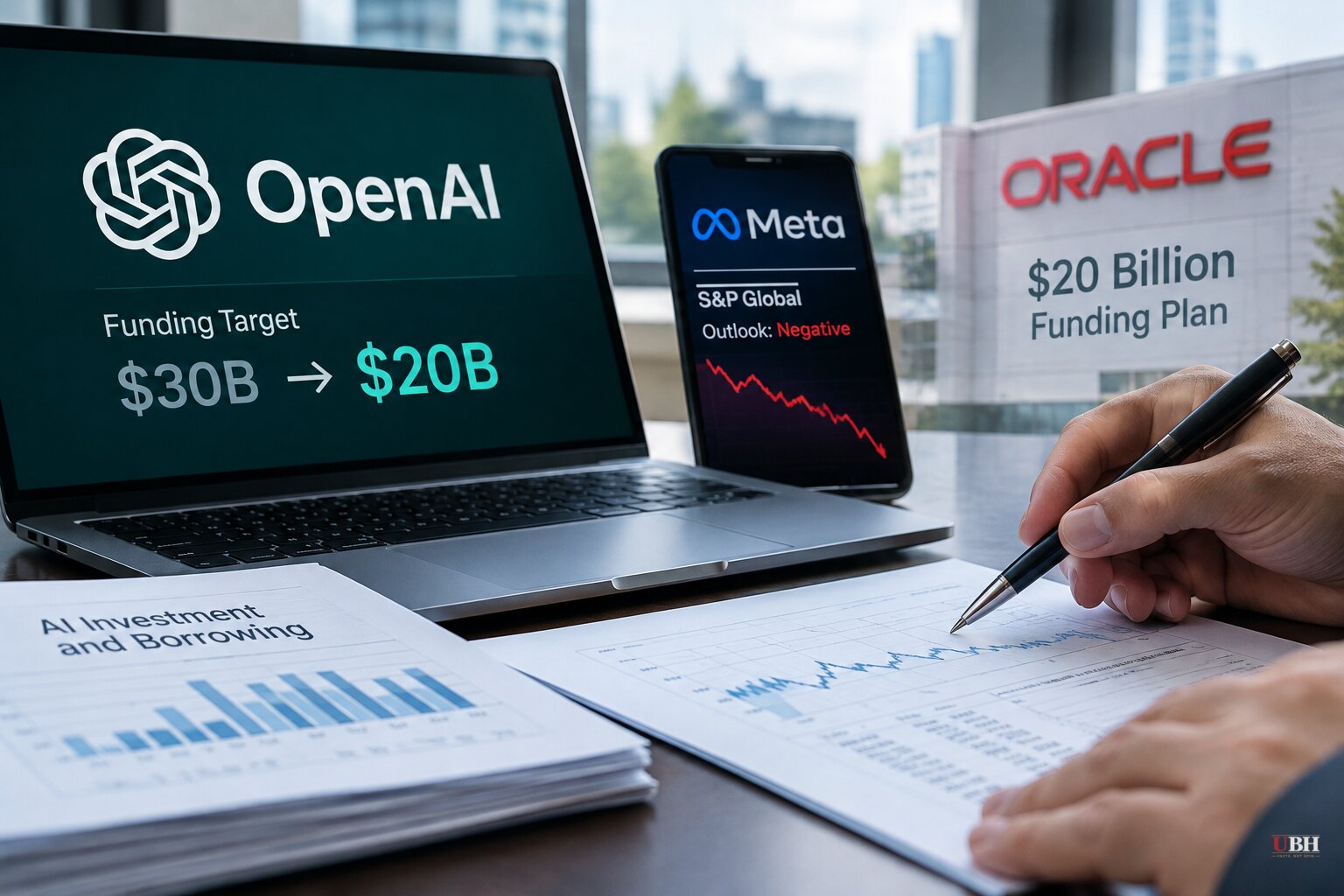
OpenAI Cuts Funding Target to $20 Billion, S&P Lowers Meta Outlook as AI Borrowing Piles Up
The money behind the AI build-out is getting harder to find, and the biggest spenders are not slowing down.
OpenAI cut the target for its latest funding round to $20 billion from $30 billion, according to sources who spoke to the Financial Times. The Wall Street Journal reported the company has secured about $11 billion in commitments so far, less than half of its original goal.
On late Friday, Oct. 30, S&P Global cut its credit outlook on Meta to "negative" from "stable." The agency cited negative cash flow and uncertainty around capital expenditure plans.
The borrowing keeps coming
Today, Nov. 2, Oracle said it plans to raise $20 billion by issuing stock and bonds. That follows a string of large raises:
- Elon Musk said SpaceX closed $40 billion in debt financing.
- Meta announced plans to raise $95 billion in equity.
- Microsoft announced on Oct. 29 that it would issue $25 billion in corporate debt.
A handful of hyperscalers are expected to invest $800 billion this year and more than $1 trillion next year. Those are projections, not reported totals.
The head of technology, media and telecom lending at a large European bank told Bloomberg last week that the bank is approaching the limit of what it can lend to the sector, given its existing exposure.
What the executives are saying
Wall Street veteran Ed Yardeni put the question plainly in a note last week: "Does enough capital even exist to finance everyone's ambitious AI spending plans?"
He cited three executives. Broadcom CEO Hock Tan warned that capital could become the biggest constraint on AI. BlackRock CEO Larry Fink said competition for capital was the fiercest he had seen in his career. Nvidia CEO Jensen Huang said neocloud demand is "off the charts" but capital is scarce.
Meta itself acknowledged the strain. A recent company filing referred to an "increasingly challenging environment for raising capital." In the same filing, a Special Committee noted that the company presently has sufficient capital resources for its current needs.
The revenue gap
Gartner estimates that data center owners need $8.5 trillion in cumulative revenue by the end of the decade to justify their investments. It expects no more than $3.6 trillion in enterprise and consumer AI revenue over that span. That is Gartner's forecast, and forecasts can miss in either direction.
The spending is not coming from weak businesses. Microsoft reported Oct. 28 that first-quarter fiscal 2027 revenue rose 19% to $92.3 billion, topping consensus estimates, with earnings per share up 32%. Capital expenditures hit $39.4 billion, nearly double the $19.4 billion from a year earlier. The company expects spending to rise further in the next quarter.
Shares of Microsoft, Alphabet and Amazon all closed lower after their reports last week. Alphabet and Amazon sold off hard, while Microsoft was less affected. Alphabet reported slower search revenue growth. Amazon reported slower advertising growth and a retail miss. Both forecast higher AI capital spending in 2027.
Epoch Times columnist Panos Mourdoukoutas argues investors have shifted from earnings per share to cash flow. In his view, the capex is draining the cash that would otherwise fund buybacks and dividends, and pushing companies toward debt markets.
The import bill
The boom is also showing up in federal data. The Commerce Department reported Thursday that third-quarter GDP grew at a 3.4% annualized rate, up from 2.2% in the second quarter. Nonresidential fixed investment grew at a 12.7% rate. Equipment investment rose 20.9%, and computers and peripherals alone added 0.72 percentage points to growth.
Net exports subtracted 3.32 points from GDP. Harvard economist Jason Furman noted that this is the third-largest negative contribution from net exports in the quarterly series, which runs back to 1947. Imports rose at a 19.7% annualized rate, and goods imports at 26.4%.
Breitbart's business digest reads those numbers as proof that decades of lost U.S. semiconductor manufacturing now carry a price. In its words, America is building the infrastructure of the future with equipment made in foreign factories. The data show a surge in imports during a surge in tech equipment investment. The Commerce figures do not break down which share of the imports was AI hardware.
What to watch
The test is whether OpenAI actually closes its round at $20 billion, and whether Oracle's stock-and-bond sale finds buyers at the size it wants. S&P's negative outlook on Meta also puts that company's own debt costs in play as it pursues its $95 billion equity raise. None of these companies has said it will cut its capex plans.
Sources used for this briefing
8 links from 8 independent newsrooms (syndicated copies of the same report count once)
These are the sources it draws on, linked so you can verify.


