
Unbiased headlines. Facts, not spin.
Unbiased Headlines is an independently owned news organization. We bring you the facts, not opinions, written fresh from 110+ named sources. Sources linked so you can verify it yourself.
 finance
Major Story (8/10)
BofA Calls an AI Correction a Major Global Risk, One Day Before Voters Decide 41 Data-Center Measures
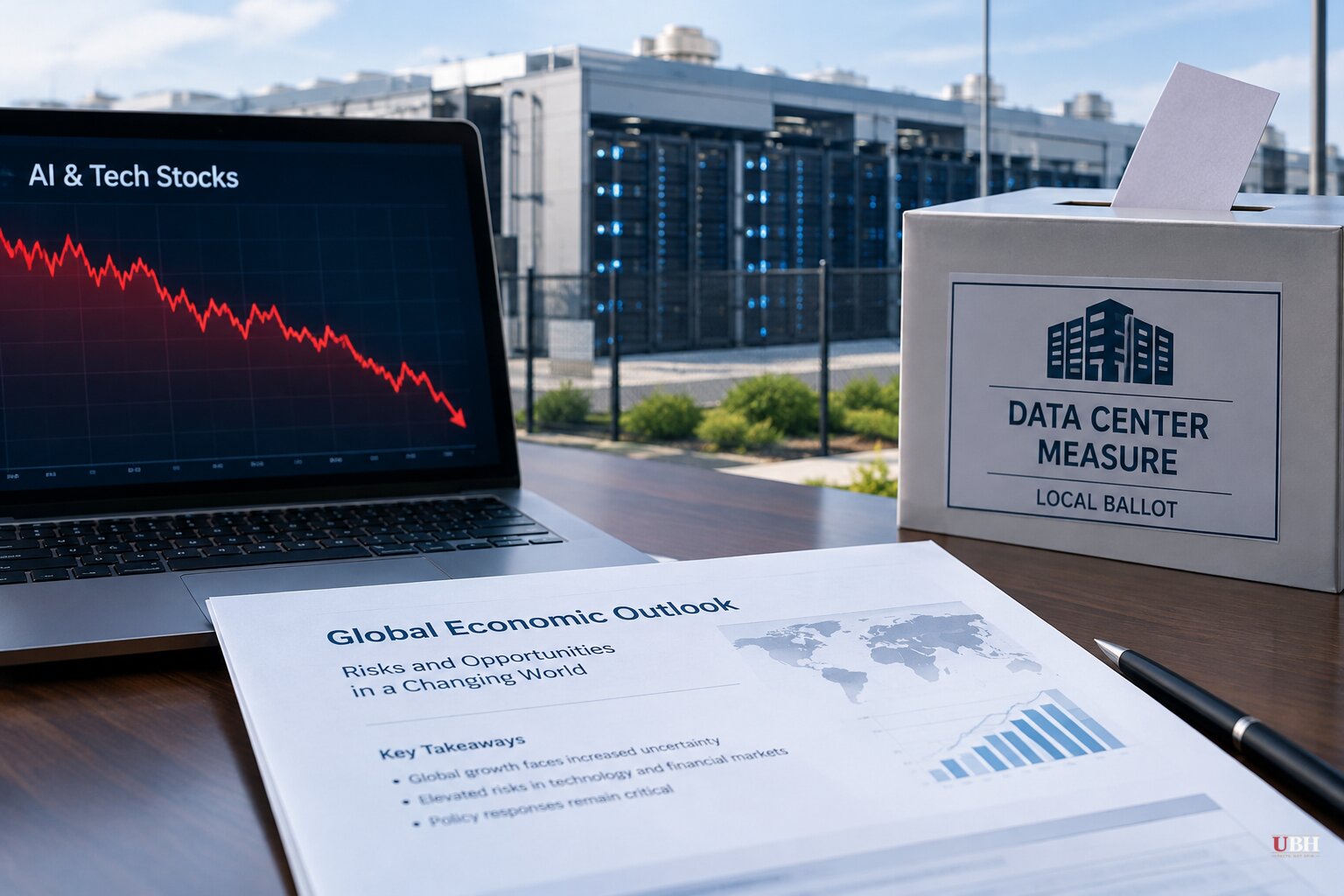
Since Microsoft's $25 billion debt issue and Oracle's filing to sell $10 billion in stock and $10 billion in bonds, the cost of the AI buildout has drawn a formal warning from Bank of America's economists.
"A sustained correction in the AI trade is a major risk to the global economy," BofA Global Research wrote Monday, Nov. 2. "Investors are increasingly concerned about the sustainability of the AI trade, and the more capex rises, the more risks loom."
The economists said a slowdown would hit growth directly through lower spending, and indirectly through the wealth effect, when falling stock prices make households spend less. They also tie some of the rise in interest rates to the borrowing needed to pay for the buildout.
The numbers behind the warning
AI stocks lost about $5 trillion in market value over a three-week stretch, according to Yahoo Finance. The Nasdaq 100 ended Friday about 9% below its Oct. 6 record before rebounding early Monday.
Investment in computers, information-processing equipment and software added more than 1 percentage point to third-quarter GDP growth of 3.4%, per Yahoo Finance calculations from Bureau of Economic Analysis data. That is about a third of the total.
BofA's economists do see a cushion. Without AI-related spending, the economy grew more than 2% last quarter, up from about 1% at the start of the year.
Households are heavily exposed. Stocks made up a record 48% of Americans' financial assets in the second quarter, according to Federal Reserve data going back to 1945. That tops the 39% peak of the dot-com bubble. The richest 10% of households own 88% of stocks.
Hedge funds are underweight the broader AI trade for the first time since early 2023, according to Morgan Stanley's prime brokerage data.
The spending has not slowed. Data-center construction hit a preliminary record annual rate of $84.95 billion in August, up 73% from a year earlier, the Census Bureau reported. Goldman Sachs strategist Ben Snider says the biggest tech companies are on track to spend roughly $800 billion on capex this year, up 96%, and that analysts expect $1.2 trillion next year.
Since earnings season began, the S&P 500 has fallen 3% while the index excluding AI stocks has risen 5%, Snider wrote.
The bills keep landing in the bond market. On Monday, Oracle launched its $10 billion bond sale alongside the $10 billion stock offering, and Alphabet began its second euro bond sale of the year.
Data centers on the ballot
On Tuesday, Nov. 3, voters will decide 41 local data-center measures in 10 states, according to Ballotpedia data cited by Axios. They range from new requirements for developers to outright construction bans. All six measures already decided this year, in New Hampshire, Wisconsin, Michigan and California, went against development.
The issue has reached statewide races. In Texas, Gov. Greg Abbott halted new data-center approvals pending an audit after backlash in rural communities. His Democratic challenger, Gina Hinojosa, supports a moratorium.
In Ohio, which has 21 of the 41 measures, former Democratic Sen. Sherrod Brown has spent millions on ads attacking Sen. Jon Husted over his past support for data-center tax incentives. Husted introduced the Ratepayer Protection Act, which passed the House with large bipartisan support but fell short in the Senate. Senate Democrats argued it does not go far enough because it lets states decide whether to mandate the standards.
A statewide Ohio initiative to restrict larger data centers did not make the 2026 ballot but could appear in 2027.
The industry's case and the polling
Data-center advocates point to economic value and the strategic stakes of the AI race with China. Goldman estimates data-center construction has added about 315,000 jobs since 2022 relative to broader construction trends.
Steve Everley of FTI Consulting, which works with the data-center industry, acknowledged the opposition. "The community concerns and the pushback and the questions—it's all real," he told The Epoch Times.
A recent Pew Research Center poll found most Americans believe data centers are generally detrimental to the environment and to home energy costs. Other surveys put the issue lower on voters' priority lists.
Goldman's Alec Phillips takes that view. In a Nov. 1 preview he wrote that data centers "emerged as a theme in some campaigns this year," but he expects the focus to "fade somewhat" once governors stop campaigning. Congress might limit tax breaks for data centers, he wrote, but a national moratorium looks unlikely under any outcome.
Phillips also wrote that polling shows national sentiment has swung about 10 to 11 points toward Democrats, and that prediction markets imply a House win with around 236 seats. The Senate is a closer call.
What comes next
J.P. Morgan Asset Management's David Kelly told Fortune he expects the squeeze data centers put on construction workers and materials to intensify in 2027.
Goldman also found that industries with higher AI use show weaker employment growth and higher unemployment. According to Census data cited by Goldman, 24.6% of U.S. companies use AI in at least one business function, and 28.6% plan to within six months.
The open question after Tuesday is whether the local results change where, and at what cost, the next round of buildout gets financed.
Sources used for this briefing
7 links from 6 independent newsrooms (syndicated copies of the same report count once)
These are the sources it draws on, linked so you can verify.


