
Unbiased headlines. Facts, not spin.
Unbiased Headlines is an independently owned news organization. We bring you the facts, not opinions, written fresh from 110+ named sources. Sources linked so you can verify it yourself.
 finance
Major Story (8/10)
Nasdaq-100 Stocks Shed Over $1 Trillion Friday, Days After Microsoft Announced $25 Billion in Debt
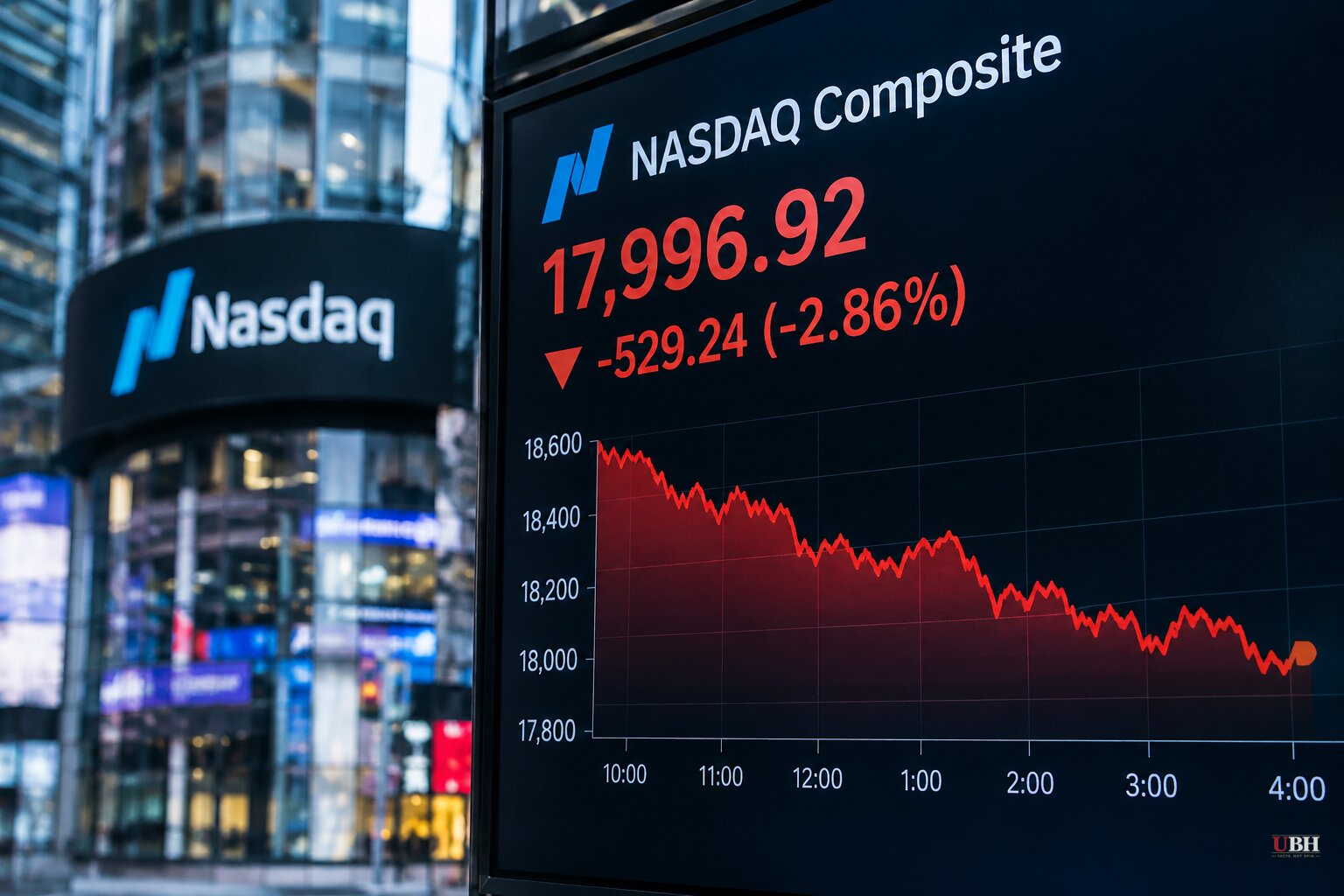
Microsoft's heavy AI spending and its $25 billion debt announcement were followed by a rout in tech shares on Friday, Oct. 30. The Nasdaq Composite fell 2.86% to 25,437, its biggest one-day drop since June 5. The S&P 500 lost 1.82% to 7,580.07, and the Dow dropped 1.09% to 51,770.31.
Based on intraday declines, Nasdaq-100 constituents shed more than $1 trillion in market value in the session. The Nasdaq-100 itself fell 3.4%, and the S&P 500 technology sector dropped 4.2%. The Philadelphia Semiconductor Index tumbled 7.2%, with 29 of its 30 components closing lower.
U.S. markets are closed until the 9:30 a.m. ET open today, Nov. 2. Friday's close is the latest regular-session reading.
What Microsoft actually reported
Microsoft reported fiscal first-quarter revenue of $92.28 billion on Wednesday, Oct. 28, up about 19% and ahead of the $90.69 billion LSEG consensus. Adjusted earnings per share were $4.92, against a $4.73 consensus. Azure grew 48% to $33.17 billion, above management's own guidance of roughly 45%.
The spending number depends on how it is counted. Capital expenditures on property and equipment were $39.4 billion, nearly double the $19.4 billion from a year earlier. Including finance leases, the total was $45.2 billion. That was below the $50.7 billion average analyst estimate compiled by StreetAccount and below Microsoft's own projection of about $50 billion.
Microsoft's earnings deck blamed timing differences between receipt of goods and payment, plus a lower mix of finance leases. The company has said it expects capital spending to rise further in its fiscal second quarter.
The $25 billion debt issue was announced Oct. 29.
Intel and Amazon lit the fuse on Friday
The immediate triggers on Friday were results released after Thursday's close by Intel and Amazon. Intel fell 28.58%, its worst one-day drop since July 1974, erasing more than $140 billion in market value. Its fourth-quarter revenue guidance came in more than $1 billion below expectations. The company also said it does not expect positive free cash flow this year.
Intel CFO David Zinsner said the PC market slowdown should last at least through the first half of next year. Bank of America cut Intel to "neutral" from "buy" and lowered its price target to $100 from $145. D.A. Davidson also downgraded the stock to "neutral."
AMD fell 10.88%, Qualcomm 11.12%, Arm 9.97%, Broadcom 5.48% and Micron 5.30%.
Amazon's trailing 12-month free cash flow was a net outflow of $42.4 billion. Alphabet's Class A shares had already closed 12.6% lower on Thursday, Oct. 29, their largest one-day fall since the stock began trading in 2004. Alphabet reported slower search-revenue growth, and Amazon reported slower advertising growth and a retail miss. Both forecast higher AI capital spending in 2027.
Cash flow is the new scoreboard
Truist chief market strategist Keith Lerner said investors now want evidence that AI spending will produce sustainable earnings and free cash flow. Strong demand alone no longer justifies the valuations, he said.
Google reported negative free cash flow in the third quarter, and Amazon followed with its own negative reading. Meta had already reported negative free cash flow for the first time since 2012. None of the three signaled a slowdown in AI investment.
Lerner pointed to history. Of the six tech pullbacks of at least 10% since 2023, including the current one, four reached losses of 14% to 27%. He did not say another 27% drop is coming.
The opposing view comes from Dan Ives of Yorkville. He argues that the evidence of enterprise AI adoption has strengthened even as shares fell, and he reads the hyperscalers' spending commitments as validation of demand, not exhaustion of the cycle.
The companies have their own logic. Falling behind in AI could threaten the franchises that generate their profits, and pulling back could leave rivals better placed to capture demand.
The financing squeeze reaches smaller players
Heavier spending and weaker cash flow leave less room for buybacks and dividends. That pushes companies toward bond markets, which is the route Microsoft just took.
The pressure is visible lower down the AI supply chain. CoreWeave and Nebius each fell almost 5% in after-hours trading Wednesday after Microsoft's spending figure, and IREN dropped about 3%. Microsoft has a nearly $20 billion compute deal with Nebius running through the 2030s and is a top CoreWeave customer.
Elon Musk posted on X that "debt markets have almost entirely shut off access to money for any company that doesn't have substantial revenue independent of AI data centers." Gartner separately predicted that by 2030, 80% of neocloud companies will be absorbed or cease operations.
Microsoft has said spending will keep climbing into its fiscal second quarter, and the $25 billion in new debt is now on its books. Alphabet, Amazon and Meta have each signaled bigger 2027 budgets. Investors will now decide whether Friday was a one-day reset or the start of a deeper pullback.
Sources used for this briefing
7 links from 7 independent newsrooms (syndicated copies of the same report count once)
These are the sources it draws on, linked so you can verify.


