
Unbiased headlines. Facts, not spin.
Unbiased Headlines is an independently owned news organization. We bring you the facts, not opinions, written fresh from 110+ named sources. Sources linked so you can verify it yourself.
 finance
Major Story (7/10)
Event date: October 3, 2026 ·
Foreign Investors Sold a Record $31.78 Billion of Taiwan Stocks in October as AI Shares Slid
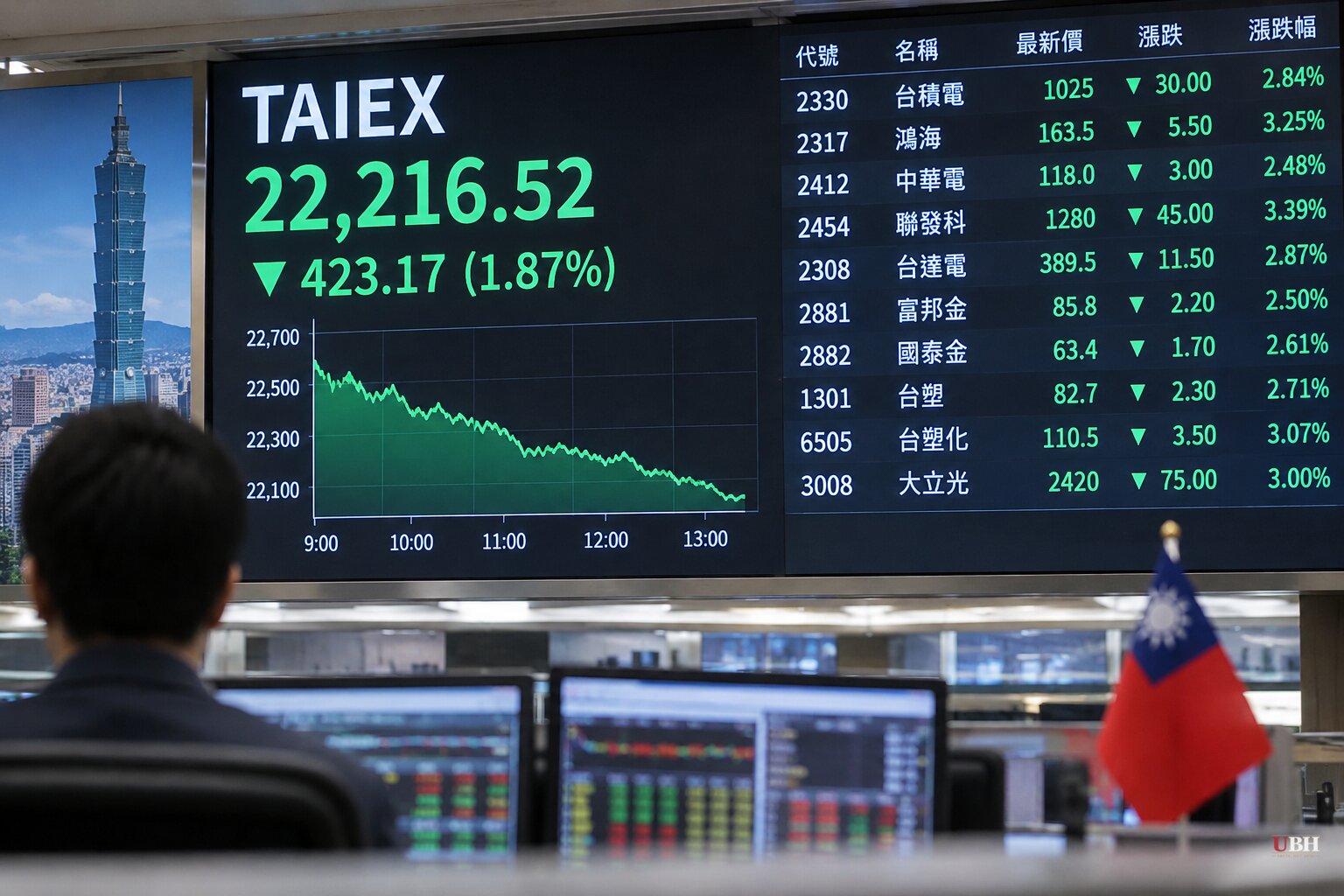
Foreign investors pulled a record amount of money out of Taiwan's stock market last month.
Overseas funds sold $31.78 billion of Taiwanese shares on a net basis in October, according to data compiled by Bloomberg. That beats the previous all-time high set in March. The selling pushed Taiwan's benchmark Taiex closer to a technical correction, which is a drop of 10% from a recent peak.
Friday's rout
The worst of it landed on Friday, Oct. 30. The Taiex fell 1,156.5 points, or 2.49%, to close at 45,211.83. At the low it was down more than 1,600 points, roughly 3.5%, and briefly sat more than 10% below its Oct. 6 record.
The close broke below key technical support of about 45,300 points, which coincides with the index's 120-day moving average, according to the Taipei Times. Another account put the index below its six-month moving average of 45,314 points. Either way, the benchmark is technically more vulnerable. It held above 45,000, barely.
TSMC, the index's heavyweight, fell 1.8% in Taipei. MediaTek lost 3.2%. Power-equipment maker Delta Electronics dropped 9.8%. TSMC and Delta were the biggest drags on the index.
Wall Street set the tone
The trigger came from the U.S. Concerns about returns on AI spending intensified after Google and Amazon released earnings, according to a Central News Agency account of the session.
On Wall Street Friday, the Nasdaq Composite fell 2.86% and the S&P 500 dropped 1.8%, breaching its 100-day moving average. The Philadelphia Semiconductor Index plunged 7.20%. Intel and Reddit each fell 29%, and Sandisk dropped 13%. It was the worst day for U.S. stocks since June.
TSMC's U.S.-traded depositary receipts fell 5.95%.
Tony Huang, chief strategy officer at Taishin Securities Investment Advisory, said sentiment remains clouded by fears that major cloud providers may struggle to generate comfortable sales from their huge AI infrastructure outlays. Huang said Taiwan is unlikely to be spared, especially with large-cap electronics names like TSMC being targeted.
Other worries cited by investors: higher borrowing costs, heavy AI capital spending and disappointing earnings.
The case that the damage is overdone
Not everyone reads the selloff as a verdict on Taiwan. Vey-Sern Ling, managing director at Union Bancaire Privee, said the pressure reflects sentiment toward global AI stocks more than any deterioration in Taiwan's fundamentals. He pointed to the cloud providers' continued spending plans and better company-level visibility.
The numbers from Taiwanese companies back some of that up. Cumulative revenue at listed and over-the-counter companies reached about NT$49.89 trillion through September, up 38.21% from a year earlier. MediaTek guided fourth-quarter revenue to NT$210.1 billion to NT$221.8 billion, up 25% to 32% from the prior quarter. It confirmed a second cloud ASIC customer, with revenue expected to start in 2028, and kept its $16 billion target for 2027 ASIC revenue.
Delta forecast that major cloud providers' combined capital spending would hit $1.2 trillion to $1.5 trillion next year. It also said power shortages would worsen and that it is discussing price increases with customers, with a decision possible as early as the fourth quarter or the first quarter of next year.
Huang also noted the Taiex held up better than the Philadelphia Semiconductor Index and South Korea's market, where memory makers Samsung and SK Hynix carry heavy weight. Meta, Alphabet, Amazon and Microsoft have all maintained commitments to substantial AI spending.
The regulator's tone was calm. Taiwan's Financial Supervisory Commission told the Taiwan Stock Exchange and Taipei Exchange to monitor international markets closely. It said Friday's decline stayed within the range of volatility seen in major Asian markets and urged investors to assess conditions rationally.
Valuation is the pressure point
The selloff is hitting an index that was priced richly. The price-to-earnings ratio of listed companies stood at about 26.68 at the end of September. That is a hefty multiple, and it leaves little room if AI spending slows or the payoff looks thinner than hoped.
Taiwan's economy leans hard on technology exports and the AI supply chain. That drives growth, but it also ties the stock market to the mood of global investors toward AI capital spending.
What comes next
Taiex futures fell 867 points, or 1.91%, to 44,433 on Friday, and TSMC futures lost 3.66%. Taishin's Huang expects heavy downward pressure when Taiwan trades Monday, Nov. 2. Analysts said investors would be watching whether the Taiex holds above Friday's intraday low of 44,726 points or records further losses.
Whether the next round of U.S. tech earnings and AI investment plans calms the market or deepens the doubt remains open. A record $31.78 billion in October outflows shows how many foreign investors already made up their minds.
Sources used for this briefing
7 links from 7 independent newsrooms (syndicated copies of the same report count once)
These are the sources it draws on, linked so you can verify.


