
Unbiased headlines. Facts, not spin.
Unbiased Headlines is an independently owned news organization. We bring you the facts, not opinions, written fresh from 110+ named sources. Sources linked so you can verify it yourself.
 finance
Major Story (7/10)
Event date: October 23, 2026 ·
Nasdaq Falls 2.86% in Worst Day Since June as Intel Plunges 29% and AI Financing Worries Spread
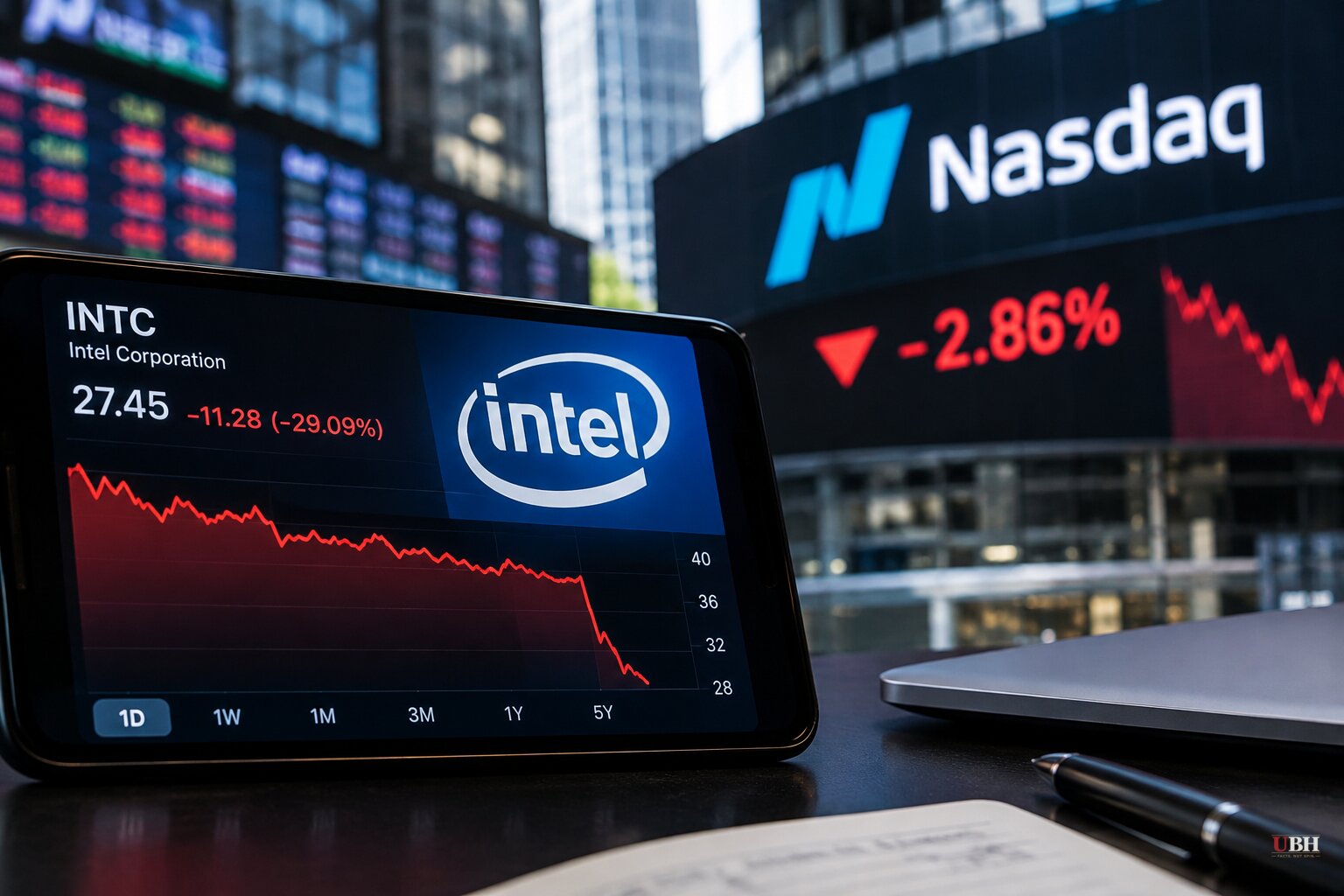
The AI trade took another hit on Friday, Oct. 30. The Nasdaq Composite fell 747.72 points, or 2.86%, to close at 25,436.99. It was the index's worst day since June and left it roughly 8% below its recent record high.
The S&P 500 dropped 1.8%. The Dow Jones Industrial Average lost 572 points, or 1.1%.
Intel leads the damage
Intel shares plunged 29% after the chipmaker gave a weaker-than-expected outlook for the current quarter and pointed to a slowdown in the PC market. Revenue in its client computing and physical AI group fell 5% from a year earlier to $8.1 billion.
Advanced Micro Devices fell 11%. Broadcom lost 5% and Nvidia 4%. Sandisk dropped 13% even though its quarterly results beat expectations.
Amazon slipped more than 1% after third-quarter earnings and revenue came in below Wall Street expectations. The company reported negative free cash flow of $42.4 billion and kept its 2026 capital spending forecast at $220 billion.
The financing question
The Financial Times reported, citing unnamed sources, that Blackstone has warned investors Anthropic may not get an investment-grade credit rating after its planned IPO, and that its debt could land in high-yield territory instead. It is a single-source claim and should be treated that way.
Other AI infrastructure names have been hit hard this month. CoreWeave shares are down more than 37% in October, and Nebius was heading for a monthly decline of about 33%. The Roundhill Memory ETF fell around 20% in October and the iShares AI Innovation and Tech Active ETF about 17%.
Nvidia CEO Jensen Huang flagged the pressure in a CNBC interview aired Oct. 22. "The demand of the capital is much greater than the availability of the capital," Huang said. "That's going to get solved."
Amazon and SpaceX are among the tech companies issuing billions in bonds to fund the buildout, and they compete with each other and with the federal government for the same pool of money. Russell Thompson, chief investment officer at Hilbert Group, said companies in that position may have to offer investors higher returns.
GMO's Ben Inker and John Pease have argued that demand for fresh capital to support AI investment could outstrip supply.
Yields: from a 2002 high to just under 5%
The bond market has been moving fast too. The 10-year Treasury yield hit 5.36% on Oct. 7, its highest since April 2002.
On Oct. 22, as tech stocks sold off, the yield fell about 18 basis points to 4.97%, the first close below 5% since Sept. 22. The 30-year yield dropped 12 basis points to 5.29%. The 2-year fell to a five-week low of 4.64%. The Nasdaq lost 2.4% that day.
Thompson described it as "a rotation of capital and a flight to quality." Treasury Secretary Scott Bessent had announced a more aggressive buyback program in August, a tool the government often uses on long-dated debt to push yields lower.
On Oct. 23, the 10-year was trying to stay beneath the pivotal 5% level. Manufacturing activity hit a 53-month high, with the S&P Global flash PMI at 56 against a 55.5 median estimate. University of Michigan consumer sentiment for October was revised to 48 from 46.3. Oil also reached a five-week high as Washington and Tehran intensified threats toward each other.
The disagreement over what the bond move means
Not everyone reads the yield drop as a warning. The Breitbart Business Digest argued that most of the earlier rise came from higher real yields, which it attributed to a strong economy, and that a 10-year still near 5% is "hardly a sign" bond investors expect a downturn. It said the AI scare centered on overextended pockets of the sector.
Credit specialists see a more mixed picture. Matt Miskin, co-chief investment strategist at Manulife John Hancock Investments, said in an interview on Monday, Oct. 20, that spreads on CCC-rated junk bonds had widened sharply while the rest of the credit market stayed calm. He called it the only time in the past 30 years he has seen that pattern.
"CCC spreads have widened like this in every major liquidity event that we've had in the last 30 years," Miskin said, citing the 2000 dot-com bubble and 2008. The CCC segment is signaling "things are starting to get bad," he said, while "the rest of the market is saying there is nothing wrong at all."
The sources do not agree on what Friday's selling was about. One account tied it to profit-taking ahead of month-end and next week's U.S. midterm elections, alongside the AI earnings and spending worries.
What comes next
The open question is the one Miskin posed: whether the broader credit market is right to look calm, or whether the stress in the weakest borrowers is an early signal of tighter capital for the AI buildout. Anthropic's IPO and its eventual credit rating are the next concrete test.
On the Federal Reserve, one account reported that fed funds futures were pricing a 90% chance that the Fed keeps rates unchanged at its next meeting and a 78% chance of a hike in December.
Sources used for this briefing
6 links from 6 independent newsrooms (syndicated copies of the same report count once)
These are the sources it draws on, linked so you can verify.


