
Unbiased headlines. Facts, not spin.
Unbiased Headlines is an independently owned news organization. We bring you the facts, not opinions, written fresh from 110+ named sources. Sources linked so you can verify it yourself.
 finance
Major Story (7/10)
Event date: October 27, 2026 ·
Nasdaq Falls 2% on the Week as Alphabet and Intel Slide Days Before Midterms
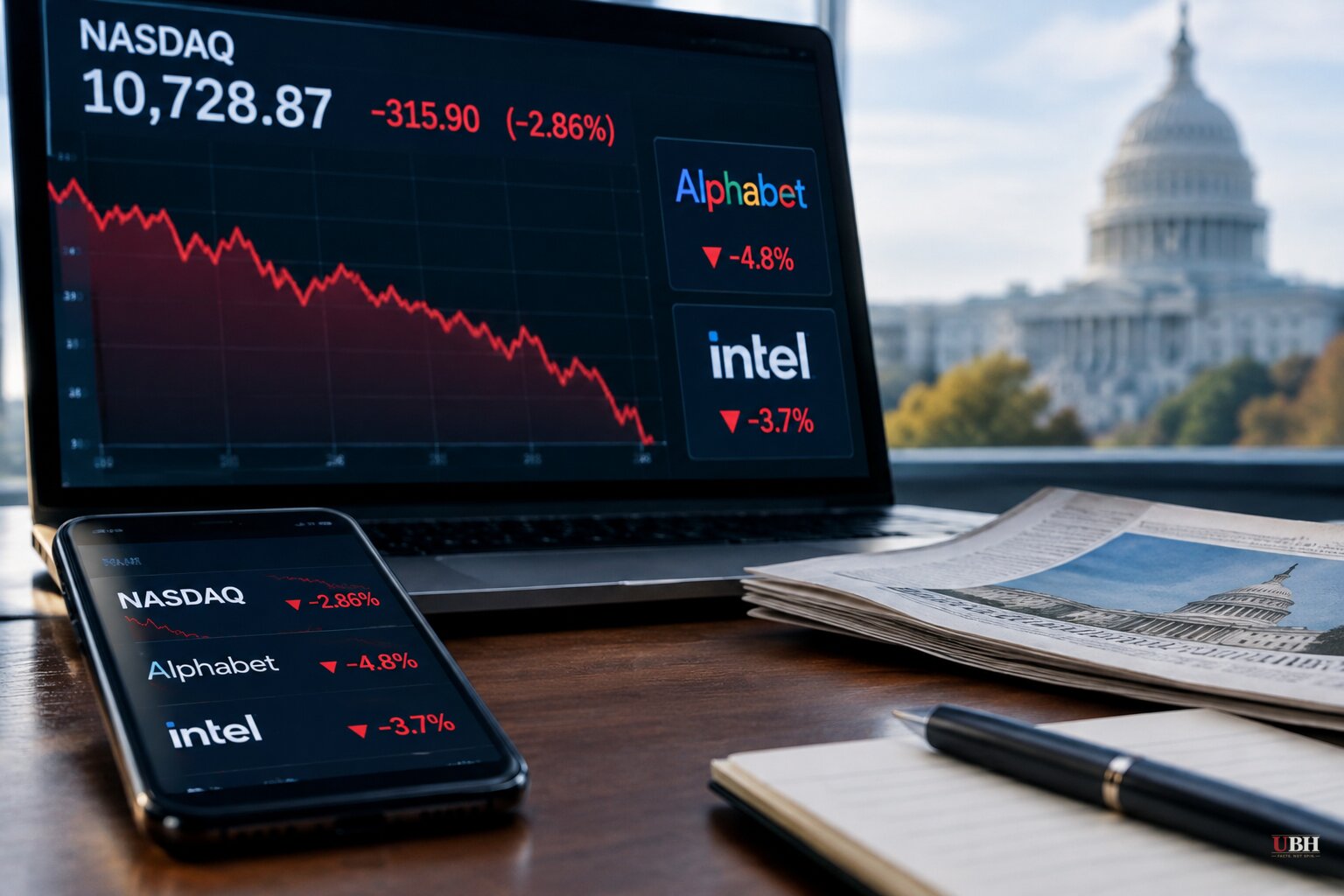
The AI trade took a hit this week, and the Nov. 3 midterms are now two days away.
The Nasdaq Composite fell 2% for the week, the weakest of the major U.S. indexes. The Dow Jones Industrial Average slipped 0.85% to 51,770. The S&P 500 lost 0.57% to 7,580. The Russell 2000 small-cap index rose 1.29%.
Friday, Oct. 30, was the ugly day. The Nasdaq fell nearly 4% at one point before closing down 2.86%. The S&P 500 ended down 1.82%, the Dow lost 1.09% and the Russell 2000 dropped 1.66%. The CBOE Volatility Index briefly topped 23 and finished the week at 19.42.
Alphabet, Amazon and Intel
Alphabet closed down 12.29% on Thursday after ad revenue came in light, raising questions about the cost of its AI spending.
Amazon fell more than 7% in early Friday trading after missing revenue and earnings estimates and reporting negative free cash flow tied to AI spending. It recovered most of that and closed down 1.41%.
Intel plunged more than 28%, its worst single-day decline in decades. It beat estimates but gave fourth-quarter guidance that disappointed, tied to sluggish PC sales growth. The iShares Semiconductor ETF dropped 8.24%.
Microsoft's Azure cloud business beat expectations, yet the stock still ended Thursday slightly lower.
Richard Saperstein, chief investment officer at Treasury Partners, told The Epoch Times the question is whether this spending can be funded from cash flow or will require new equity and debt issuance.
Bonds are telling a mixed story
Treasury yields climbed sharply for two months starting in August, then pulled back. Breitbart Business Digest put the 10-year yield at 5.36% on Oct. 7, the highest since April 2002. It said the yield fell about 19 basis points intraday on a Thursday, the biggest one-day drop in three years.
Breitbart's reading is that this is no cause for alarm. It argues the earlier rise in yields reflected a strong economy, noting record-low layoffs, and that 10-year yields near 5% are hardly a sign bond investors see a downturn coming.
Reuters analysis quotes portfolio managers who see more behind the move. Christian Hoffmann, head of fixed income at Thornburg Investment Management, said money has moved out of some AI-related trades and into bonds in what looks like a flight to quality. "I don't think the Fed is entirely in the driver's seat in today's market," he said.
The benchmark 10-year yield is still up 84 basis points this year, on track for its largest annual increase since 2022. The 30-year is up nearly 50 basis points.
Inflation is the other drag. Consumer and producer prices rose in August and September, with energy as a main driver. Breitbart reported oil prices near their highest since the Iran War began. Jack Herr, senior investment analyst at GuideStone Funds, said inflation "has clearly re-accelerated" and that "the Fed will probably hike again this year." Reuters reported investors expected the Fed to hold at its late-October meeting and raise rates again in December.
Midterms: Democrats hold the enthusiasm edge
A CNN/SSRS survey found 61% of Democratic-leaning registered voters are extremely motivated to vote, up from 34% four years ago. Republican enthusiasm has barely moved.
Republicans are saying so publicly. Florida Gov. Ron DeSantis described turnout in his state as underwhelming: "Republicans have some work to do." Georgia GOP governor nominee Rick Jackson has voiced concern that rural voters have grown complacent. An unnamed Republican National Committee official told CNN that selling Trump's record amid economic worries is a harder task than the Democratic message.
Democrats have their own problems. In Michigan, Senate nominee Abdul El-Sayed's campaign told former primary rival Rep. Haley Stevens to stay away from his events, according to a source who confirmed the move to Fox News. Stevens has sharply criticized his views on Israel. The dispute puts a planned Sunday appearance with Rep. Jim Clyburn in doubt. El-Sayed faces Republican Mike Rogers on Tuesday.
President Trump rallied in Daytona Beach on Friday with Florida gubernatorial nominee Byron Donalds and Sen. Ashley Moody. He also pressed Attorney General Todd Blanche from the stage over Alaska's "Decoy Dan" controversy. Trump alleged Democrats recruited a candidate with a name nearly identical to Republican Sen. Dan Sullivan and said Democratic nominee Mary Peltola "should be removed from the ballot and prosecuted." Peltola has denied involvement.
What Tuesday means for markets
BNY's midterm outlook says the latest polls point to divided government, with Democrats taking at least one chamber. It describes a split Congress with Republicans holding the Senate as likely positive for markets because it limits change, though shutdown risks would persist. A Republican sweep would likely be read first as supportive for risk assets, BNY says, but could add the most pressure on bond markets through more fiscal supply. A Democratic Congress would bring tougher scrutiny of any Iran-conflict spending.
BNY also calls this the first election shaped by an AI backlash. It expects Trump's opposition to limit federal regulation, which puts state-level action in focus. Texas, Georgia, Ohio and Pennsylvania are the states to watch, where utility commissions and legislatures will shape data-center approvals, grid costs and tax incentives.
Polls close Tuesday, Nov. 3. Whatever the result, the next test is the December Fed meeting, where investors expect another rate increase.
Sources used for this briefing
6 links from 6 independent newsrooms (syndicated copies of the same report count once)
These are the sources it draws on, linked so you can verify.


