
Unbiased headlines. Facts, not spin.
Unbiased Headlines is an independently owned news organization. We bring you the facts, not opinions, written fresh from 110+ named sources. Sources linked so you can verify it yourself.
 finance
Major Story (7/10)
Event date: October 27, 2026 ·
CFTC Chair Selig Vows Supreme Court Fight Over Prediction Markets as Utah Fight Escalates
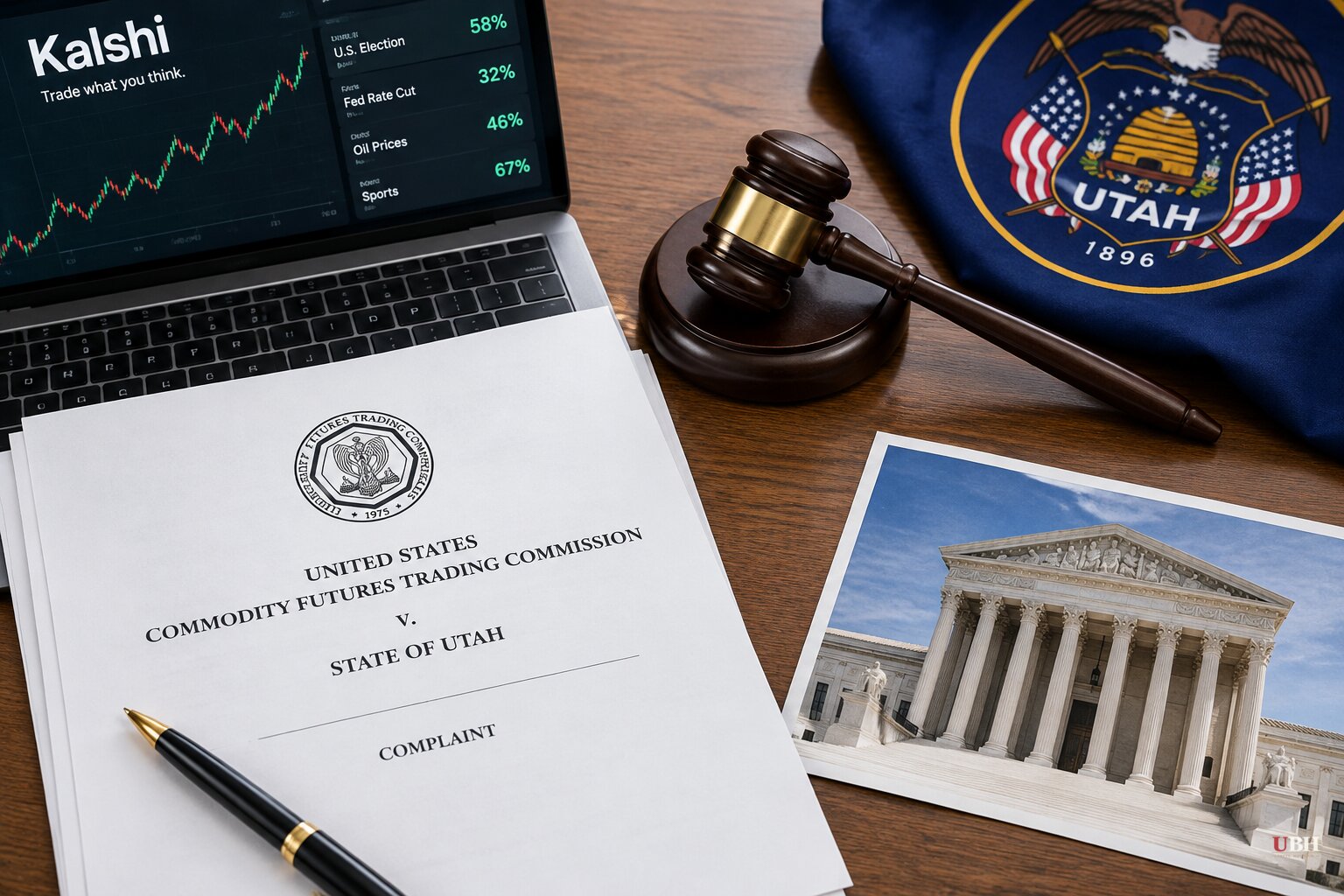
Michael Selig, the chair of the Commodity Futures Trading Commission, said Friday, Oct. 30, that his agency will not stop at the appeals courts in its fight with the states over prediction markets.
"We're prepared to fight these challenges all the way up to the Supreme Court," Selig said.
The remark follows the CFTC's lawsuit against Utah, announced Oct. 27, which targets the state's enforcement campaign against Kalshi. Selig has called Utah's prosecution of the company "blatant overreach."
A 10-state campaign
The Utah case is the CFTC's 10th lawsuit against a state over prediction markets. It is also the first against a state with a Republican governor. Other defendants include Arizona, Connecticut and Illinois. The first suits were filed in April 2026.
The agency has also filed amicus briefs in four federal appeals courts and one state supreme court.
The CFTC's argument rests on the Commodity Exchange Act. Selig says the law gives the agency exclusive jurisdiction over swaps and futures traded on designated contract markets, the exchanges it registers and supervises. The agency says federal law overrides conflicting state rules aimed at those venues.
"Congress entrusted the CFTC to be the federal regulator with sole responsibility to oversee these markets," Selig said in his Oct. 27 statement on the Utah suit. He said the agency has "the expertise and responsibility to defend its exclusive jurisdiction over commodity derivatives."
What Utah wants
Utah's action against Kalshi seeks up to $60 million in allegedly illegal profits. That figure is a demand, not an awarded judgment or a fine. Attorney General Derek Brown, a Republican, has accused Kalshi of running an online casino and says offering gambling to Utah residents violates state law.
Kalshi rejects the charge. Spokesperson Jacki McGavick said the company, as a federally regulated financial exchange, "answers to federal law, and no single state should have a veto over it."
Gov. Spencer Cox, also a Republican, said earlier this year at a POLITICO event that the idea of the CFTC being in charge of regulating these platforms is "a joke." Brown's office said it had no comment on the CFTC suit because the matter is ongoing.
The states' core position is simple. Officials say prediction markets are gambling platforms and belong under state oversight. Former CFTC Chair Gary Gensler and former Sen. Chris Dodd have made the legal version of that case in Supreme Court briefs. They argue the Dodd-Frank Act did not hand the CFTC authority over sports betting that previously belonged to the states.
Courts have not lined up
The early rulings point in different directions. Preliminary injunctions favoring the CFTC were granted in initial rulings in the Arizona and Illinois cases. A federal district judge has also sided with Utah in earlier litigation involving Kalshi, giving the state a courtroom win to defend.
Federal appellate decisions have gone both for the states and for Kalshi. Neither side has a uniform outcome.
New Jersey has asked the Supreme Court to take up its dispute with Kalshi. As of Oct. 27 the justices were still weighing that petition. The Court has not announced whether it will hear the case.
The platforms caught up in the litigation include Kalshi, Polymarket and Crypto.com/Nadex.
If the justices pass
Linda Goldstein, a partner at CM Law, has examined what happens if the Supreme Court declines to hear the pending Kalshi cases and leaves competing appeals court rulings standing. She says the CFTC could adjust its litigation and rulemaking strategy. Prediction market operators, she says, might put more resources into lobbying Congress for a national framework.
The central question, in her framing, is whether sports event contracts are financial instruments under federal commodities law or gambling products under state law. Without a definitive ruling from the Court or Congress, she says, operators face continued uncertainty.
The election money
The fight is not limited to sports. A Council on Foreign Relations report released in October says Americans have staked more than $1.4 billion on prediction markets tied to the 2026 midterms. It expects that figure to exceed $2 billion by election day.
The report says election markets will operate at scale with the Trump administration's support until the courts decide. It also notes opposition from Democratic Party leaders, state governments and much of the electorate.
The CFR authors argue that existing rules invite fraud and insider trading. They want Congress and the CFTC to define insider trading standards for election markets, require disclosure of large positions, and study the effect on retail traders. They also call for adequate CFTC funding.
The immediate question is procedural. A federal court in Utah must decide whether to halt the state's enforcement, and the Supreme Court has yet to act on New Jersey's petition. Selig's pledge signals the CFTC will keep litigating through multiple rounds rather than accept a patchwork of state rules.
Sources used for this briefing
7 links from 7 independent newsrooms (syndicated copies of the same report count once)
These are the sources it draws on, linked so you can verify.


