
Unbiased headlines. Facts, not spin.
Unbiased Headlines is an independently owned news organization. We bring you the facts, not opinions, written fresh from 110+ named sources. Sources linked so you can verify it yourself.
 finance
Major Story (8/10)
Nasdaq-100 Closes in Correction as Intel Falls 29% and Amazon Capex Tops $77 Billion
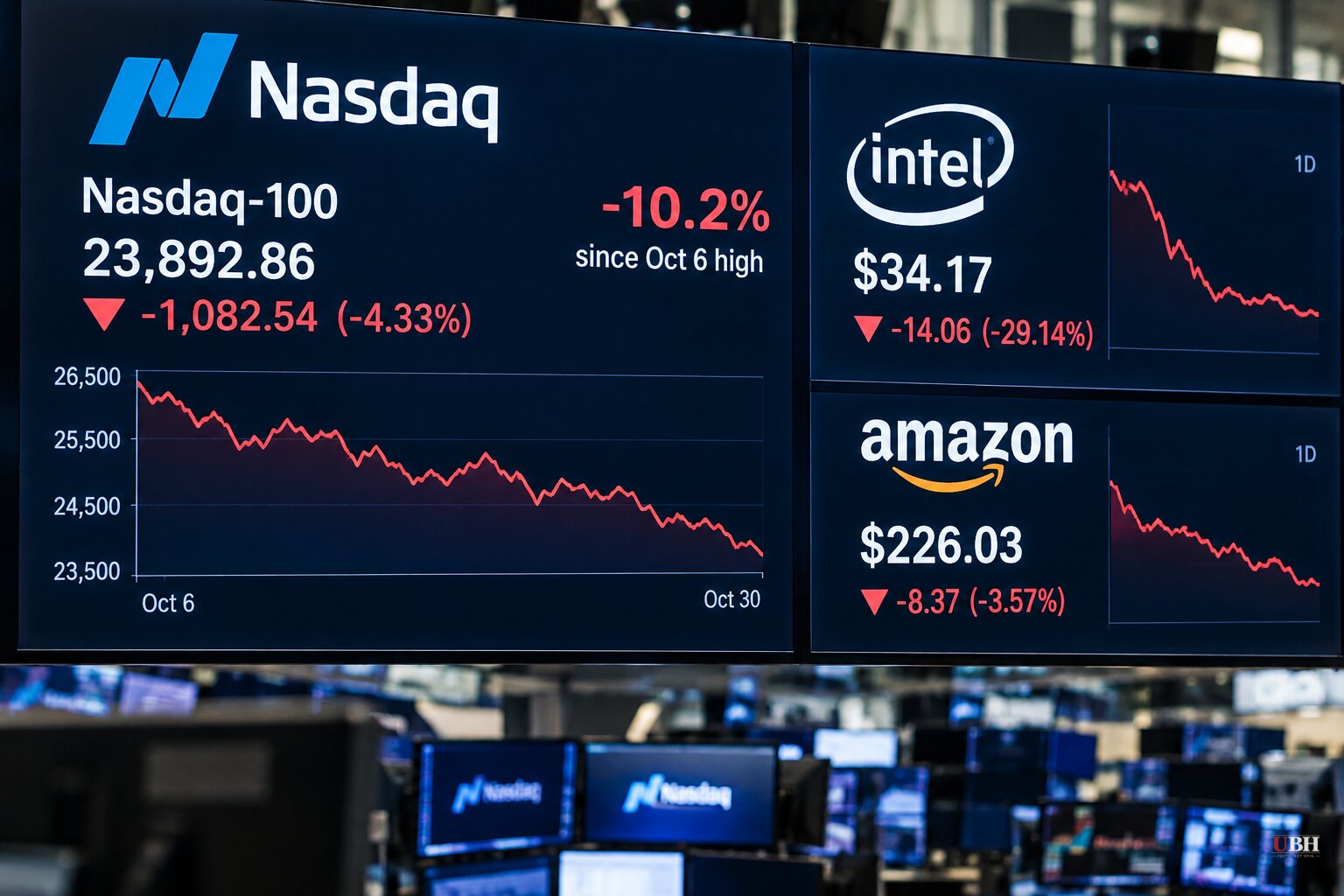
Since Alphabet's record one-day drop on Thursday, Oct. 29, the damage has spread from one stock to the whole AI trade. The Nasdaq-100 finished Friday in correction territory, a drop of 10% or more from its Oct. 6 record high. The Nasdaq Composite logged its worst day since June 5 and its worst month since March 2025, according to MarketWatch's close-of-day tally.
The index was already down 4.45% for October before Friday's session. Through Thursday it was lagging the equal-weighted S&P 500 by the widest margin since 2001. About 400 S&P 500 names rose Thursday while the megacaps sank.
Intel's forecast does the damage
Intel shares fell 29% Friday, their worst single-day performance since at least 1980. The stock had more than doubled this year on hopes of a turnaround.
The quarter itself was fine. Third-quarter revenue rose 21% to $16.51 billion, and adjusted earnings came in at 52 cents a share, ahead of estimates. Data center and AI revenue jumped 78% to $7.3 billion. PC chip sales fell 5% to $8.1 billion.
The guidance was the problem. Intel forecast fourth-quarter revenue of $15 billion to $16 billion against Wall Street expectations of roughly $17 billion. It guided adjusted earnings to 25 cents a share against 43 cents expected. It also projected a gross margin of 38%, down from 43% in the third quarter.
CFO David Zinsner said Intel expects global PC shipments to fall about 12% this year and another 10% in 2027. "We see the PC slowdown continuing at least through the first half of next year," he said.
Intel blames part of that on the AI boom itself. Data center buildouts have driven up memory-chip prices, which Intel says is squeezing PC makers. The company also said it could not make enough server chips to meet demand. CEO Lip-Bu Tan said he was "disappointed that we were not able to meet strong customer demand in this quarter."
A deadly accident at Intel's Israel manufacturing plant earlier this month forced the facility to suspend operations. The company expects that shutdown to cut fourth-quarter revenue by about $300 million.
Amazon's cash burn
Amazon's third-quarter report added to the pressure. Capital spending topped $77 billion for the quarter, well above the $58.7 billion analysts expected and more than double a year earlier. Amazon reported earnings of $1.89 a share on $201.94 billion in revenue, both short of Wall Street estimates.
Free cash flow was negative for the second straight quarter. The trailing 12-month outflow reached $42.4 billion, up from $7.6 billion in the prior quarter. Amazon held its 2026 capital expenditure forecast at $220 billion.
Amazon shares fell 2.4% after Thursday's results, as investors focused on AI spending plans and a sluggish e-commerce unit despite solid cloud growth.
CEO Andy Jassy told analysts the company will "spend meaningfully more in 2027." He said Amazon has a "clear line of sight to attractive financial returns." He added that Amazon Web Services "can grow north of 40 percent in each of 2027 and 2028 and be a trillion-dollar-revenue business in the next five to 10 years."
That is the bull case from the person writing the checks. The market spent Friday declining to pay for it.
Core businesses under scrutiny
Alphabet missed quarterly revenue expectations for the first time since 2024. Its search revenue came in light, which stoked fears that AI is eating into the franchise that funds everything else. Reddit shares had their worst day on record Friday after management warned that declining referral traffic from Google search was squeezing audience growth.
Charlie McElligott, a strategist at Nomura, said the earnings reports exposed incipient weakness in core businesses at a number of tech firms. That raises the question of whether those companies can keep up the pace of spending on chips and data centers.
Matt Maley, chief market strategist at Miller Tabak, called the weakness in core businesses "a new wrinkle in the debate" over whether AI returns will arrive fast enough to justify the spending.
Ken Mahoney, CEO of Mahoney Asset Management, put it more bluntly. "All earnings season, it has been clear we were too far out in front of our skis, and even most beats-and-raises in the tech sector found themselves lower," he said. "If you miss like Intel did, forget it."
The scale of the spending
Ipek Ozkardeskaya, senior analyst at Swissquote Bank, said Alphabet, Amazon, Meta and Microsoft spent more than $200 billion on capital investment in the third quarter. That brings the year-to-date total to more than $500 billion. "The AI race is getting very, very expensive," she said.
With free cash flow under pressure, companies in the buildout are increasingly turning to debt and equity issuance to pay for it, Epoch Times reported in its market coverage.
The correction is a price move, not a verdict on the technology. Demand is not the issue. Intel's AI data center revenue is up 78% and Alphabet's cloud growth ran in triple digits. The open question is whether the companies spending hundreds of billions can show returns before investors stop giving them room. Amazon has already told them 2027 will cost more, and Intel says its PC slump runs at least through the first half of next year.
The next test is the following earnings round.
Sources used for this briefing
7 links from 6 independent newsrooms (syndicated copies of the same report count once)
These are the sources it draws on, linked so you can verify.


