
Unbiased headlines. Facts, not spin.
Unbiased Headlines is an independently owned news organization. We bring you the facts, not opinions, written fresh from 110+ named sources. Sources linked so you can verify it yourself.
 finance
Major Story (7/10)
China's Central Bank and Regulators Set to Meet Banks Monday on Stock Support After Shanghai Index Drops Below 3,600
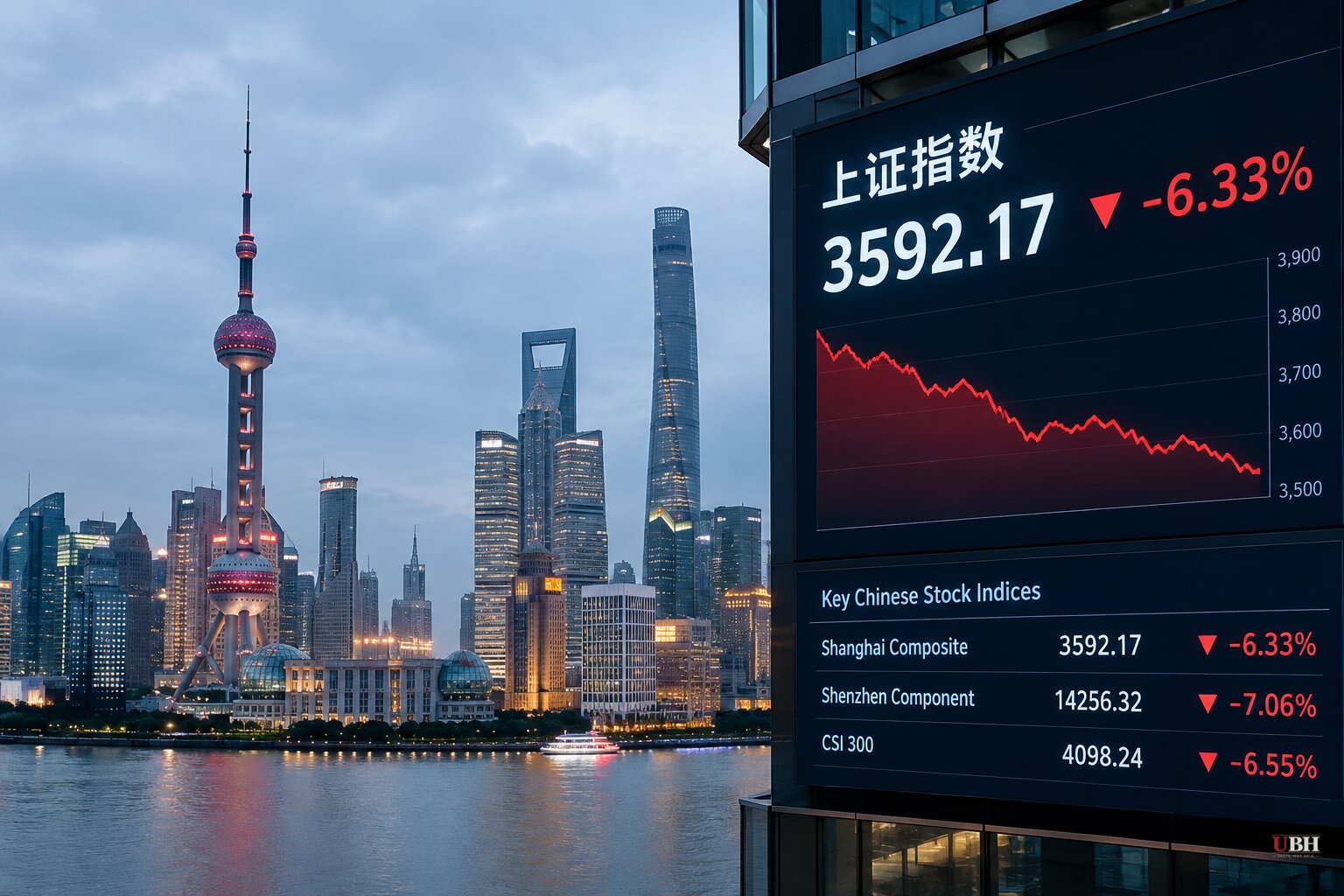
Since China's benchmark indexes peaked in June, the CSI 300 has fallen more than 20%, and Beijing's response so far, about $19 billion poured into exchange-traded funds according to Bloomberg data, has not stopped the slide. Now regulators are preparing a bigger push.
The People's Bank of China, the China Securities Regulatory Commission and the National Financial Regulatory Administration are expected to meet major banks on Monday, Nov. 2, according to Shanghai Securities News, a state-owned paper, citing industry sources. The agenda is to optimize a special re-lending facility that gives listed companies and their major shareholders cheap funds to buy back shares and raise their stakes. Some securities firms and fund managers have received meeting notices, the paper reported.
October's damage
On the final trading day of October, the Shanghai Composite fell 1.44% to 3,599.00. That was the first close below 3,600 this year. For the month, the index lost 6.33%.
Growth and tech names took the worst of it that day. The Shenzhen Component dropped 2.73% to 10,833.78. The ChiNext fell 4.13% to 2,413.63. The STAR 50 sank 4.66% to 1,421.31. More than 4,600 stocks closed lower, and turnover on the two mainland exchanges hit 1.67 trillion yuan.
The STAR 50, which holds China's homegrown AI and chip leaders, is down more than 40% from its June peak. Unitree, the humanoid robot maker that surged 600% in its Shanghai debut in August, has seen its shares cut in half. Memory chipmaker CXMT, which became Shanghai's top-weighted stock three months after listing, is down nearly 30% from its August peak.
Hong Kong is dragging too. The Hang Seng is down more than 12% this year. Analysts in Hong Kong expect more pressure in November and say the index could test 22,800, citing the AI stock sell-off, weak mainland manufacturing data, continued outflows through Southbound Stock Connect and uncertainty ahead of the U.S. midterm elections.
Why the market is falling
Gary Ng, senior economist for Asia Pacific at Natixis, said the sell-off reflects "a repricing of crowded AI trades, weak domestic demand, and the lack of stimulus." He also pointed to Beijing's tighter scrutiny of cross-border investment and offshore tax rules.
Lorraine Tan, director of equity research in Asia at Morningstar, said any measure to lift sentiment "tends to be short-lived if there are no policies to address underlying key issues." She named excess capacity in many sectors and a lack of fiscal spending this year, and called for measures to boost consumption.
The economic data back up the weak-demand story. Retail sales grew just 1.1% in September. Fixed-asset investment fell 7.2% in the first three quarters, and real estate development investment dropped 20.6%. China's Ministry of Finance said land-use rights revenue was 1.61 trillion yuan in the first nine months, down 27.9% from a year earlier. That is a major funding source for local governments.
Beijing's counterpoint is the headline growth number. The National Bureau of Statistics put third-quarter GDP growth at 4.5% and nine-month growth at 4.6%, inside the official target range of 4.5% to 5%. Derek Scissors, senior fellow at the American Enterprise Institute, questioned the credibility of the GDP figures in an Oct. 19 commentary, citing slower M1 money supply growth.
CNN reported that the global AI boom has helped sustain China's economy this year, and that the equity sell-off is unlikely to cause major spillovers into global markets for now.
Who is propping up prices
Li Hengqing, a U.S.-based Chinese economist, told The Epoch Times that state-backed funds appear to be stepping in to support prices. He said that could briefly steady the market but not restore confidence, and that using public money this way could shift risk to taxpayers. He also said the aim is "to protect Xi Jinping's image and the political line he has put forward," a motive Beijing has not stated.
The buyback facility is a different tool. It lends to companies and large shareholders rather than buying shares directly, though both aim to put a floor under prices.
The plenum had other priorities
The Communist Party's fifth plenum ran from Oct. 26 to Oct. 29. It confirmed the expulsion of 33 senior party members, including Zhang Youxia, formerly China's most senior military general, and Liu Jianchao, a senior diplomat once tipped as a future foreign minister. Only 279 of the 376 full and alternate Central Committee members named in 2022 attended.
Joseph Torigian, a professor at American University, said the meeting was Xi "setting up for the next party congress next year by ensuring that everybody is on the same page as him." Neil Thomas of the Asia Society Policy Institute said the focus on party discipline suggests Xi is unlikely to risk force over Taiwan or the South China Sea until he is more comfortable with the party he leads.
The next test comes when mainland markets open Monday, Nov. 2. Traders will find out what changes come out of the regulators' meeting with the banks, and whether any new money comes with them.
The Shanghai Composite is sitting 1 point below the 3,600 mark it just lost.
Sources used for this briefing
5 links from 5 independent newsrooms (syndicated copies of the same report count once)
These are the sources it draws on, linked so you can verify.


