
Unbiased headlines. Facts, not spin.
Unbiased Headlines is an independently owned news organization. We bring you the facts, not opinions, written fresh from 110+ named sources. Sources linked so you can verify it yourself.
 finance
Notable (6/10)
VIX Closed at 19.4 Friday as S&P 500 Fell Nearly 2%, a Smaller Jump Than Past Selloffs Implied
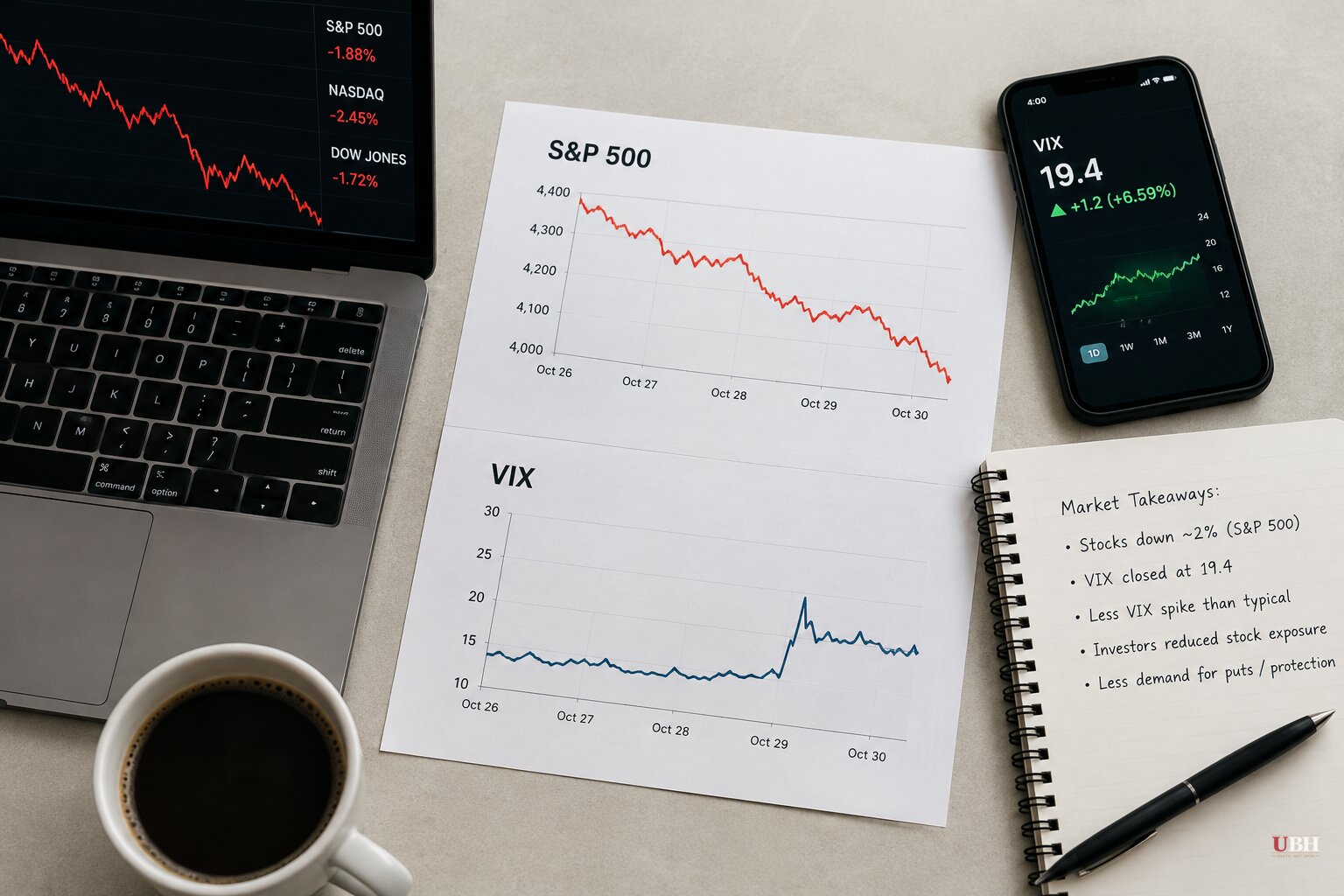
The S&P 500 fell nearly 2% on Friday, Oct. 30, and capped the worst week for U.S. stocks since June. The options market barely flinched.
The Cboe Volatility Index, the so-called fear index, touched its highest intraday level since April on Friday. It then retreated and closed at 19.4.
A smaller jump than the history suggests
The VIX rose 2.2 points on the day. SpotGamma's Brent Kochuba called that "relatively muted."
Kochuba studied 126 selloffs since 2018. By that measure, a decline of Friday's size should have pushed the VIX up closer to 2.6 points.
The gap is small, but the pattern held across several corners of the options market.
In the Nasdaq 100, implied volatility rose for most contracts. There were exceptions. According to data shared by Nasdaq's Kevin Davitt, put contracts 20% to 50% out-of-the-money were priced higher on a volatility basis after the Oct. 16 selloff. Nations Indexes data also showed Nasdaq puts were more expensive two weeks earlier.
Nomura managing director Charlie McElligott told clients Friday that out-of-the-money S&P 500 puts "just aren't being chased-into at this moment." He said index options skew hadn't been "particularly reactive" to the week's stock selloff. Where it had moved, he wrote, it was "partially a function of call vol getting mushed."
Selling shares instead of buying protection
One explanation is that big money is simply selling stock rather than hedging it.
Morgan Stanley's prime brokerage data on long-short active managers shows total global gross equity exposure down 8% from its most recent peak. That is the biggest drawdown in at least ten years.
Zed Francis, chief investment officer of Chicago-based Convexitas, called it "a massive de-levering event." His logic: "Buy the shorts, sell the longs. If you were closer to cash than you were before, no need to hedge." He believes that is the main reason implied volatility stayed quiet during a stressful month.
A portfolio that has already been sold down has little left to insure.
What drove the selling
The AI trade is at the center of the stress. A newsletter writer who tracks markets under the name Kris said some AI-related stocks dropped on their earnings reports Thursday, Oct. 29, and especially Friday. The newsletter's sentiment gauge sat in "fear" territory, close to "extreme fear."
The week before, on Oct. 23, the Dow Jones Industrial Average fell 652.82 points, or 1.23%, to 52,215.16. The Nasdaq Composite lost 0.7% for the week of Oct. 19 to 23, with technology and semiconductor shares falling harder than the headline figures.
Edward Chin of The Epoch Times wrote that investors are increasingly asking whether the enormous spending on AI will generate sufficient returns. He pointed to increased credit default swap trading involving Oracle, Alphabet, Amazon, Meta Platforms, Broadcom and Nvidia, and raised the question of who is financing the AI buildout and how much debt is involved.
Chin also cautioned against over-reading that signal. Higher CDS trading volume, he wrote, does not necessarily mean investors expect a financial crisis, and it is not the same as the amount spent on protection. A CDS covers credit losses on a company's debt, not a falling share price.
That is the opposing read to the calm-options story. Francis and McElligott describe an options market that is quiet because exposure was already cut. Chin describes a market where debt-financed AI spending is drawing closer scrutiny. Both can be true at once. The options data say how investors are positioned, not whether their worries are justified.
Today's trading
The 19.4 close left the VIX just under the 20 level. One trader posting on X today, Nov. 2, claimed the index was "pressed up above the 20 level" midday on light volume. That is an unverified social media claim, and today's VIX close is not established.
The open question
The calm Friday reading has a downside built in. If long-short managers have already de-risked, as Morgan Stanley's data indicates, fewer sellers may be left when the next shock arrives. Whether the quiet VIX reflects confidence or a market that has simply gone to cash is something the next round of AI earnings and the next heavy selling day will answer.
Sources used for this briefing
6 links from 4 independent newsrooms (syndicated copies of the same report count once)
These are the sources it draws on, linked so you can verify.


