
Unbiased headlines. Facts, not spin.
Unbiased Headlines is an independently owned news organization. We bring you the facts, not opinions, written fresh from 110+ named sources. Sources linked so you can verify it yourself.
 economy
Notable (5/10)
CFR scholar says Beijing wants the yuan as a sanctions-proof No. 2, not a replacement for the dollar
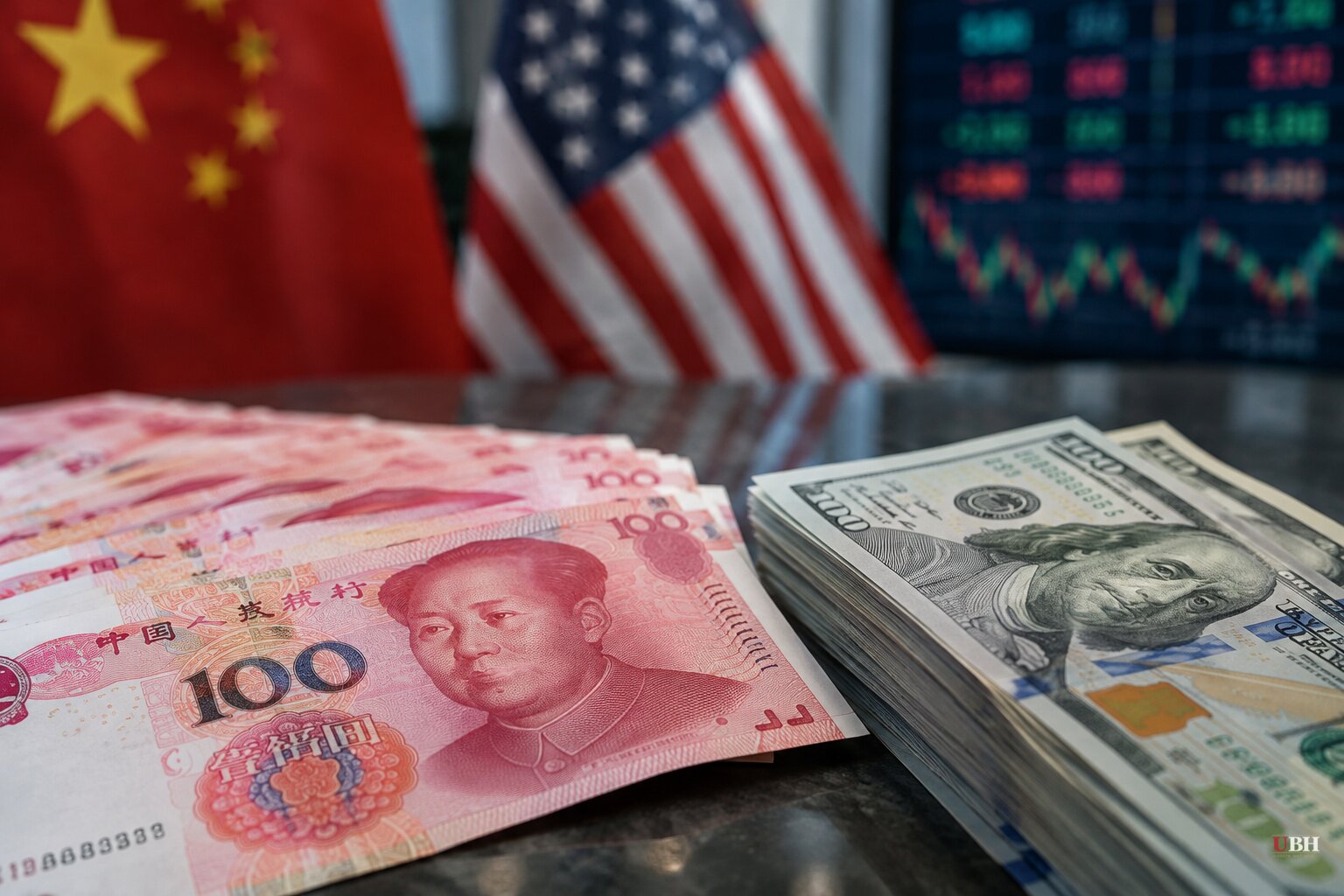
Beijing is not trying to knock the dollar off its perch. It wants a yuan system big enough that U.S. sanctions can't corner it.
That is the argument Zongyuan Zoe Liu, senior fellow for China studies at the Council on Foreign Relations, made in Foreign Affairs this month. Her reasoning is straightforward. Being the world's reserve currency means open capital markets, and open capital markets would loosen the Communist Party's control over who gets capital and how.
Chinese elites also lean on offshore dollar holdings as insurance against domestic political persecution, Liu wrote. A dollar that stays on top suits them fine.
The goal is a sanctions workaround
Liu says the real motive for pushing the yuan abroad is to stop Washington from weaponizing the financial system against China, as it did to Russia after the 2022 invasion of Ukraine.
"Placing a respectable second, or even a consequential third, would suffice to break the dollar's effective monopoly and constrain the United States' ability to impose financial sanctions unilaterally, while saving China the effort and cost of sustaining currency supremacy," she wrote.
Her shorthand: the renminbi as "the Pepsi to the dollar's Coca-Cola: never the market leader, but serviceable in a pinch and more than capable of keeping the dominant incumbent honest."
What China has built so far
The plumbing is real. As of June, China's Cross-Border Interbank Payment System had 1,829 participants able to send payments to more than 5,200 banks in 191 countries. Firms in more than a hundred countries use the renminbi.
The People's Bank of China has currency swap agreements with 32 foreign central banks and monetary authorities. Chinese banks more than doubled their yuan lending to overseas borrowers between 2023 and mid-2026, Liu noted.
Beijing is also pushing "China prices," yuan benchmarks on domestic commodity exchanges. Lithium is the success story, she said.
But the scale gap is large. Liu says the payment network handles a small fraction of what the U.S.-dominated system processes. Chinese exporters still invoice in dollars and convert to yuan just before the money enters China. A global currency also needs pricing, financing, risk transfer and reinvestment, and the yuan is only partway there.
The Treasury sell-off question
A related argument concerns China's falling Treasury holdings, which some read as a sign of flight from the dollar. Antonio Graceffo, writing in a commentary in The Epoch Times, calls that reading "pro-China propaganda."
Beijing's own account is different. In April 2025, People's Bank of China Deputy Governor Zou Lan said the country's foreign exchange reserve investments had been "effectively diversified." In January 2026, a Shanghai University of Finance and Economics professor told the state-run Global Times the reduction reflected "optimization and diversification" of foreign assets.
Graceffo's counter: nothing diversified in the truest sense. China moved from one dollar security to others. He cites Treasury figures showing China sold $183.1 billion in Treasurys between November 2013 and late 2023 while buying $543.5 billion in U.S. agency bonds, including debt backed by Fannie Mae and Freddie Mac.
He also notes that U.S. data record holdings at U.S.-based custodians. Treasurys held through third-party custodians such as Euroclear in Belgium and Clearstream in Luxembourg are logged under those countries, not China.
How big is China's dollar exposure?
Analyst Setser, whose estimates Graceffo cites, puts about $1.8 trillion of China's $3.3 trillion in official reserves in dollars. He estimates state commercial banks hold roughly $1.1 trillion in dollar assets. Policy banks could hold close to $1 trillion in mostly dollar-denominated claims abroad. Most of the China Investment Corp.'s $450 billion in foreign assets are in dollars.
Setser concluded that China stopped adding to official reserves while state banks and funds kept accumulating dollars. By his estimate, China could hold more dollars outside its official reserves than inside them.
Graceffo argues the perception of a Treasury dump serves Beijing by portraying the dollar and U.S. economy as weak, boosting the yuan's case and China's negotiating hand. Alicia García-Herrero, chief Asia-Pacific economist at Natixis, said China's intent is "mainly to show" the United States it can sell large amounts of Treasurys. During an earlier bond market wobble, SMBC Nikko strategist Ataru Okumura wrote that a country selling in retaliation would want to show it could cause turmoil to strengthen its bargaining position.
Two readings, one tension
The two accounts fit together more than they conflict. Liu says China wants the dollar system to survive and wants an escape hatch from it. The Treasury-holdings analysis says China remains deeply invested in dollars while it builds that hatch.
What neither settles is how large the escape hatch can get. The yuan network is growing, but it still processes a fraction of dollar flows, and the dollar exposure Setser describes sits partly in places U.S. data do not attribute to China. How much of that exposure Washington can actually see remains the open question.
The U.S. holds the leverage Liu says Beijing is trying to dilute: the ability to sanction unilaterally through the dollar system. Every additional yuan bank, swap line and commodity benchmark chips at it.
Sources used for this briefing
7 links from 4 independent newsrooms (syndicated copies of the same report count once)
These are the sources it draws on, linked so you can verify.


