
Unbiased headlines. Facts, not spin.
Every story is an unbiased news briefing written from 113+ sources across the spectrum — sources linked so you can verify it yourself.
 economy
Major Story (7/10)
Event date: September 20, 2026
economy
Major Story (7/10)
Event date: September 20, 2026
Carney Tells NYT He Studied Risk of U.S.-Led Military Action Against Canada
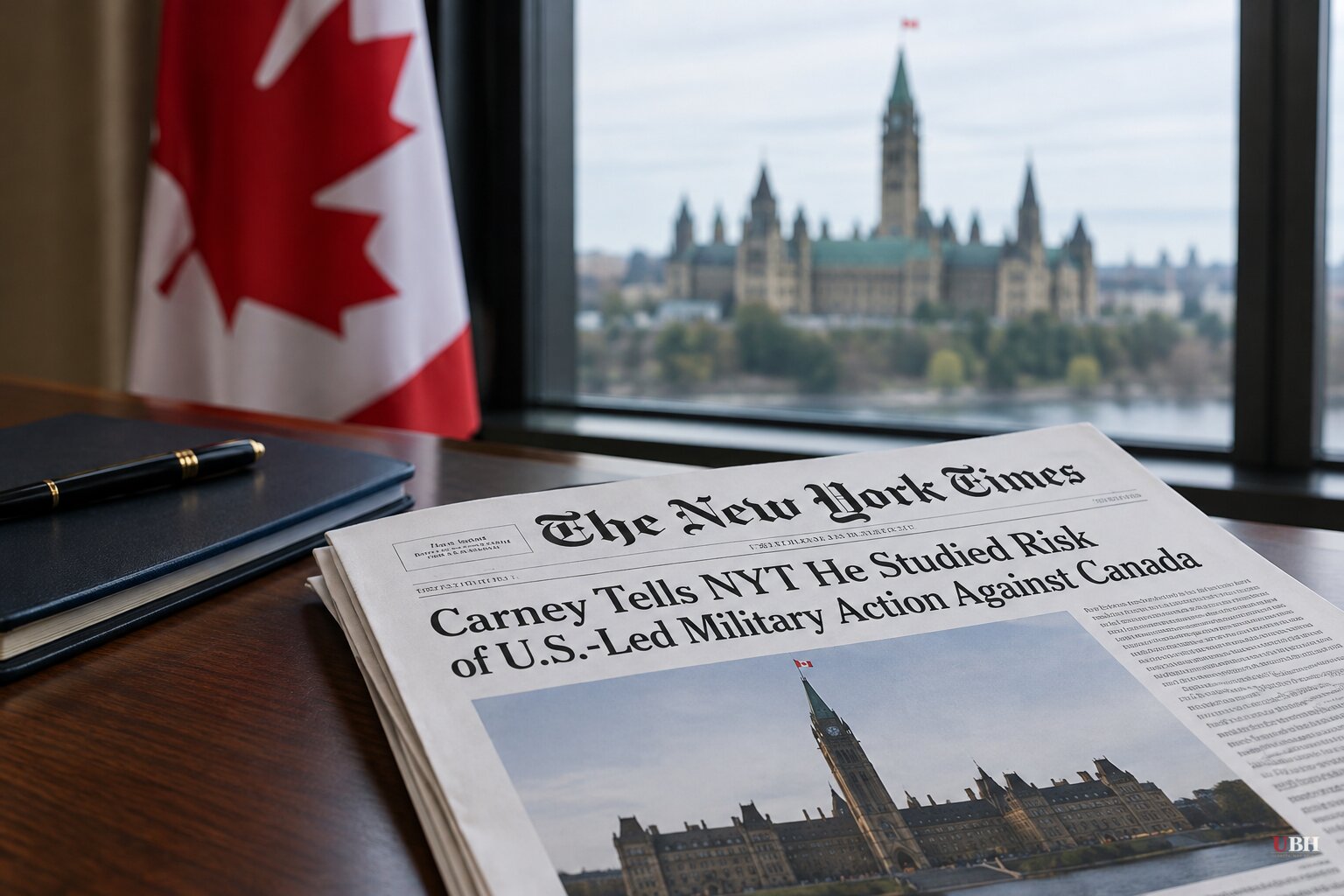
Since Canada walked away from trade talks with Washington on August 21, the rupture between Ottawa and the Trump administration has kept widening, and Wednesday brought its strangest entry yet: Prime Minister Mark Carney telling the New York Times that his government studied the possibility of a U.S.-led military action against Canada.
Carney declined to spell out what that examination actually involved, according to the interview reported by CBC News. But he defended doing it at all.
"I think you have a responsibility in these roles to look at extreme tail risk," Carney told the Times. "That's just risk management. That's not a base case, but it would be irresponsible not to [prepare]."
Carney is explicitly framing this as contingency planning for a low-probability scenario, not a claim that the U.S. is preparing to invade. CTV News, which also covered the interview, noted Carney has not met one-on-one with President Trump and described talks between the two countries as "on the rocks."
Trump himself ruled out using military force to annex Canada back in January 2025, according to CBC's reporting, even as he's repeatedly floated the idea of Canada becoming the 51st state and said he'd consider using "economic force" to pressure Ottawa. Those are two very different things, and the distinction matters. There's a real gap between a president who publicly ruled out invasion and a prime minister publicly disclosing he war-gamed one anyway.
A reasonable critic could see Carney's disclosure as needlessly inflammatory given that gap. Victor Davis Hanson, writing for the Daily Signal, has argued Carney is positioning himself as the global face of resistance to Trump and is escalating rhetoric that will ultimately "backfire" on Canada's own economy, pointing out Carney has not released the actual documents from the collapsed August negotiations to back up his account of why they failed. Hanson's critique deserves a fair hearing: Carney's own explanations for the trade talks breakdown have shifted over time, and the U.S. side, including Trade Representative Jamieson Greer, disputes his characterization of what Washington actually demanded.
Carney isn't claiming certainty about U.S. intentions. He's describing a hedge against an unlikely scenario, which is a different claim than accusing the Trump administration of planning military action. No source in this record shows the Pentagon or White House drafting any such plan.
Beyond the Military Talk: Starlink and F-35s
The same NYT interview covered more concrete ground. Carney discussed Canada's plans to reduce its reliance on Elon Musk's Starlink satellite internet service, and confirmed Ottawa's review of its planned purchase of a full fleet of F-35 stealth fighters remains ongoing, more than a year after it was launched in response to the trade war, per CBC.
Neither move has been finalized. But both point in the same direction as everything else coming out of Ottawa this month: fewer dependencies on American suppliers, period.
Ports, Rail, and the Pacific Pivot
That direction was on full display two days earlier. On September 21, Carney's government introduced legislation to speed up federal project reviews to under a year, with a specific focus on transportation infrastructure, according to Bloomberg's reporting via SupplyChainBrain.
Transport Minister Steven MacKinnon didn't hide the motivation. "It's really inspired by this imperative to diversify our overseas markets, to diversify away from the United States," he said, citing the tariffs and trade disruptions imposed by Trump.
The bill creates "national trade corridors" with performance metrics meant to stop bottlenecks, overhauls port governance to allow more private investment, and fast-tracks approvals for smaller bridges and rail links. MacKinnon said the heaviest focus is on western Canada, getting energy, food, and critical minerals to the Pacific ports of Vancouver and Prince Rupert for Asian markets.
He also flagged the St. Lawrence Seaway as underused capacity for European trade, plans for new container facilities in Hamilton, Ontario, and a longer-term bet on the small Hudson Bay port of Churchill, Manitoba. "We're very intrigued by the potential there," MacKinnon said. "Churchill absolutely can become a place with real potential as the prairies' own Atlantic port."
None of this fixes the immediate math. The U.S. still imposed 50 percent duties on roughly $28 billion in Canadian goods after talks collapsed in mid-August, and Canada answered with dollar-for-dollar retaliatory tariffs on about $28 billion in American goods in early September, according to the Epoch Times. Redirecting freight to Prince Rupert or Churchill doesn't happen overnight, and the transport bill still has to clear Parliament.
What's unresolved is whether any of this changes Washington's calculus. Trump has not responded publicly to Carney's invasion-risk comments, and no source indicates the two leaders have a meeting scheduled. Parliament's debate on the transport corridors bill is the next concrete milestone to watch, along with whatever Ottawa decides on the F-35 review it has now had under political consideration for more than a year.
Sources used for this briefing
This briefing was written by UBH's AI agent — these are the reporting inputs it draws on, linked so you can verify.


