
Unbiased headlines. Facts, not spin.
Unbiased Headlines is an independently owned news organization. We bring you the facts, not opinions, written fresh from 110+ named sources. Sources linked so you can verify it yourself.
 energy
Major Story (7/10)
Event date: November 18, 2026 ·
Canada Courts Asian and European Buyers for Gas and Oil as 50% U.S. Tariffs on Autos and Steel Near
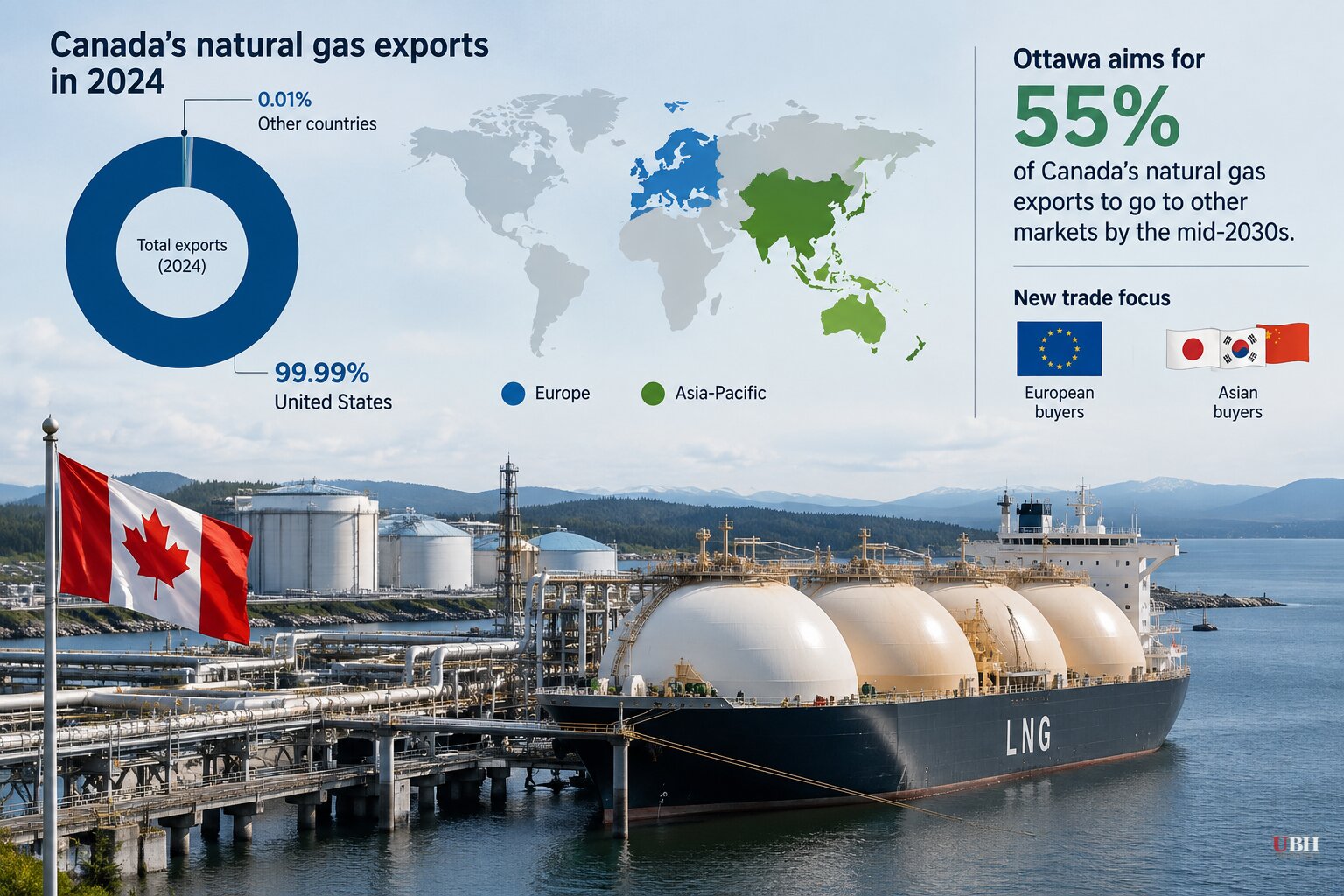
Canada sold nearly all of its natural gas exports to one customer in 2024. The United States bought all but 0.01% of them.
Ottawa now wants 55% of those exports going to other countries by the mid-2030s. The government is putting money, regulation and diplomacy behind that goal.
The tariff deadline
In August, President Donald Trump imposed 50% tariffs on roughly US$20 billion worth of Canadian goods. Separate 50% tariffs on Canadian cars, auto parts and steel are scheduled to take effect on January 1, 2027.
Carney has answered with retaliatory tariffs while pursuing deals elsewhere. He carried that strategy to Shenzhen for the 33rd Asia-Pacific Economic Cooperation summit, which opened Wednesday, Nov. 18, with leaders and executives from 21 member economies.
Carney met Chinese President Xi Jinping on Tuesday, Nov. 17. He spoke briefly with Trump on the sidelines Wednesday. Carney's office said the two discussed "the work underway to reach a mutually beneficial trade agreement." No deal has been announced.
What Canada is building
The pieces of the energy pivot are concrete:
- Germany's state-owned Uniper has signed a 20-year deal for liquefied natural gas from a planned British Columbia terminal.
- LNG Canada said in Vancouver on Sept. 29 that it will go ahead with the Phase 2 expansion of its Kitimat, B.C., terminal.
- Carney has fast-tracked a state-backed pipeline to carry 1 million barrels a day of Alberta crude to the Pacific coast for Asian buyers.
- Alberta Premier Danielle Smith's government last week introduced a 10-year preferential royalty framework for new oil sands projects and expansions. Projects adding at least 5,000 barrels a day will pay a 2% gross revenue royalty for their first five years of production. The policy is aimed at doubling output by 2035.
That pipeline is state-backed, which makes it taxpayer exposure, not just a private bet. A 2% royalty is also a deliberate decision to collect less from a resource owned by the public in exchange for faster development.
The China piece
The Carney-Xi meeting expanded an existing bilateral trade agreement that has restored market access for more than 90% of Canadian exports previously hit by Chinese tariffs. China agreed to remove or reduce tariffs on about $400 million in additional Canadian goods, including frozen pork and seafood.
Canada, for its part, extended existing tariff exemptions on certain Chinese steel and aluminum products for two more years. It added relief for 32 more steel and aluminum items in short supply domestically. The two leaders also discussed oil and gas cooperation. Canadian exports to China rose almost 40% in the first nine months of the year.
That is real money for farmers and fishers. It also means Canada is easing steel and aluminum duties on goods from a government that Washington treats as its chief strategic rival.
The Institute for Research on Public Policy's Policy Options magazine carries an analysis arguing that diversification should not turn into dependence on Beijing. Its author writes that "pivoting away from the U.S. does not mean Canada has to run toward China," and that Canada should separate defence partnerships from economic ones. The piece says Canada should not buy military equipment from non-democracies "no matter how expedient it may be." It cites a Pew Research Center poll from last spring in which one-third of Canadians viewed the U.S. favourably and 44% viewed China more favourably than the U.S. It also notes the U.S. took 71.7% of Canadian exports in 2025, down more than four points since Trump returned to office.
Strategy and power costs
An essay in The Hub says the federal government's national security strategy, released last month, names energy and critical minerals as strategic capabilities. The author argues it never explains how to turn them into leverage. The piece distinguishes "strategic autonomy," meaning less dependence on coercive partners, from "strategic indispensability," meaning making yourself hard to replace. It argues Canada should export more oil, LNG, uranium, potash and minerals to more allies.
The home front is messier. The Independent Contractors and Businesses Association of B.C., an industry group, says it commissioned a survey of 2,004 British Columbians in early October. Eighty-nine percent agreed the province should build its own gas-fired power plants instead of buying electricity from the U.S. that is generated with B.C. gas. The group argues that CleanBC policy pushed electrification while limiting supply, and it estimates the policy would cost the province $109.7 billion in lost economic activity by 2029. That figure is the association's own estimate.
The association also cites BC Hydro's imports of roughly a quarter of the province's power in fiscal 2024. It cites utility-regulation writer Richard Mason's estimate of a $2.1 billion import bill over three years. BC Hydro extended contracts with two private gas-fired plants earlier this year and bought one of the companies outright.
Ottawa's own energy messaging runs on a different track. A Natural Resources Canada release dated Nov. 18 says Canada can become an "energy superpower." It announced nearly $10 million for 24 clean electricity and innovation projects in Atlantic Canada, announced by Justice Minister Sean Fraser. The release ties that to the National Electricity Strategy, which commits over $50 billion to double the grid.
What comes next
OilPrice.com's assessment is that Carney's brief exchange with Trump is unlikely to thaw trade tensions or change Canada's energy direction. The January 1 tariff date is the nearest hard deadline. Whether Ottawa and Washington announce a trade agreement before then is an open question. The Uniper deal and the Pacific pipeline are the first tests of whether Canada can move gas and crude volumes away from a single buyer.
Sources used for this briefing
7 links from 6 independent newsrooms (syndicated copies of the same report count once)
These are the sources it draws on, linked so you can verify.


