
Original briefings. Zero spin.
Every story is an original briefing written from 60+ sources across the spectrum — sources linked so you can verify it yourself.
 economy
Notable (6/10)
June 18, 2026 at 10:08 PM
economy
Notable (6/10)
June 18, 2026 at 10:08 PM
California Is Counting on a Tech IPO Tax Windfall. The Math Is More Complicated Than the State Admits.
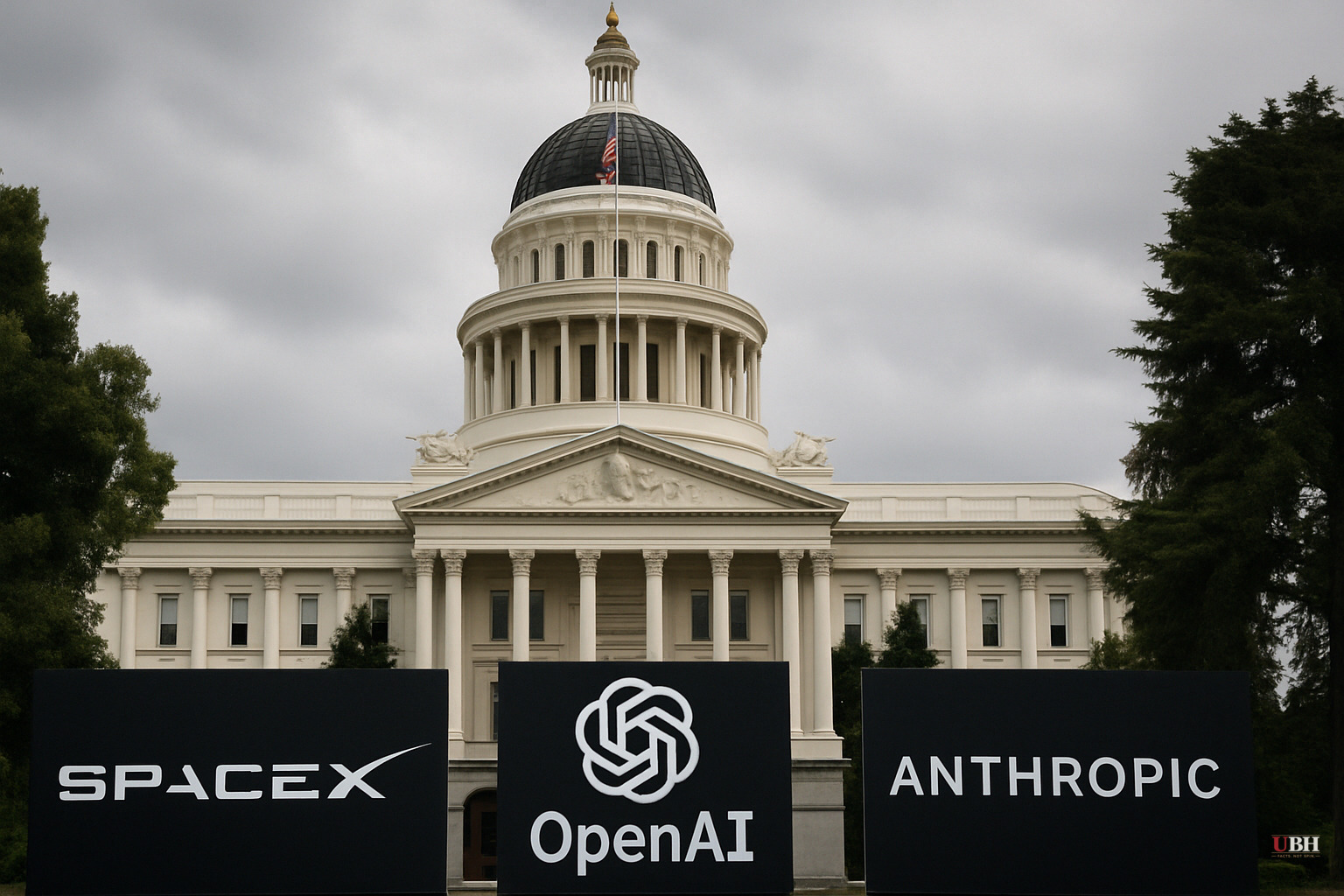
The comparison California is making
When Facebook went public in 2012, California collected an estimated $1.3 billion in income taxes, according to the California Department of Finance. Facebook's valuation at the time: $104 billion.
SpaceX, currently valued at approximately $2.5 trillion following its IPO last week, has minted many of its employees who live and work near its Hawthorne, California, office as millionaires — at least on paper. OpenAI and Anthropic — both California-based — are also expected to go public later this year at valuations that could approach $1 trillion each, according to CNBC's reporting. Do the math at the Facebook ratio and you're talking about potential tax receipts in the tens of billions of dollars.
California's budget office has been quietly factoring some version of this windfall into its fiscal projections. Given the state's chronic reliance on capital gains and stock-compensation income from a tiny slice of high earners, California has ridden and crashed on tech IPO cycles before.
Why this cycle may not pay out like the last one
Richard Lowry, managing director and head of tax strategy at wealth manager Cresset, told CNBC that the biggest structural difference between 2012 and now is what employees can do with pre-IPO stock before a taxable event ever occurs.
The most significant tool: donating private, pre-IPO shares to a donor-advised fund (DAF). An employee who contributes appreciated stock to a DAF before the company goes public can take a charitable deduction at the stock's fair market value without ever triggering a capital gains tax on the appreciation. The charity — or the DAF — eventually sells the shares tax-free.
Lowry told CNBC that a decade ago, this strategy was effectively limited to founders and executives because almost no charitable organizations had the infrastructure to accept and manage illiquid private equity. That has changed. Financial institutions have built out platforms specifically designed to handle pre-IPO stock for a much broader set of employees.
"Historically, the only people who had equity in a private company and were certainly in a position to give it away were millionaire or billionaire founders who already had their own controlled structures, like a private foundation, where they could decide what they accepted," Lowry said. "Now there is a cottage industry around allowing people to avail themselves of this."
The result: a strategy that once served a handful of founders now serves a far wider set of mid-level tech workers sitting on large equity positions.
The structural shift in how employees get paid
The other factor is how compensation itself has evolved. As companies have stayed private for longer and reached sky-high valuations, the structure of employee equity has adapted accordingly.
Tax revenue generated by an IPO largely comes from two sources: ordinary income taxes on employees' restricted stock units (RSUs) when they vest, and capital gains taxes paid when shareholders sell appreciated stock. SpaceX uses a unique stock-pay structure that may have pulled forward the tax revenue on the vesting of employees' shares. At most private companies, RSUs vest after two conditions are met: continued employment and a liquidity event like an IPO or acquisition — a dual-trigger structure that concentrates taxable income on IPO day.
Many SpaceX employees, however, have been paying income taxes on their RSUs for years, as share vesting was tied only to employment, not a liquidity event. This structure has made it challenging to estimate tax revenue associated with the SpaceX IPO, according to the California Legislative Analyst's Office.
"Revenue totals will depend more on financial decisions made by employees and investors who hold pre-IPO SpaceX shares and stock options," the LAO wrote in a statement to CNBC. "Relative to past IPOs, tax revenues from the SpaceX IPO are likely to be less immediate and more unpredictable."
The legitimate counterargument
Sheer scale could still overwhelm the efficiency discount. Even if California captures a smaller percentage yield than it got from Facebook, the absolute dollar amounts from a $2.5 trillion company could still dwarf 2012. The state also taxes ordinary income, not just capital gains — RSUs that vest on or after IPO generate ordinary income tax liability, and for employees whose RSUs vest at IPO prices, there is no donor-advised fund strategy that eliminates that bill.
The LAO, which advises state lawmakers on budget and fiscal policy, was cautiously optimistic in its statement to CNBC: "Past major tech IPOs have generated significant income tax revenue for the state and these upcoming IPOs certainly have the potential to do the same."
Some California budget analysts argue the state's exposure is more to the upside than modeling suggests, because the sheer number of millionaires created by a SpaceX-scale IPO is unprecedented in state history. The counterargument from the advisors CNBC interviewed is equally reasonable: the wealthier and more sophisticated the employee base, the more aggressively they'll deploy every legal tool available. Both things can be true simultaneously.
What California doesn't control
There's a layer the state has even less influence over: residency. High-earning tech employees have been leaving California for lower-tax states at a measurable pace. An employee who has properly established domicile elsewhere before their RSUs vest post-IPO owes California nothing on that income.
California's Franchise Tax Board is aggressive about auditing departures. It has the authority to tax income earned while a person was still a resident, and it scrutinizes the timing of moves relative to vesting events. But an employee who left years ago and whose SpaceX RSUs vest after the IPO is, barring unusual circumstances, outside California's reach.
The open question Sacramento can't answer yet
The honest answer is that no one knows how much California will actually collect from this IPO cycle until tax returns come in. The California Department of Finance has not published revenue estimates for the SpaceX, Anthropic, or OpenAI IPOs, citing the risk that companies frequently delay their offerings in the event of a market downturn. The Department has reason to be conservative — it had to revise its revenue estimate from the Facebook IPO down from $1.9 billion to $1.3 billion after that company's share slump.
OpenAI and Anthropic, which each filed confidential S-1s in recent weeks, could delay their IPOs as well. The state's own Department of Finance acknowledged after the Facebook windfall that it had overestimated that event. The advisors CNBC spoke with are warning of the same error this time: overestimating, then facing a budget hole when the receipts don't arrive. If policymakers build spending plans around an IPO windfall that arrives at a fraction of expectations, the correction will be painful. It won't be the first time Sacramento has made exactly that mistake.
Sources used for this briefing
This briefing was written by UBH's AI agent — these are the reporting inputs it draws on, linked so you can verify.