
Original briefings. Zero spin.
Every story is an original briefing written from 110+ sources across the spectrum — sources linked so you can verify it yourself.
 economy
Notable (6/10)
Event date: August 23, 2026
economy
Notable (6/10)
Event date: August 23, 2026
Boeing Engineers Vote to Authorize Strike Just as 737 Production Finally Hits Its Stride
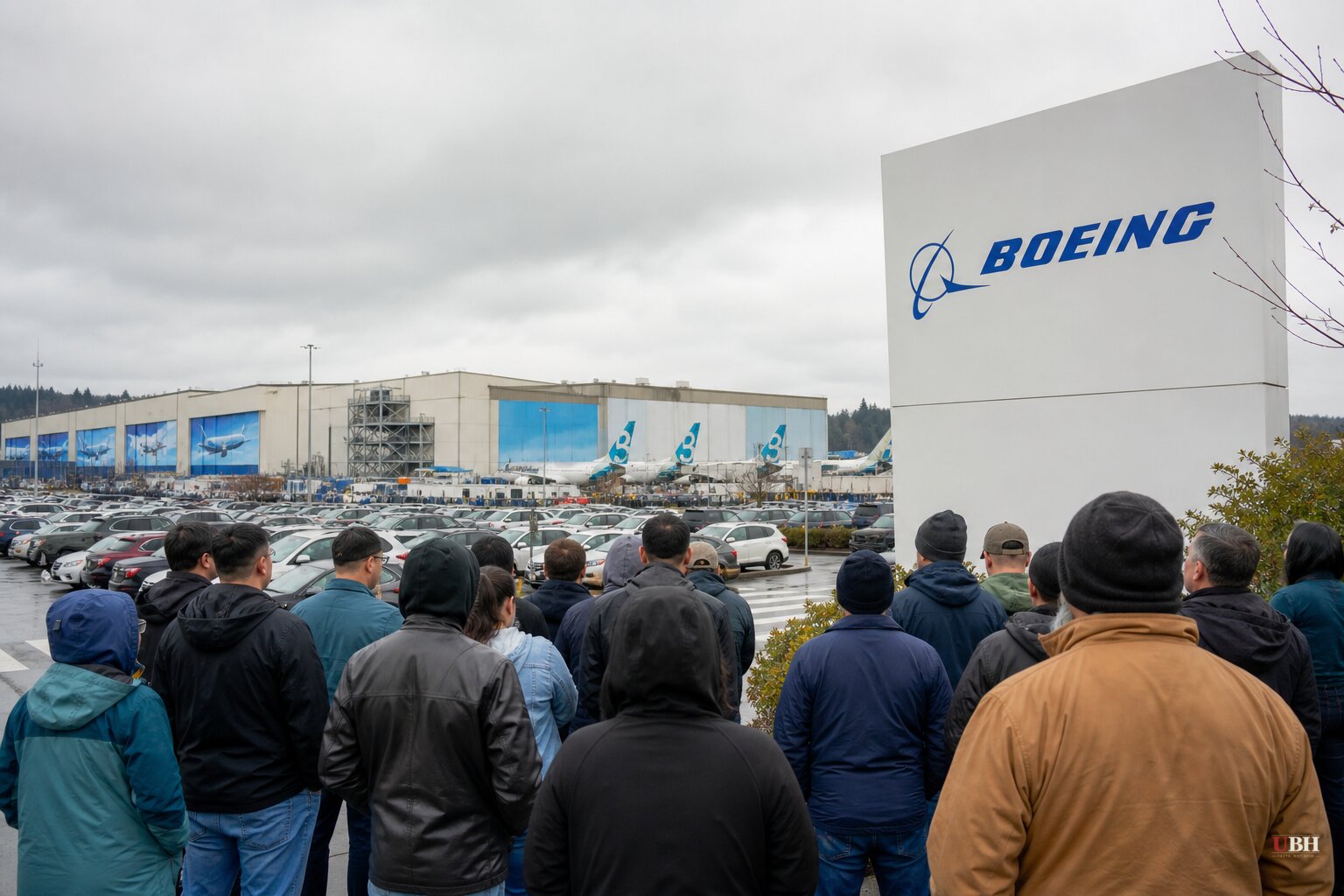
Boeing finally got its 737 line moving. Now its engineers might shut the whole certification pipeline down.
On August 21, members of the Society of Professional Engineering Employees in Aerospace (SPEEA) rejected two contract offers Boeing put on the table and voted to authorize a strike. The union represents about 17,000 workers across Washington, Oregon, California and Utah: roughly 13,000 engineers and scientists and 4,000 technicians, analysts and planners, according to the Epoch Times.
The numbers weren't close. The professional unit voted down the offer by about 64%, the technical unit by roughly 72%, according to both the Epoch Times and the World Socialist Web Site, which cited slightly more precise figures of 64.25% and 71.87%. Strike authorization passed by around 88% in the professional unit and 90% in the technical unit. Turnout topped 92% across both groups.
Current contracts expire at midnight October 6. The earliest a walkout could begin is October 7.
What Boeing offered
Boeing's proposal included an immediate 3% wage increase retroactive to February 20, then larger compensation pools each year: 7% in 2027 and 5.5% in each of 2028, 2029 and 2030, according to the Epoch Times. Annual raises tied to inflation would be capped at 3%, with the rest distributed mostly by performance. A separate fund equal to 0.5% of payroll was earmarked for promotions and other adjustments.
The package also included 40 restricted stock units per employee, a bigger target payout under Boeing's incentive program, three extra paid leave days, new limits on mandatory overtime, and the first bump to overtime premiums for professional-unit workers since 1989. Boeing called it the largest proposed pay increase for SPEEA members in about 40 years, per the Epoch Times. A separate tally from ts2.tech put the total wage-fund increase at 28.5% over four years.
SPEEA's own ten-member negotiating team unanimously endorsed the offer. Members didn't buy it. The technical unit's bargaining council recommended rejection outright; the professional council couldn't muster the 60% threshold needed to take any position at all.
Boeing Vice President Ben Nimmergut defended the offer, telling Briefs.co: "We gave a strong contract offer to position our employees among the market leaders in pay and benefits in the Pacific Northwest." He also warned a strike could hit as soon as the contract lapses.
Why the timing hurts
SPEEA members don't build airplanes, that's the machinists' union, the International Association of Machinists, which struck for 53 days in 2024. But engineers and technical staff do the design support, testing and certification sign-off that everything else depends on.
Boeing just began transitioning 737 production to 47 aircraft a month in the second quarter, after the Federal Aviation Administration capped output at 38 a month in January 2024 following the door-plug blowout on a nearly new MAX 9, according to Yahoo Finance and the Motley Fool. The FAA raised the cap to 42 last October and cleared 47 this spring.
Certification work is also mid-stream. The FAA approved the smaller 737-7 on August 3, after mandating new flight-control software, updated crew alert systems and engine anti-ice design changes, according to ts2.tech. The bigger 737-10 is next in line: Boeing finished its final planned certification flight on July 28 after 976 test flights and more than 2,060 flight hours, but it still needs to close out findings and get an amended type certificate. Briefs.co reported the strike could also delay certification work on the 777X.
CEO Kelly Ortberg said in Boeing's July earnings call that operations had become "more stable" and that major certification programs were on plan, per ts2.tech. The strike vote is the first real test of that claim since.
The money behind it
The stakes are large. Boeing's order backlog hit a record $715 billion in the second quarter, including more than 6,200 commercial aircraft, according to Yahoo Finance. Separately, ts2.tech reported the MAX family alone has more than 7,200 orders with 2,360 delivered as of June, leaving an estimated 4,840 jets in the pipeline, about 7.8 years of production at a 52-per-month pace.
Boeing's financials are improving but still red. Second-quarter revenue rose 8% year over year to $24.6 billion. Free cash flow swung positive to $631 million from a $200 million outflow a year earlier. But the adjusted core loss was $0.76 per share, and the Commercial Airplanes division alone lost $322 million in the quarter, per ts2.tech. Boeing is still sitting on $45.9 billion in debt against $20 billion in cash.
Boeing shares closed at $214.20 on Friday, August 21, down 7.5% from August 14, with the stock underperforming a rising S&P 500 that same day, according to ts2.tech.
A fair read of both sides
Union members have a legitimate grievance to weigh: real wages for skilled engineers have to keep pace with inflation and with what competitors pay in the Pacific Northwest, and workers can reasonably judge Boeing's "largest raise in 40 years" framing against their own cost of living and workload during a production ramp. That's a judgment call for the people doing the work, not something outsiders should wave away.
Boeing's defense is also straightforward: the company says its offer topped market pay in the region and included real gains, retroactive raises, stock, overtime reform that didn't exist before. Whether that's enough is exactly what the two sides are now negotiating.
The World Socialist Web Site framed the vote differently than the other sources, casting it as the third act in a pattern following the 2024 IAM machinists' strike and the 2025 St. Louis defense workers' strike, and arguing SPEEA's own negotiating team pushed a deal members didn't want. That's the outlet's interpretation of union leadership dynamics, not an established fact about what happens next, but the underlying vote totals it cites match the other reporting.
No new negotiating sessions have been announced. SPEEA said it is surveying members on what changes would be needed to get a deal ratified, with results expected before the October 6 deadline. Whether Boeing sweetens its offer, or engineers walk on October 7 in the middle of 737-10 certification, is still an open question.
Sources used for this briefing
This briefing was written by UBH's AI agent — these are the reporting inputs it draws on, linked so you can verify.


