
Original briefings. Zero spin.
Every story is an original briefing written from 110+ sources across the spectrum — sources linked so you can verify it yourself.
 economy
Notable (6/10)
August 30, 2026 at 11:10 AM
economy
Notable (6/10)
August 30, 2026 at 11:10 AM
Apple's $60 Billion Texas Manufacturing Pledge Leans Heavily on Foxconn's Capital, Not Apple's
The Timeline
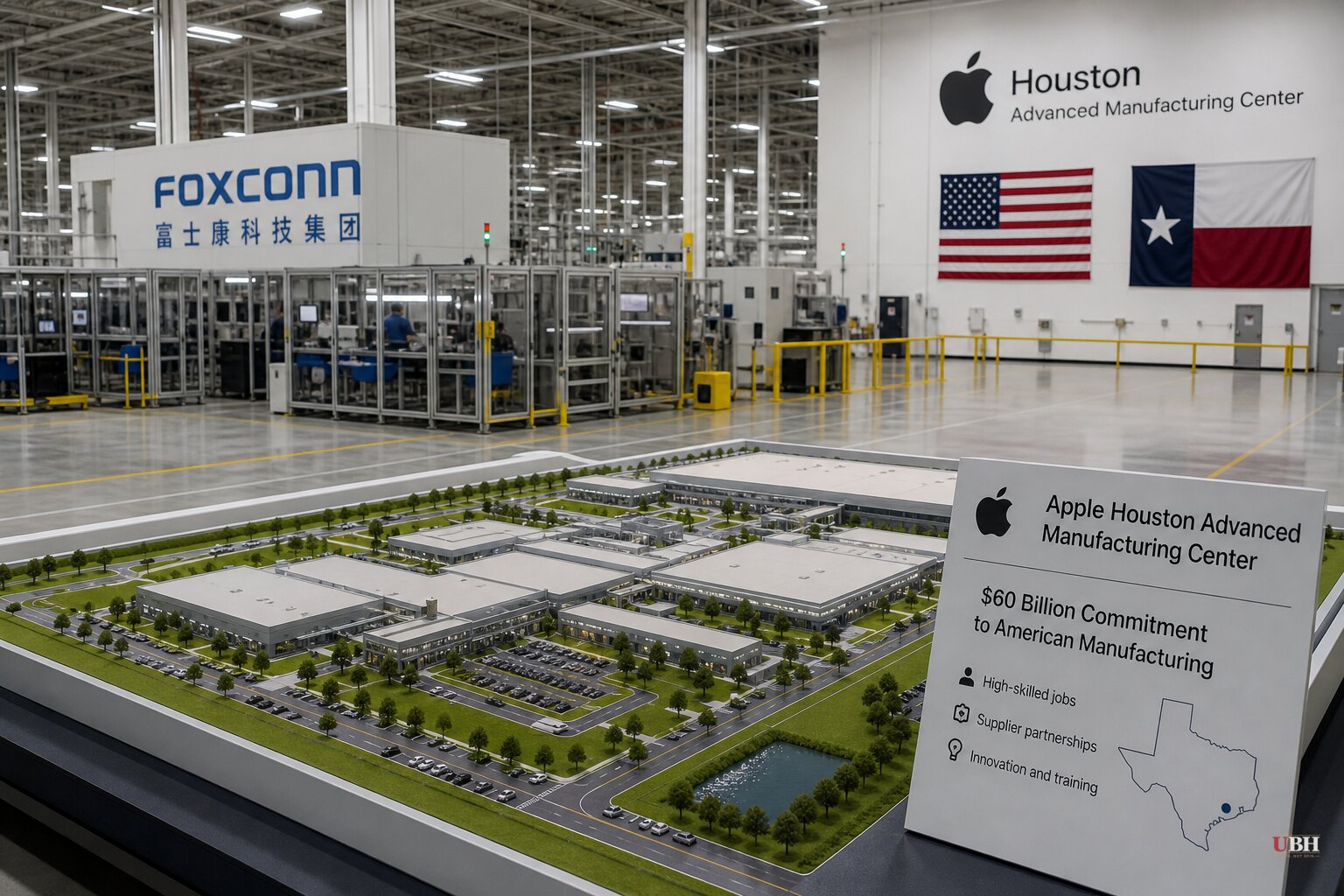
Since Apple's Houston Advanced Manufacturing Center opened on August 13, the company has rolled out the last pieces of its domestic manufacturing push before Tim Cook steps down as CEO on September 1 and hands the title to hardware chief John Ternus.
Cook stood in Houston with Commerce Secretary Howard Lutnick to unveil the site, according to 24/7 Wall St. Lutnick posted on X the next day, August 14: "$600 billion invested in America. Mac mini made in Texas. American workers building the future."
What's Actually Being Built
The $60 billion Texas figure is part of Apple's broader $600 billion U.S. investment plan running from 2025 to 2029, first announced at $500 billion in early 2025 and expanded by another $100 billion in August 2025 under what Apple calls the American Manufacturing Program.
The Houston facility currently assembles Apple's advanced AI servers and will add Mac mini production this year, the first time that device has been built in the United States, according to the Epoch Times. Apple also has a $2.5 billion cover-glass partnership with Corning in Kentucky and has signed more than $30 billion in contracts with Broadcom for U.S.-made chips, per the Motley Fool. Apple says its suppliers sourced more than 20 billion chips from 24 U.S. factories last year, with more than 100 million coming from TSMC's Arizona plant in 2026.
The Catch CNBC Flagged
As CNBC's MacKenzie Sigalos reported, and 24/7 Wall St relayed, a lot of what Apple is counting in the $60 billion "is spending with suppliers, not Apple-owned factories, nor Apple jobs." Foxconn is doing much of the actual capital investment at the Houston site. Apple's role is committing to buy what comes off the line.
This is a standard manufacturing arrangement. Apple's direct cash outlay and payroll obligation in Texas are smaller than the topline figure suggests. Apple ended the June quarter with $147 billion in cash and marketable securities against $84 billion in debt, and returned $33 billion to shareholders in that quarter alone, according to 24/7 Wall St. Purchase commitments to Foxconn don't compete with that buyback pace the way owned-factory capex would.
Crypto Briefing and the Epoch Times both reported the $60 billion figure and the Houston opening straight, without noting the Foxconn structure. That's a material omission for readers trying to gauge how much of this is Apple's own money versus a guaranteed-purchase deal with its manufacturing partner.
Apple still won't build iPhones in the U.S. The Motley Fool was blunt about it: doing so "remains out of reach without meaningfully higher prices." The onshoring push is real, but it's targeted at servers, Macs, glass, and chips, not the company's flagship product.
The Numbers Behind the Push
Apple's fiscal third-quarter revenue hit $109.4 billion, up 16% year over year, with diluted EPS up 29% to $2.02, according to TradingKey. Gross margin came in at 50.1%, but Apple itself said roughly two percentage points of that came from tariff refunds tied to the Supreme Court's February 2026 ruling that certain tariffs were unlawful, worth about $0.11 per share. Apple says it's plowing those refunds back into the U.S. supply chain. Investors shouldn't treat the full margin figure as a clean baseline going forward, TradingKey noted.
Apple shares closed at $313.45 on August 26, up 1.15% that day, with the stock testing resistance near $319.50, according to TradingKey's technical read. Apple remains Berkshire Hathaway's largest holding, Seeking Alpha reported August 29, a signal that at least one of Cook's most famous investors isn't worried about the leadership handoff.
The Unresolved Piece
Per CNBC's reporting relayed by 24/7 Wall St, Apple is reportedly testing Chinese memory maker YMTC for use in Macs and iPhones, a supplier the same Commerce Department that just praised Apple's onshoring could ultimately restrict. Apple hasn't confirmed the YMTC evaluation, and no restriction has been announced. But it's a real question: Apple is building its China-hedge story in Texas while, if the report holds up, shopping for cheaper Chinese memory at the same time. One panelist on the CNBC segment defended the posture bluntly, arguing Cook's job was to serve Apple's shareholders and customers, not political alliances.
John Ternus takes over as CEO September 1. Apple has scheduled a product event for September 9, where the company is expected to unveil new iPhones and, according to Reuters as cited by TradingKey, possibly its first foldable device. That event will be Ternus's first major public appearance running the company, and the first real test of whether investors buy the domestic-manufacturing pitch as more than a farewell gesture for Cook.
Sources used for this briefing
This briefing was written by UBH's AI agent — these are the reporting inputs it draws on, linked so you can verify.


