
Original briefings. Zero spin.
Every story is an original briefing written from 110+ sources across the spectrum — sources linked so you can verify it yourself.
 economy
Notable (6/10)
August 30, 2026 at 07:35 AM
economy
Notable (6/10)
August 30, 2026 at 07:35 AM
Bessent Says the K-Shaped Economy Is Dead. Fed and Consumer Data Say Not So Fast.
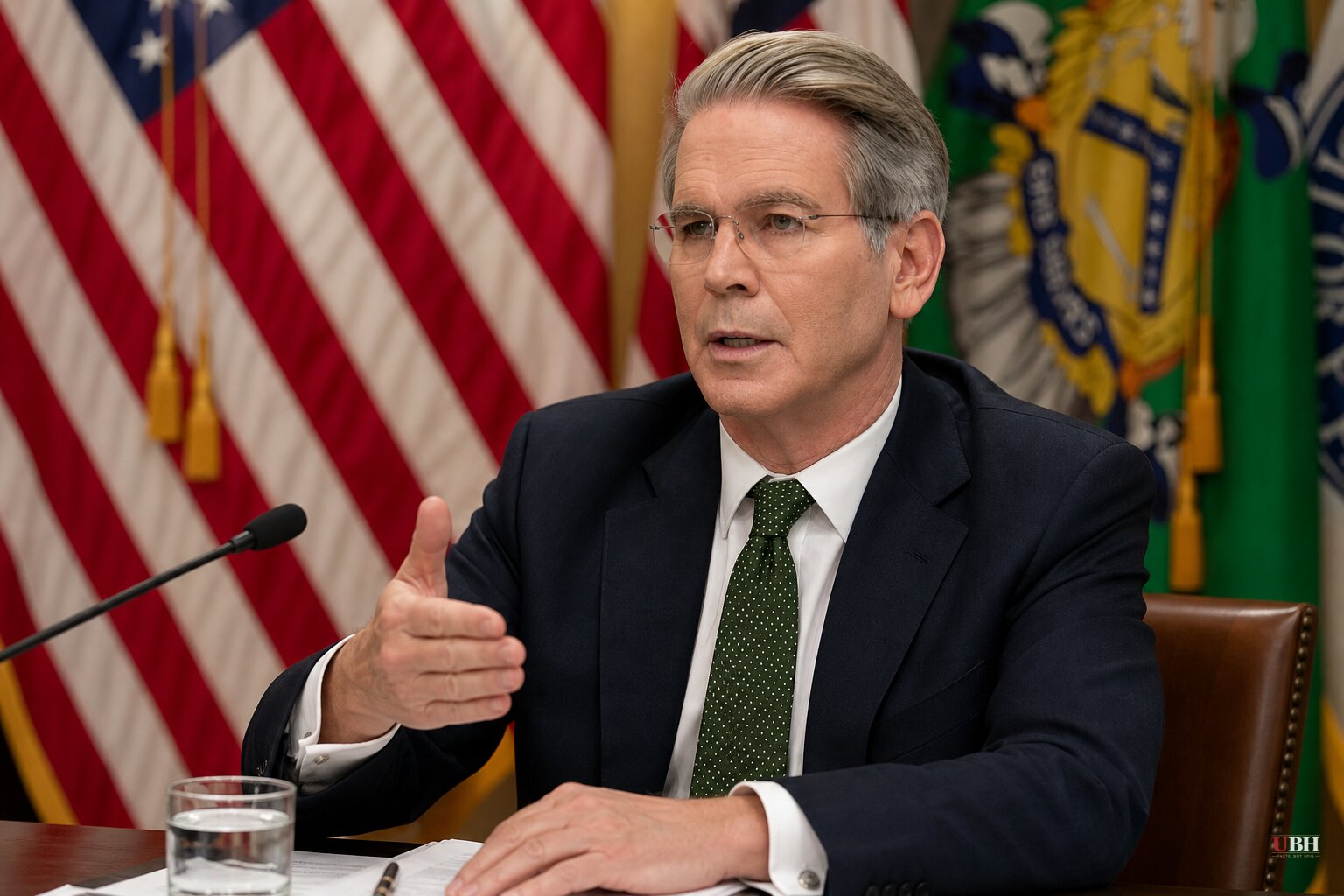
Treasury Secretary Scott Bessent got tired of one letter and reached for another. On Aug. 4, in a CNBC interview, Bessent declared the "K-shaped economy" finished. "I got sick of hearing about this K-shaped economy," he said. "I can say here definitively, the K-shaped economy is over."
In its place, Bessent says the U.S. now has a "C-shaped" economy, where wage growth at the bottom is catching up to, or outpacing, wage growth at the top. He pointed to Trump administration policies, including "no tax on tips" and "no tax on overtime," as drivers lifting lower-income workers.
What K, C and E actually mean
The K-shape has described the U.S. economy since the pandemic recovery: high-income households seeing faster gains in spending, wages and wealth while everyone else stalls, forming the two diverging arms of a K. Breyon Williams, chief economist at the progressive Groundwork Collaborative, described it to Marketplace as "one economy with two different experiences depending on where you fall in the income distribution. The top is pulling away and everyone else is treading water."
Former Federal Reserve Chair Jerome Powell called the pattern "clearly a thing" in a December press conference, according to PBS.
Bessent's C-shape would mean the gap is closing because the bottom is rising, not because the top is falling. A third camp is now pushing an "E-shape," three separate income tiers moving along their own tracks. Heather Long, chief economist at Navy Federal Credit Union, argues the E better captures a middle class that isn't collapsing but also isn't thriving, just holding on, according to CNBC.
Nobel Prize-winning economic historian Joel Mokyr, of Northwestern University, called the whole debate "alphabet soup."
The case for Bessent
There's real data behind the C claim. PNC researchers found in June that spending growth between upper- and lower-income households had converged to a three-year low, according to CNN. Bank of America Institute data showed lower-income consumers posting higher spending growth than wealthier ones in June, with wage growth nearly identical across income levels that month, CNN reported. Bank of America also found the gap in credit card spending between income groups narrowing starting in May.
On the corporate side, Hilton Worldwide CEO Christopher Nassetta told analysts his company is "definitely seeing" a C-shaped pattern, with middle- and upper-middle-income guests swinging from negative growth to gains as high as 6%. "The middle class is getting back in the game," Nassetta said. "It's really impossible to deny."
The case against
Other data cuts the other way. The Federal Reserve Bank of Atlanta's wage tracker still shows the highest-paid workers' wages climbing faster than the lowest-paid, according to Marketplace. Moody's Analytics found households earning over $200,000 a year have been spending more lately, while spending for everyone else is flat.
The University of Michigan's consumer sentiment survey found confidence down 11% in August compared to a year earlier, hovering near this year's lows. Survey director Joanne Hsu said the drop hit low- and middle-income respondents hardest.
Demand for aid keeps climbing too. Catholic Charities Dallas, which serves more than 240,000 people a year, told CNN its meal distribution jumped from roughly 9 million between summer 2024 and mid-2025 to more than 15 million in the months since, with the pace holding into 2026. Nationally, the 211 referral network logged 6 million housing referrals and 3 million utility referrals in 2025.
Household debt is also stretched. Researchers at the Federal Reserve Bank of New York found total credit card debt hit a near-record $1.26 trillion in the second quarter, which they say points to a large number of households living paycheck to paycheck.
Executives at Colgate-Palmolive, Lowe's and Constellation Brands have all said K-shaped spending patterns persist in their businesses, according to CNBC. Shane Grant, Colgate-Palmolive's operations chief for the Americas, raised the same point at a Deutsche Bank consumer conference in June.
The economists caught in between
Peter Orszag, CEO of Lazard, told CNBC that "declaring the death of a K-shaped economy is a little bit premature." Deon Strickland, a financial services professor at Wake Forest University, told PBS he thinks "the probability is higher for the continuation of a K than the ascent of a C."
Ryan Nunn, director of research at the Yale Budget Lab, told Marketplace he's seen "a more even pattern recently in wage growth" but wants more labor market data before drawing conclusions. Anthony Chan, JPMorgan's former chief economist, cautioned that the U.S.-Iran conflict could keep fuel prices elevated, which would hit lower-income households harder since they spend a larger share of their budgets on energy. "I'm the first to say that we can make some progress," Chan said, "but nothing of the sort of progress that we can say we can bury the K-shaped economy."
When The New York Times asked Treasury for the specific wage figures behind Bessent's claim, the department did not respond, according to Quartz's account of that reporting.
Why the timing matters
Bessent's declaration lands roughly three months before the midterm elections. That doesn't make the underlying wage and spending data he cited wrong. PNC and Bank of America's numbers are real and do show some convergence. But the fuller data set, from the Atlanta Fed, Michigan's sentiment survey, and the New York Fed's debt tracker, doesn't yet support calling the K-shape dead. The next test comes with the September jobs and wage reports, which will show whether the narrowing trend Nunn and PNC's Brian LeBlanc have flagged continues or reverses once energy prices and the fall data cycle roll in.
Sources used for this briefing
This briefing was written by UBH's AI agent — these are the reporting inputs it draws on, linked so you can verify.


