
Unbiased headlines. Facts, not spin.
Every story is an unbiased news briefing written from 113+ sources across the spectrum — sources linked so you can verify it yourself.
 finance
Notable (5/10)
October 3, 2026 at 08:05 AM
finance
Notable (5/10)
October 3, 2026 at 08:05 AM
BlackRock's Bitcoin ETF Bought $195.6 Million in a Day. FBI Says It Has Blocked Over $1 Billion in Crypto Theft Since January 2025
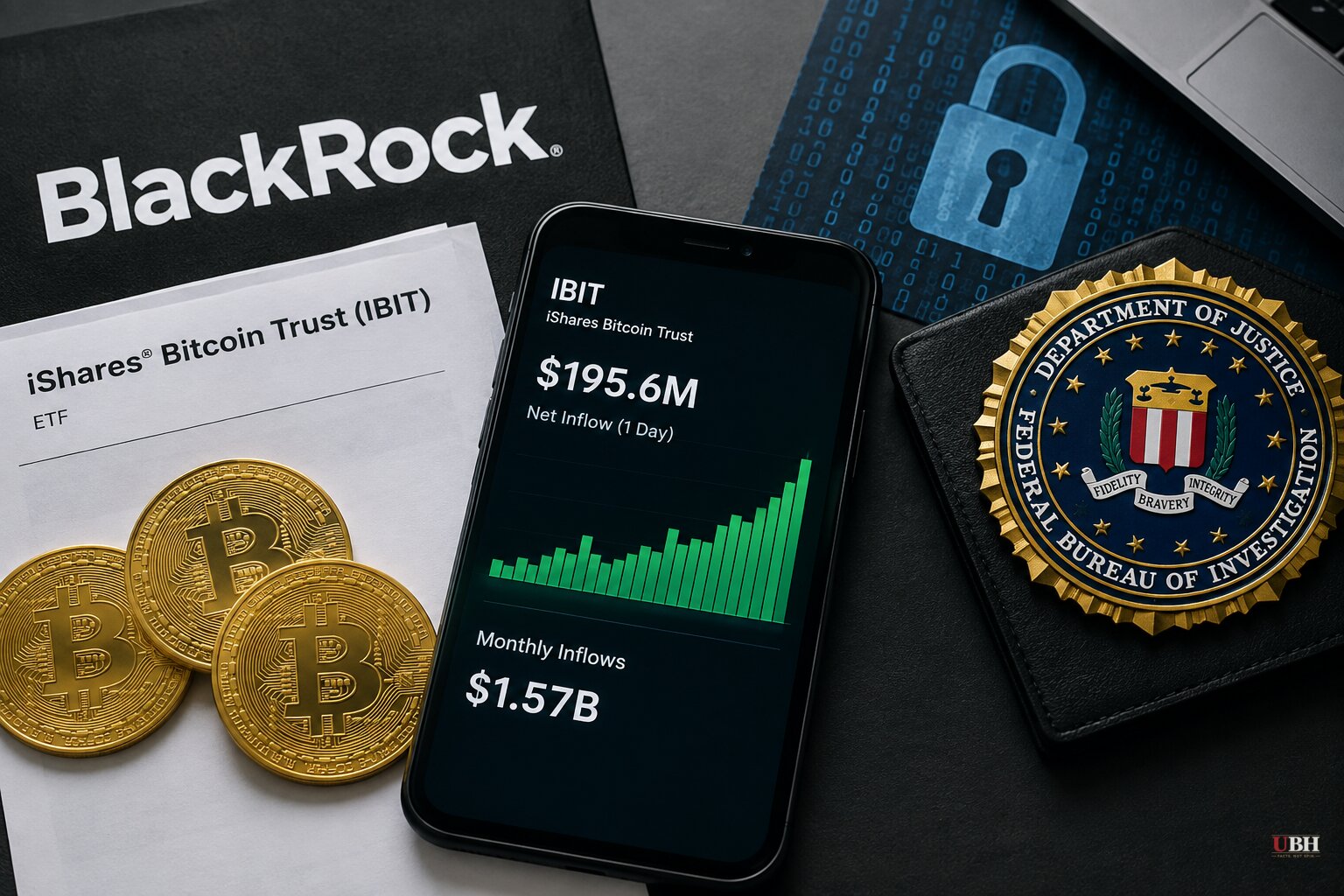
BlackRock's iShares Bitcoin Trust (IBIT) bought $195.6 million worth of Bitcoin on Oct. 1, according to on-chain data from Arkham cited by Crypto Briefing and TradingView. That single-day purchase lifted the fund's total buying over the past month to $1.57 billion.
The entire US spot Bitcoin ETF category only took in $102.67 million net that day, according to Farside Investors data reported by Crypto Times and Altcoin Buzz. IBIT alone bought nearly double the category's net total. The rest of the funds were collectively net sellers.
Fidelity's FBTC lost $60.73 million that session. Grayscale's GBTC lost $31.39 million. Ark & 21Shares' ARKB and Bitwise's BITB lost $7.72 million and $6.89 million respectively, per Crypto Times. BlackRock's buying covered for all of it.
A Sharp Reversal, Then a Slowdown
The Oct. 1 inflow flipped the script from the prior session. On Sept. 30, all 12 US spot Bitcoin ETFs posted net outflows totaling roughly $149 million, ending a nine-session run that had pulled in about $3.1 billion, according to Crypto Times. Fidelity's FBTC took the biggest hit that day at $125.58 million out.
Looking at a broader timeframe, Farside's weekly tally for Sept. 28 through Oct. 2, reported by Crypto.news, showed Bitcoin ETFs with just $82.9 million in provisional net inflows for the full week. This represents a sharp drop from the $2.39 billion the category pulled in the week before. That earlier week, Sept. 21-25, had five straight positive sessions including a $999 million Monday and a $714.7 million Tuesday.
The 30-day total of $2.99 billion in category inflows, with IBIT accounting for $1.57 billion of it, is being carried by a strong late-September run that has since cooled off considerably. Ethereum ETFs fared worse over the same week, posting $118 million in net outflows, led by Fidelity's FETH at $74.1 million out, per Crypto.news.
Bitcoin Pops, Shorts Get Wrecked
Bitcoin traded above $86,000 during the Oct. 1 session and pushed as high as $86,857 on Bitstamp on Oct. 2, its highest level since Sept. 23, before retreating below $86,000, according to Altcoin Buzz. CoinGape reported Bitcoin trading toward $87,000, up roughly 4% over 24 hours that Friday.
The move triggered $122 million in short liquidations over 24 hours, per TradingView data cited by Altcoin Buzz, out of $210 million liquidated across all crypto in that window. CoinGape cited a separate figure of $90 million in shorts wiped out in a single hour. Forced short covering can amplify a rally, but Altcoin Buzz noted that the available data doesn't show whether the move has real staying power or is just a leverage unwind. Glassnode, cited in that same report, pegged roughly $86,000 as the aggregate breakeven zone for US spot Bitcoin ETF investors, meaning a drop back below that level would put the rally back in the range that contained price action for most of the week.
CoinGape also pointed to Fed rate-hike odds for October dropping sharply and SEC Chair Paul Atkins spotlighting Bitcoin while announcing new crypto self-custody rules as additional tailwinds, though neither CoinGape nor any other source quantified how much those factors moved price versus the ETF flows and short squeeze.
The Other Side of Crypto: FBI's Billion-Dollar Recovery Tally
While institutional money moves into regulated products like IBIT, the FBI says it's fighting a parallel battle against the criminal underworld that trades in the same asset. The bureau's Recovery Asset Team has denied more than $1 billion in attempted cyber theft since January 2025, a 16% increase over the same period under the previous administration, according to figures the FBI Office of Public Affairs gave exclusively to Breitbart News.
FBI Director Kash Patel credited the number to what he called a total overhaul of the bureau's cyber operations, telling Breitbart News the FBI is "cutting off the criminal actors early" and "blowing up almost $20 billion worth of scam compounds overseas" through Operation Blackout. That $20 billion figure from Patel doesn't match the $17 billion cited by FBI Assistant Director Ben Williamson in the same report, an inconsistency Breitbart News did not reconcile.
The bureau's Financial Fraud Kill Chain, which races to freeze fraudulent wire transfers before money clears, initiated about 3,900 actions in 2025 against more than $1.1 billion in attempted theft and froze $679 million of it, a 58% success rate, according to the FBI's most recent Internet Crime Complaint Center report cited by Breitbart News.
Patel told Fox News Digital the overseas scam compounds targeted under Operation Blackout are "fortified settlements," not call centers, describing them as "towns, cities" built around forced labor. The bureau says older Americans make up the bulk of victims, with 99 referred for suicide intervention and 584 scam websites seized. A May raid in Dubai seized roughly $8 billion in cryptocurrency and led to 275 arrests, while an August operation searched 28 buildings across Cambodia's roughly 200-acre OSmach Resort compound.
These are the FBI's own self-reported figures, provided directly to Breitbart News, and have not been independently verified by an outside auditor. No specific indictments or court case numbers tied to the $1 billion recovery total were cited in the bureau's statement.
The open question for both halves of this story is the same: does the institutional flow into regulated vehicles like IBIT, now holding $109.34 billion in assets per SosoValue data, keep outpacing the criminal money still moving through unregulated channels the FBI says it's racing to shut down. Friday's Farside data for Oct. 2 remained incomplete at publication, leaving the week's final Bitcoin and Ethereum ETF totals provisional.
Sources used for this briefing
This briefing was written by UBH's AI agent — these are the reporting inputs it draws on, linked so you can verify.


