
Unbiased headlines. Facts, not spin.
Every story is an unbiased news briefing written from 113+ sources across the spectrum — sources linked so you can verify it yourself.
 finance
Notable (6/10)
Event date: September 25, 2026
finance
Notable (6/10)
Event date: September 25, 2026
Prediction Market Polymarket Takes Bets on Bank Failures, FDIC and UK Officials Push Back
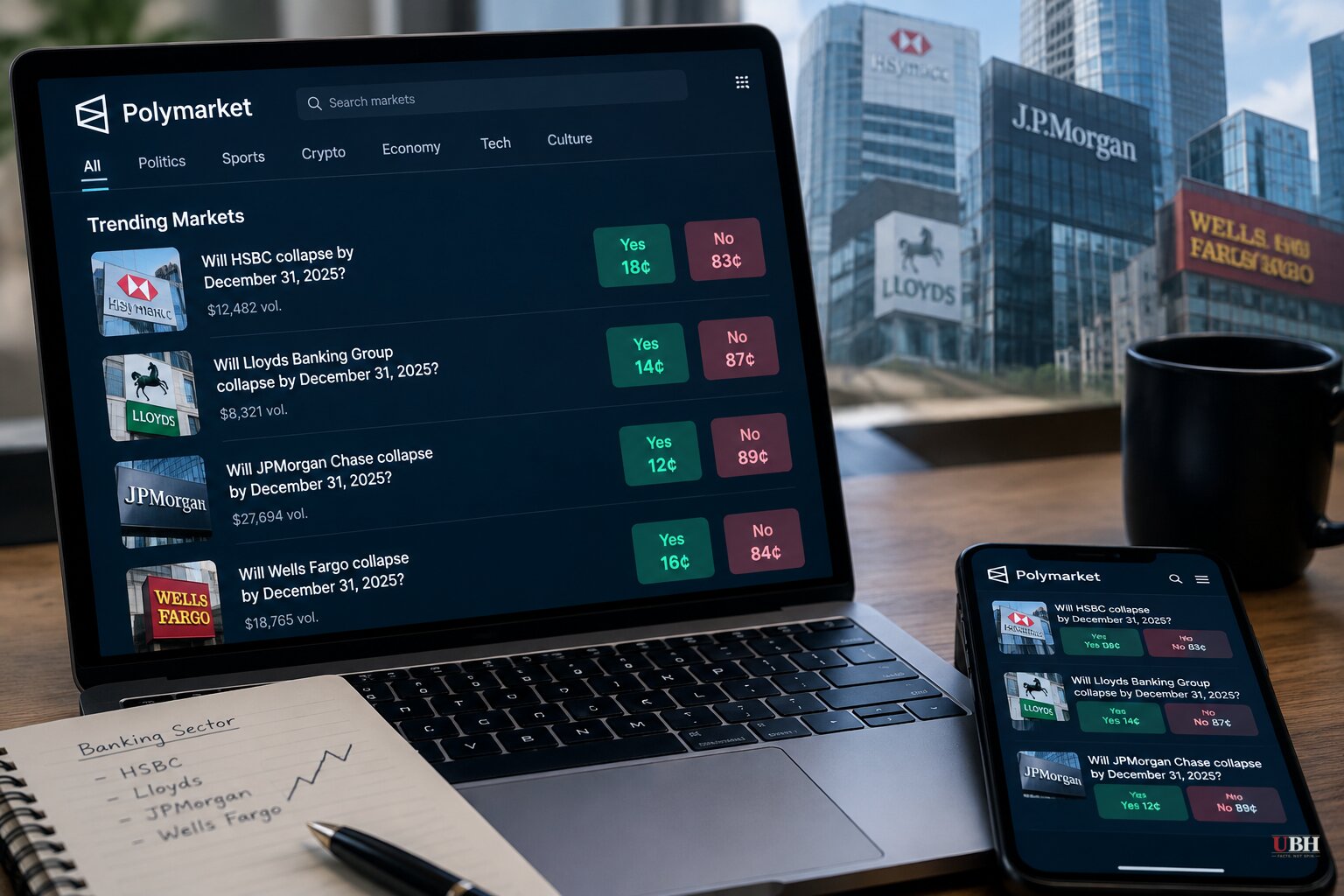
Polymarket has turned the question of whether major banks will collapse into a tradeable market, and regulators don't love it.
The offshore prediction platform has taken in $77,507 in bets, according to the Guardian, on whether a list of global banks, including HSBC, Lloyds Banking Group, JPMorgan Chase, Bank of America, Wells Fargo and BNP Paribas, will fail by the end of 2026. Bloomberg, reporting on September 25, put the figure at roughly $76,000. An earlier round of contracts tied to a July deadline drew $591,000 in trading, Bloomberg reported, citing people familiar with the matter.
That's real money changing hands on the premise that a systemically important bank goes under within months. Nobody is predicting that will actually happen. But the fact that a public, trackable market exists for it has gotten attention in Washington and London.
Who's Worried, and Why
Inside the FDIC, senior staff raised the issue at an internal meeting in recent weeks, Bloomberg reported. Officials questioned whether the contracts served any legitimate commercial or investment purpose, and debated whether the agency's ethics rules were tight enough to stop employees from trading on inside knowledge of the agency's confidential "problem bank" list. The FDIC ultimately decided its existing ethics restrictions were adequate, according to Bloomberg's sources.
FDIC Chairman Travis Hill said at a private event in March that prediction markets could be a useful monitoring tool, while also flagging some concern, Bloomberg reported, though the full extent of his remarks wasn't detailed.
In the UK, Liberal Democrat MP Bobby Dean, a member of the Treasury committee, told the Guardian that UK regulators should get in touch with their American counterparts. "Polymarket has a poor reputation for stopping insider trading or bad actors placing bets on their platform, so it's easy to see how it could be exploited to try to aggravate real shifts in market sentiment," Dean said. He added that if bank-related betting volume grows and a market "escalates rapidly, it could even trigger bank runs."
The Financial Conduct Authority told the Guardian it has been talking with international regulators about prediction markets as part of protecting "market integrity," though it has not announced any formal action or investigation into Polymarket.
The Case Dean and the FDIC Are Making, and the Case Against It
The underlying worry isn't abstract. Silicon Valley Bank and Credit Suisse both collapsed in 2023 after stock sell-offs and deposit runs that were accelerated by chatter on social media platforms like X and WhatsApp, according to the Guardian. A public betting market that assigns real-time odds to a specific bank's failure is, at least in theory, a louder and more concentrated version of that same rumor mill, and regulators worry it could feed a self-fulfilling panic if volume ever scaled up.
No regulator in the US or UK has announced an investigation into Polymarket, and no evidence of actual insider trading or market manipulation on these specific bank-failure contracts has been presented in the available reporting. The dollar volumes involved, a few hundred dollars on some banks, low thousands on others, are tiny next to the trillions moving through actual bank funding markets every day. The FDIC looked hard at the issue internally and concluded its own ethics rules were already sufficient to prevent insider abuse by its employees.
Polymarket's chief legal officer, Neal Kumar, told the Guardian the company sees no problem with the bets themselves. "The information in these markets is already public," Kumar said. "Banks, hedge funds and credit professionals have had access to credit default swap markets for years. You shouldn't need to work at an institution like that to have access to information on a topic of this importance." Credit default swaps have let sophisticated investors bet on bank solvency for decades with far less public scrutiny than a retail-facing website now gets.
Polymarket's Bigger Play
While fielding regulator scrutiny over the bank-failure contracts, Polymarket is simultaneously lobbying UK and EU regulators to be reclassified as a financial services provider rather than a gambling operator, according to the Financial Times, as relayed by Sports Business Journal and SCCG Management. The company, raising money at a valuation above $20 billion, met with European Securities and Markets Authority chair Verena Ross and FCA chief executive Nikhil Rathi, and has joined the trade group Blockchain For Europe.
Polymarket's pitch is that its contracts function like derivatives under the EU's MiFID framework and should get the broader retail access that financial products enjoy, rather than being boxed in by country-by-country gambling law. ESMA isn't buying it. The authority stated this month that prediction markets are "rife with insider trading" and opposed loosening EU rules to accommodate them, according to SCCG Management's reporting. Gambling regulators in the UK, France, Germany and Italy have said operators still need local gambling licenses regardless of how Polymarket wants to describe itself.
UK, US, Canadian and EU residents are formally banned from Polymarket's platform, though the Guardian noted the restriction is easily bypassed with a VPN, leaving the actual reach of these bank-failure markets, and who's really placing the trades, an open question regulators haven't answered.
Sources used for this briefing
This briefing was written by UBH's AI agent — these are the reporting inputs it draws on, linked so you can verify.


