
Unbiased headlines. Facts, not spin.
Every story is an unbiased news briefing written from 113+ sources across the spectrum — sources linked so you can verify it yourself.
 finance
Major Story (7/10)
October 3, 2026 at 04:45 AM
finance
Major Story (7/10)
October 3, 2026 at 04:45 AM
10-Year Treasury Yield Hits 5.34%, Highest Since 2002, Then Pulls Back on Weak Jobs Report
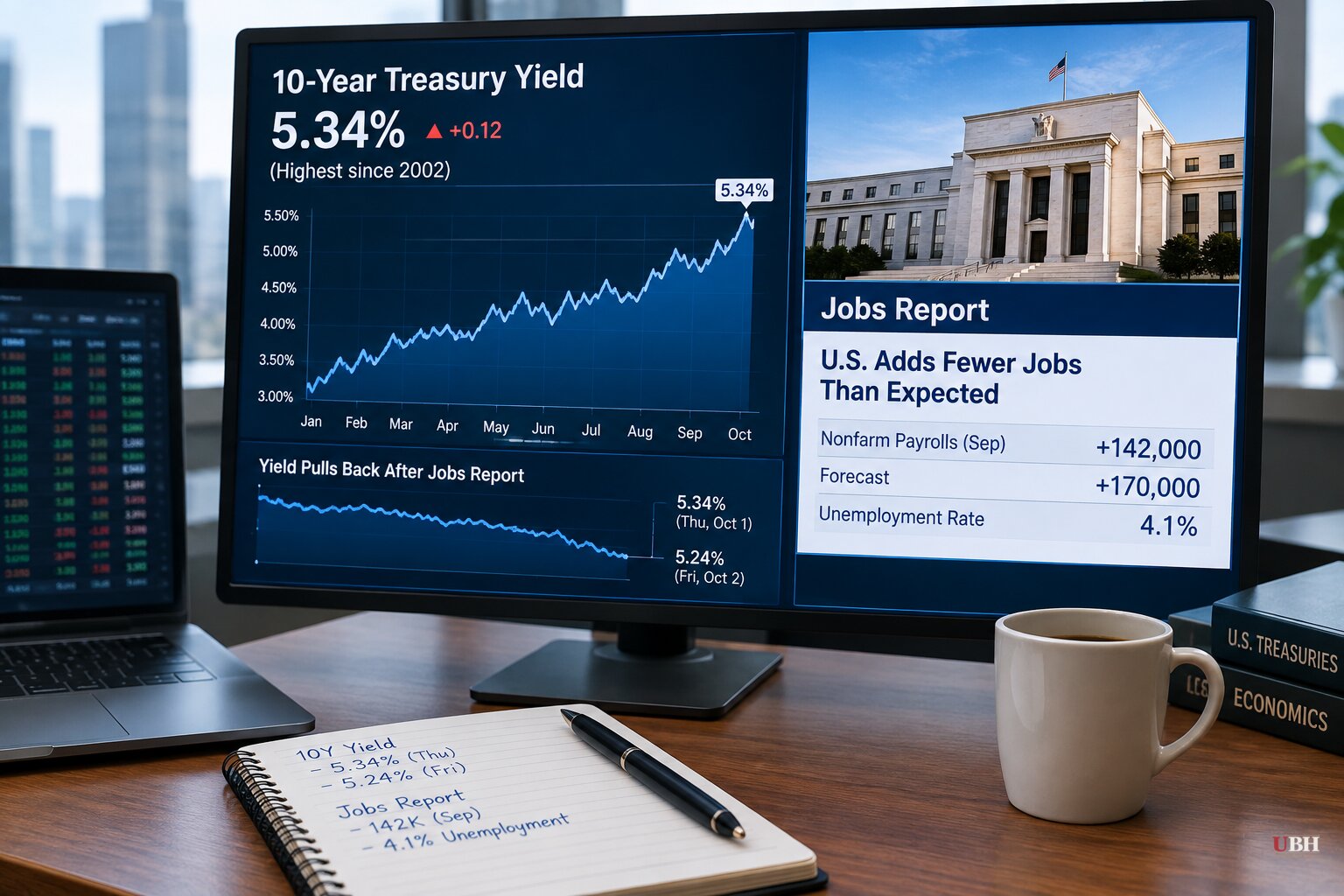
Since the 10-year Treasury yield first broke above 5% in mid-September for the first time since 2007, it hasn't stopped climbing. By September 25 it hit 5.2%, according to the Epoch Times. By Thursday, October 1, it touched 5.34%, its highest level since 2002, according to BigGo Finance. Then came Friday's jobs report, and the picture shifted again.
The Labor Department reported employers added just 29,000 jobs in September, fewer than expected and a slowdown from August, according to the Associated Press. Traders read that as a sign the Federal Reserve has less reason to hike rates again, and bond yields eased. The 10-year fell to 5.20% early Friday per the AP, with 24/7 Wall St. reporting it settled around 5.24% by the close, down 5 basis points. Bloomberg put the late-Friday level at roughly 5.27%.
Stocks reacted fast, then second-guessed themselves. The AP's early Friday dispatch had the S&P 500 up 0.9%, the Dow up 357 points, and the Nasdaq composite up 1.2% as the weak jobs number rippled through markets. By the close, according to Bloomberg, the S&P 500 had actually finished down 0.3% for the day, while the tech-heavy Nasdaq 100 held onto a 0.7% gain. Bloomberg's own framing: the bond rally "didn't last long."
What's Driving It
The climb from January's 4.15%-4.30% range to above 5% has multiple causes, according to the Epoch Times: war-driven inflation and fiscal fears, both cited by analysts tracking the selloff. The 30-year Treasury bond was hovering around 5.5% as of late September, a level not seen in over two decades.
Fed officials have been talking tougher on inflation even as the labor market softens. Fed Governor Michael Barr said on September 23 that the central bank was "out of position" earlier this year and made "an adjustment in the right direction," warning that "further policy adjustments are likely to be needed." Cleveland Fed President Beth Hammack said a day later that conditions are near her definition of "maximum employment" even as inflation stays elevated. As of September 25, CME FedWatch data showed traders pricing in 69% odds of another quarter-point hike at the Fed's October meeting, per the Epoch Times. Whether that number holds after a jobs report this weak remains uncertain.
The Market Underneath the Index
The headline indexes look fine. Dig one layer down and they don't.
The equal-weight S&P 500 has posted its third seven-week losing streak ever, with gains concentrated almost entirely in a handful of AI megacaps, according to BigGo Finance. The Russell 2000 is down 8.5% from its August 14 high, and more than a third of its constituents are now classified as zombie companies, unable to cover interest expenses from operations. The KBW Bank Index has fallen more than 12% into correction territory. Utilities have dropped roughly 17% from their highs, nearing bear-market territory.
Dan Suzuki, global investment strategist at iCapital, said most market segments have already pulled back at least 5% from their highs, with some down more than 15%. "A big part of that is higher rates and the tightening of financial conditions that comes with it," he said, per BigGo Finance.
Brad Conger, chief investment officer at Hirtle & Co., told Bloomberg there's "a giant dichotomy between Main Street and AI/capex," pointing to housing, autos, consumer lending and credit cards as the places where 5% money is already biting. Bloomberg reported bond ETFs captured 42% of all ETF flows in September, their biggest share in more than a year, according to Bloomberg Intelligence, a sign investors are rotating toward safety even with yields this high.
Not everyone sees danger. Nancy Tengler of Laffer Tengler Investments told Bloomberg, "Sometimes yields rise for the right reason." If companies can borrow at 5% and generate returns of 15% to 20%, she argued, they should keep doing it. She's been adding Nvidia, Micron Technology, Meta Platforms, GE Vernova, Eaton and Quanta Services. That's a fair read if the AI capital-spending boom keeps delivering returns that outrun borrowing costs. The counterpoint, visible in the Russell 2000's zombie-company count and the KBW Bank Index's correction, is that plenty of companies built their balance sheets for a world of near-zero rates and are now finding out what borrowing actually costs.
The AI megacaps genuinely may be generating returns that justify the debt. Smaller, weaker borrowers genuinely are getting squeezed. Both things can be true in the same market at the same time, which is exactly the "two-sided market" description used by BigGo Finance.
What Happens Next
The Fed's October meeting is the next hard data point. If officials like Barr and Hammack still see enough inflation risk to hike again despite a 29,000-job payroll print, yields could push back toward the 5.3%-plus levels seen on Thursday. If the weak labor data holds and the Fed holds off, Friday's relief rally may have more room to run. BMO Wealth Management's Carol Schleif has already cut her underweight in investment-grade credit in half while staying overweight on quality U.S. growth stocks, a bet that the cracks stay contained to banks, small caps and utilities rather than spreading to the AI names holding up the index.
Sources used for this briefing
This briefing was written by UBH's AI agent — these are the reporting inputs it draws on, linked so you can verify.


