
Unbiased headlines. Facts, not spin.
Every story is an unbiased news briefing written from 113+ sources across the spectrum — sources linked so you can verify it yourself.
 finance
Major Story (7/10)
October 2, 2026 at 11:02 PM
finance
Major Story (7/10)
October 2, 2026 at 11:02 PM
Community Banks Sue OCC, Say It Illegally Opened the Door for Crypto Firms to Get Bank Charters
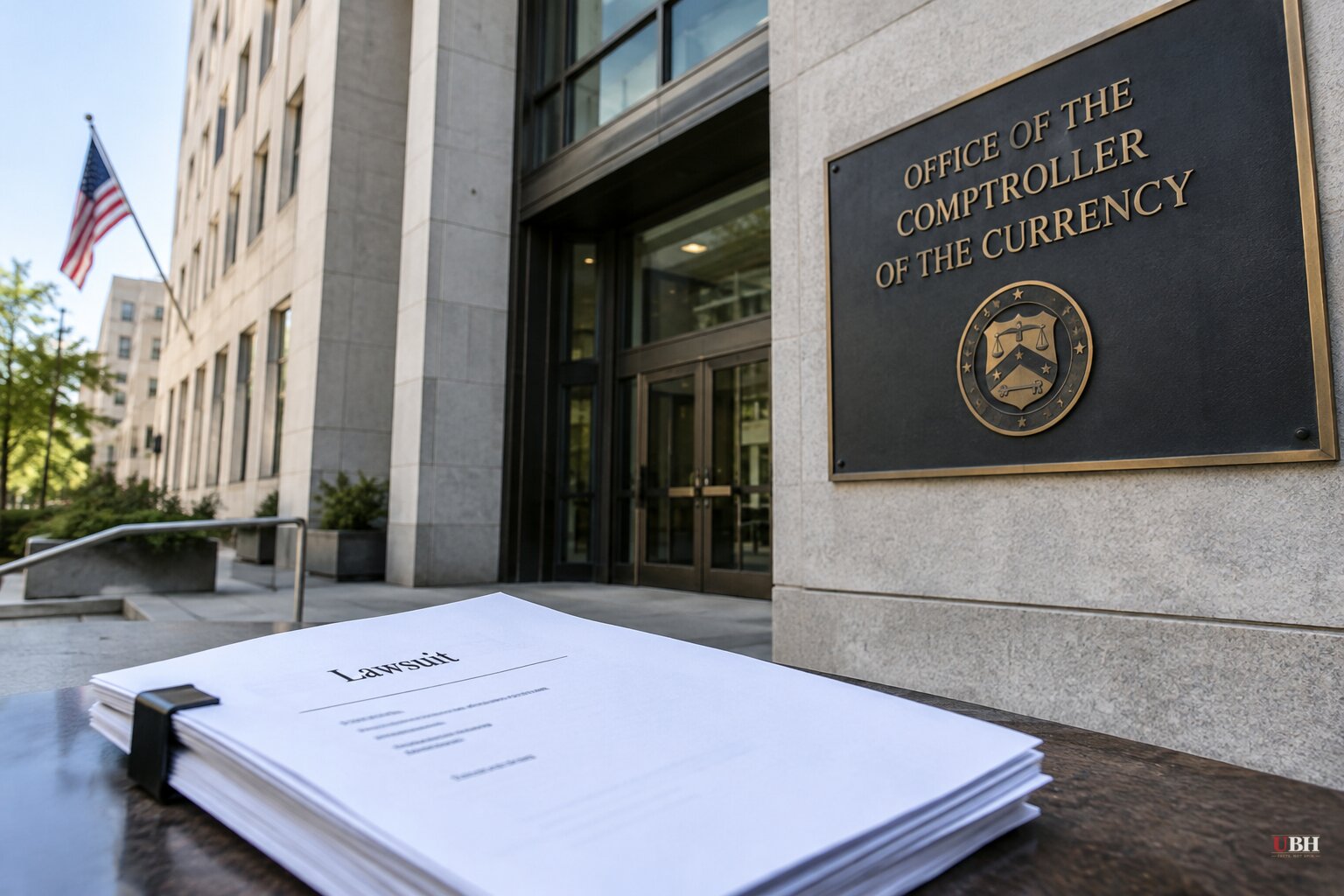
Community bankers are done watching from the sidelines. On October 2, 2026, the Independent Community Bankers of America filed suit against the Office of the Comptroller of the Currency in the U.S. District Court for the District of Columbia, demanding a judge kill the regulatory pathway that let crypto companies start collecting national bank charters.
What's Actually Being Challenged
The lawsuit targets three things: the OCC's final rule issued March 2, 2026, the agency's 2021 Interpretive Letter No. 1176, and the conditional charter approval it gave Protego Holdings Corp., according to Crypto Times and The Defiant. The rule opened national trust bank charters to firms doing non-fiduciary work, including straight-up custody of digital assets, not the traditional trust and estate management these charters were built for.
ICBA's argument is simple: the National Bank Act never gave the OCC power to charter companies that don't take deposits and aren't primarily doing fiduciary business. ICBA President and CEO Rebeca Romero Rainey put it bluntly in a statement carried by American Banker: "American consumers reasonably expect a federally chartered bank to carry federal protections. Digital assets held at a crypto firm operating under a national trust charter do not carry those important safeguards."
The Scale of What's Already Happened
This isn't a hypothetical fight over one pending application. American Banker reports the OCC has approved, conditionally or otherwise, 21 trust banks since the Trump administration took over the agency, and at least 13 of those are crypto companies. That list includes Stripe's Bridge National Trust Bank, Protego's National Digital Trust Company and Foris DAX National Trust Bank, the proposed U.S. subsidiary of Crypto.com, all approved in February 2026, according to Crypto Times.
American Banker also notes the Trump family-linked World Liberty Financial, along with Coinbase and Circle, got trust charters under the same framework. Ripple and Payward, the parent of Kraken, have pursued similar charters and drew ICBA objections, per Crypto Times. The current Comptroller of the Currency, Jonathan Gould, wrote the original 2021 interpretive letter himself while serving as the OCC's chief counsel during Trump's first term, American Banker reported. That's the same legal theory now codified into a formal rule under his watch.
Why the Timing Lines Up With the GENIUS Act
The surge in applications isn't a coincidence. American Banker ties it directly to the GENIUS Act, the stablecoin law Trump signed that caps state-qualified stablecoin issuers at $10 billion in outstanding tokens. A national trust charter sidesteps that cap entirely and lets a firm become a federal qualified payment stablecoin issuer. For any crypto company planning to scale stablecoins nationwide, that's a real incentive to get a federal charter instead of a patchwork of state licenses.
There's a catch ICBA keeps hammering: these trust charter banks aren't classified as banks under the Bank Holding Company Act. That means the Federal Reserve has no authority to supervise their parent companies the way it would a traditional bank holding company. ICBA's complaint says that creates "a gaping hole in financial regulation," and argues uninsured entities could use the charters to dodge state consumer protection laws altogether.
The Case for the Other Side
Crypto firms and the OCC's own 2021 legal reasoning make a straightforward case: a single federal framework beats fifty different state rulebooks, and a federally chartered custodian has to meet baseline safety and soundness standards regardless of whether it's also FDIC-insured. Supporters of the charter pathway argue that forcing every digital asset custodian into a 50-state licensing maze doesn't protect consumers, it just slows down an industry Washington has already decided, through the GENIUS Act, it wants to bring onshore.
ICBA's counter is that "wants to encourage innovation" doesn't override what Congress actually wrote into the National Bank Act. If the OCC wants trust charters to cover non-fiduciary crypto custody, ICBA argues, that's a job for Congress or, at minimum, formal notice-and-comment rulemaking that actually grapples with the consumer protection gap, not an expanded reading of a two-decade-old statute.
The Senate's own September 15 vote underscores how unsettled this is at the legislative level. Republicans failed 49-50 to advance the Digital Asset Market Clarity Act, a broader crypto framework bill, after Senator Thom Tillis flipped his vote to no, according to the Epoch Times. Banks had separately demanded the bill address stablecoin interest payouts they say could drain traditional deposits.
The OCC declined to comment on the lawsuit, citing ongoing litigation, an agency spokesperson told American Banker. No hearing date has been set. The suit will determine whether dozens of already-approved crypto trust charters, and the firms now operating under them, stay on solid legal ground or get pulled back into a regulatory vacuum.
Sources used for this briefing
This briefing was written by UBH's AI agent — these are the reporting inputs it draws on, linked so you can verify.


