
Unbiased headlines. Facts, not spin.
Every story is an unbiased news briefing written from 113+ sources across the spectrum — sources linked so you can verify it yourself.
 finance
Notable (6/10)
October 2, 2026 at 10:06 PM
finance
Notable (6/10)
October 2, 2026 at 10:06 PM
IMF Approves $138 Million for El Salvador After Waiving Its Own Bitcoin Rule Breach
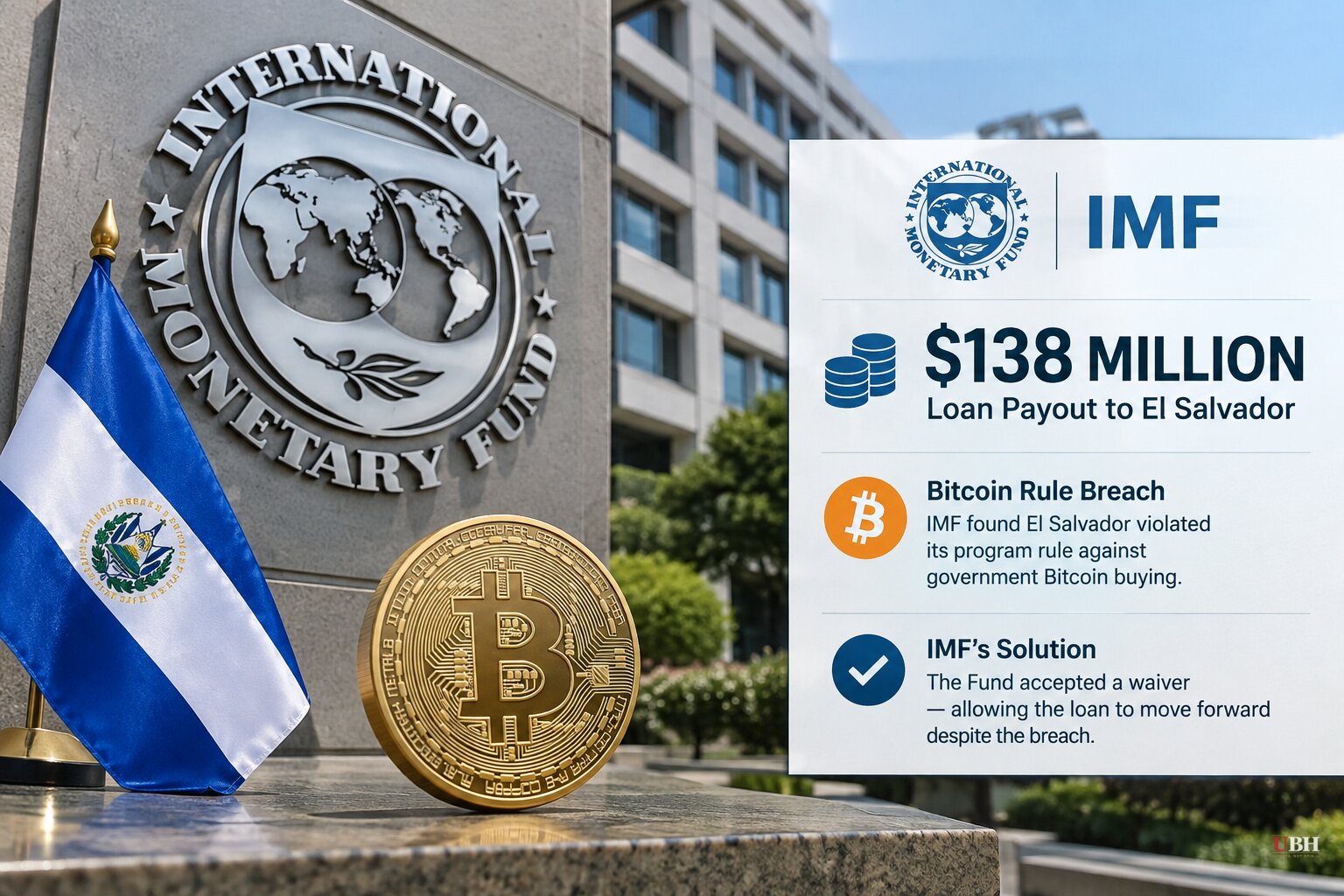
El Salvador got paid anyway.
The IMF's Executive Board completed the combined second and third reviews of the country's $1.4 billion Extended Fund Facility on October 1, 2026, and released SDR 101.96 million, which the Fund values at roughly $138 million, according to Central Banking and Crypto News. Bloomberg pegged the same disbursement at $139 million, a gap that comes down to which day's exchange rate you use for converting Special Drawing Rights, not a factual dispute.
The board found El Salvador had missed several performance targets, including the one capping government Bitcoin purchases, according to Crypto News and BigGo Finance. Under the program, there's a continuous zero-ceiling rule on voluntary public-sector Bitcoin accumulation, as Tech Times reported. El Salvador exceeded it anyway.
How Much Bitcoin, and How It Grew
When the program's Bitcoin baseline was set, the government held somewhere between 5,968 and 6,070 BTC, depending on the source, per Crypto Briefing and TradingView. By early September 2026, that had climbed to roughly 7,760 to 7,792 BTC, an increase north of 1,700 coins. Tech Times pegged the increase more precisely at about 1,796 BTC.
At current prices the stash is worth approximately $618 million, with a range of $598 million to $660 million depending on Bitcoin's swings, according to figures from BitcoinTreasuries.net cited by Crypto Briefing and TradingView. Every coin sits on a public blockchain, so the holdings themselves aren't in dispute. What's in dispute is where the new coins came from.
The Donation Explanation
The IMF split the breach into two time periods. Movement before June 27, 2025, the date of the program's first review, was explained as the government moving coins it already owned from a BANDESAL cold-storage wallet into the Strategic Bitcoin Reserve Fund wallet, not new purchases. IMF spokesperson Julie Kozack confirmed that explanation back in July 2025, per Tech Times.
Movement after that date is a different story. That includes a November 2025 announcement of a 1,090 BTC purchase worth about $100 million. The IMF's position, confirmed in its October 2026 review, is that Bitcoin added since June 2025 came from private donations rather than government resources, according to Crypto Briefing, TradingView and Crypto News. Because the coins were classified as donations rather than state purchases, the accumulation limit didn't technically apply to them.
The distinction depends on whether the documentation holds up, and it's also convenient. Tech Times flagged directly that the private donors behind this were never named or quantified in anything the IMF has made public. Crypto News reported the same gap, noting "donor identities and individual donation amounts were not made public." The Fund says it reviewed documentation. The public hasn't seen it.
A reasonable defender of the arrangement would point out that IMF program reviews routinely rely on confidential financial documentation that governments aren't required to publish, and that the Fund's own economists, not outside critics, signed off on the paper trail. About how IMF reviews normally work, this is accurate. It doesn't change the fact that outside observers have no way to independently verify who funded roughly $100 million-plus in Bitcoin purchases routed through a government wallet.
Chivo Gets Privatized, Sort Of
As part of the deal, El Salvador transferred majority ownership and operational control of Chivo, the state-linked Bitcoin wallet, to a private operator, according to BigGo Finance and Cryptonomist. Dan Katz, the IMF's First Deputy Managing Director, who chaired the board discussion, called the Chivo transfer "a welcome step" but said remaining public-sector exposure should be fully unwound, per Cryptonomist. Katz also said regulations are being strengthened as the state's role in Bitcoin shrinks and called for more transparency and oversight of whatever Bitcoin exposure the government still holds.
The IMF's broader economic assessment was upbeat. The Fund's statement said "economic activity has exceeded expectations, supported by sustained improvements in security and investor confidence, as macroeconomic imbalances continue to be addressed," and that fiscal consolidation has advanced broadly in line with program objectives, according to Central Banking. BigGo Finance reported the IMF now projects El Salvador's economy will grow 4.5% in 2026 and 4% in 2027.
What's Actually Settled, and What Isn't
The Bitcoin conditions aren't gone. They remain in place for future disbursements, meaning any further breach requires another waiver and could put the entire $1.4 billion program at risk, per BigGo Finance. The Fund's stated expectation, as reported by Crypto News, is that "no further Bitcoin accumulation is expected beyond documented donations" going forward.
Tech Times framed the broader significance plainly: this is the first time the IMF's governing board has formally accommodated a sovereign government's crypto holdings under an active loan program rather than treating accumulation as a program-ending breach. That's now sitting on the books as precedent, available to any other emerging-market government that wants to keep buying or holding Bitcoin while staying eligible for IMF money.
The open question is simple and still unanswered: who are the donors, how much did each one give, and will the next IMF review demand that information be made public before approving the next tranche. Nobody in these reports has an answer yet.
Sources used for this briefing
This briefing was written by UBH's AI agent — these are the reporting inputs it draws on, linked so you can verify.


