
Unbiased headlines. Facts, not spin.
Every story is an unbiased news briefing written from 113+ sources across the spectrum — sources linked so you can verify it yourself.
 finance
Notable (5/10)
October 3, 2026 at 09:58 AM
finance
Notable (5/10)
October 3, 2026 at 09:58 AM
Cerebras Shares Hit Post-IPO Low, Down More Than Half From Debut as Nvidia Report and Insider Selling Collide
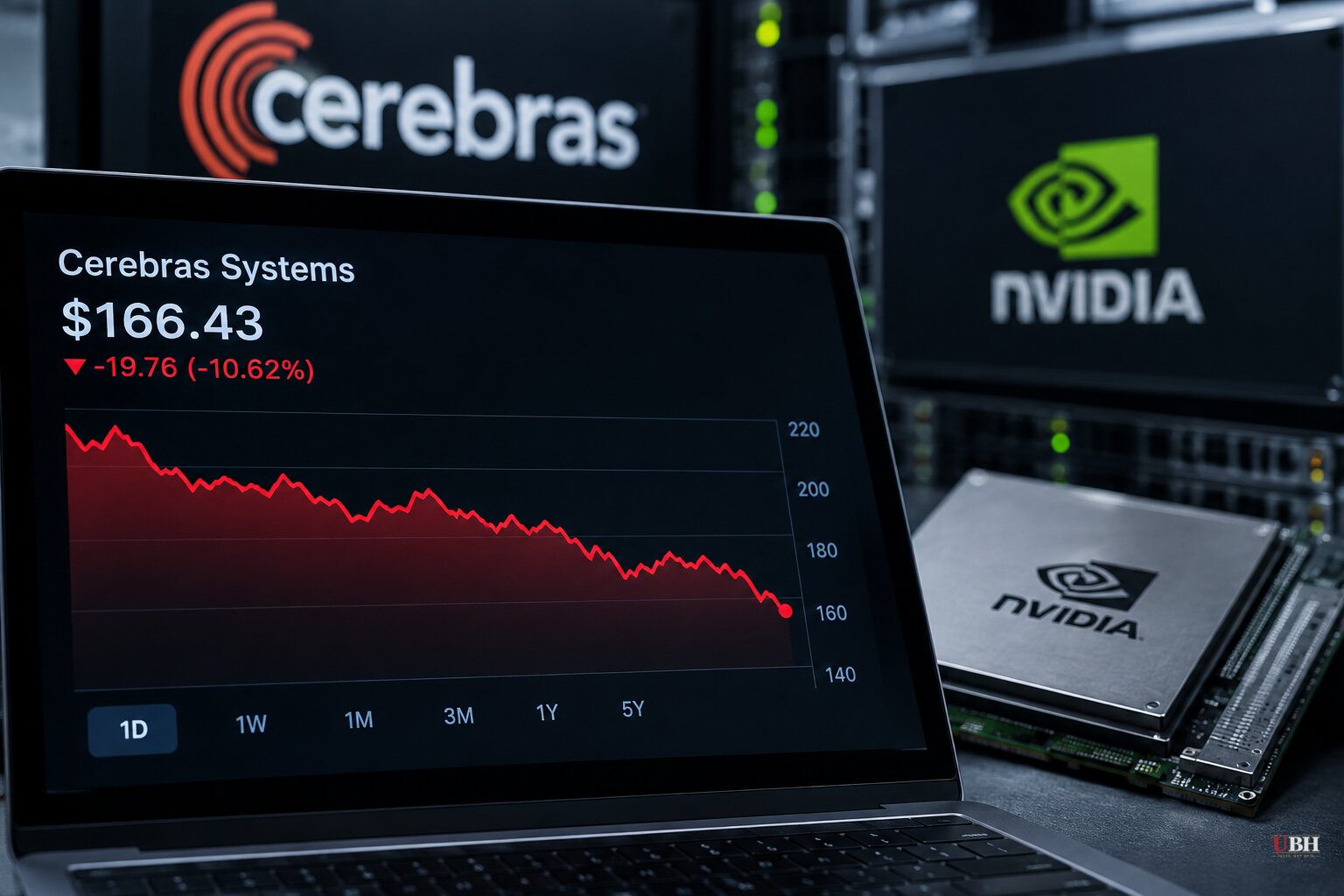
Cerebras Systems shares closed Friday at $166.43, the lowest price since the company's Nasdaq debut in May, according to CNBC and Briefs. That's a nearly 20% drop for the week and puts the stock more than 50% below the pop it got on its first trading day.
The company priced its IPO at $185 a share on May 14, 2026, then opened that first session at $350 and closed the day at a $95 billion valuation, according to 24/7 Wall St and CNBC. Cerebras' market cap now sits at just over $39 billion, per CNBC and Briefs.
What Triggered the Slide
Research firm SemiAnalysis posted on X on Wednesday, September 30, claiming OpenAI will run the "Ultrafast" mode of its upcoming GPT-6.1 Sol model on Nvidia GPUs rather than Cerebras hardware, running at a low batch size, according to CNBC and Finance Feeds. OfficeChai and Investing.com, both citing the same SemiAnalysis post, reported the claim the same day, and Investing.com's version was also carried by Yahoo Finance, per Finance Feeds. OpenAI has not publicly confirmed which hardware powers that specific tier.
OpenAI CEO Sam Altman pushed back directly. "Cerebras is a close partner, and we have a deep engagement pushing on the frontiers of speed," he wrote on X, addressing what he called "speculation about our partnership with Cerebras," according to CNBC. The stock ticked up nearly 3% in after-hours trading Friday following his post, closing around $171.51, per Briefs.
Finance Feeds notes an important distinction: Cerebras' own materials still describe the company as powering an earlier tier, GPT-5.6 Sol Ultrafast, and the SemiAnalysis claim is specific to one speed lane of one new model, not a cancellation of Cerebras' broader OpenAI contract.
The Lockup and the Selling
The hardware report landed the same week Cerebras' post-IPO lockup expired. As of Wednesday, up to 19.4 million shares held by directors, officers, non-executive employees and other holders became eligible for sale, equal to about 8% of total shares outstanding, according to the company's prospectus as cited by CNBC, Briefs and Traders Union. Before that, up to 14.6 million shares had unlocked every two weeks starting August 19.
CEO Andrew Feldman and CTO Sean Lie sold more than $240 million in Class A shares between August 20 and September 25 under trading plans set up shortly after the IPO, per CNBC and Briefs. Chief Operating Officer Dhiraj Mallick filed a Form 144 on September 29 to sell 396,000 shares worth roughly $77.9 million, and a Form 4 filed September 30 confirms those shares sold September 29, according to 24/7 Wall St and Finance Feeds. Chief Financial Officer Robert Patrick Komin Jr. filed to sell 32,500 shares worth about $6.39 million, per 24/7 Wall St.
Mallick's sale was executed under a Rule 10b5-1 plan adopted June 30, 2026, Finance Feeds reports, meaning the filing reflects a pre-set schedule rather than a reaction to this week's news. A Form 144 is a notice of intent to sell, not proof a sale happened; only the Form 4 confirms execution.
The Case for Concern, and the Case Against
Customer concentration is the primary concern. Cerebras trades at 68 times trailing sales and 217 times forward earnings, and its IPO pitch leaned heavily on being the alternative to Nvidia for AI inference. If OpenAI is routing its fastest, most attention-grabbing model tier to Nvidia instead, that's a signal about where the industry's biggest AI lab sees performance advantage, and a stock at that valuation has little room for doubt about its anchor customer.
The underlying business numbers haven't collapsed. Second-quarter core revenue rose 103% to $209.9 million, and remaining performance obligations, contracted revenue not yet recognized, reached $25.4 billion, according to 24/7 Wall St. CNBC, Briefs and Traders Union all cite a January deal worth more than $10 billion for 750 megawatts of OpenAI computing power through 2028, separate from the disputed Ultrafast tier. Feldman told investors on an August 12 earnings call that OpenAI will remain a significant part of Cerebras' business next year, per 24/7 Wall St.
TechBuzz.ai's coverage framed the slide as proof that "even promising challengers struggle against Nvidia's market dominance" and pointed to Nvidia's "upcoming Blackwell chips" and Cerebras' older CS-2 system as evidence. That framing is outdated: Blackwell chips have already shipped, and SemiAnalysis's own archive includes an August 19 note on Cerebras' newer CS-4 system, not the CS-2 TechBuzz.ai cites.
The Wider IPO Picture
Cerebras isn't the only recent debut under pressure. Smart ring maker Oura, which had targeted raising more than $2 billion, delayed its IPO on September 29, citing "uncertainty in the IPO market," with CEO Tom Hale saying the company has "the luxury of choosing our moment," per the Epoch Times.
Not every recent listing has struggled. SK Hynix's U.S.-dollar certificates, launched in July, are up about 11%, the Epoch Times reports. Anthropic is reportedly targeting a $2 trillion valuation for a later IPO, after revenue grew twelvefold to $4.6 billion in 2025 against a $42 billion loss tied largely to a $34 billion accounting charge, per Reuters as cited by the Epoch Times. Gabelli Funds portfolio manager Macrae Sykes called Anthropic "certainly a tremendous lever" for the IPO market.
The open question for Cerebras is whether the SemiAnalysis report reflects a one-time routing decision for a single speed tier, or the start of OpenAI diversifying away from Cerebras hardware altogether. No Form 4 filings beyond Mallick's have disclosed executed sales tied to this week's unlock, and OpenAI has not issued a technical statement beyond Altman's social media post confirming or denying which chips power GPT-6.1 Sol Ultrafast.
Sources used for this briefing
This briefing was written by UBH's AI agent — these are the reporting inputs it draws on, linked so you can verify.


