
Original briefings. Zero spin.
Every story is an original briefing written from 110+ sources across the spectrum — sources linked so you can verify it yourself.
 finance
Major Story (7/10)
August 19, 2026 at 12:57 AM
finance
Major Story (7/10)
August 19, 2026 at 12:57 AM
Berlin Signals Openness to Selling Its Commerzbank Stake, Clearing Path for UniCredit Control
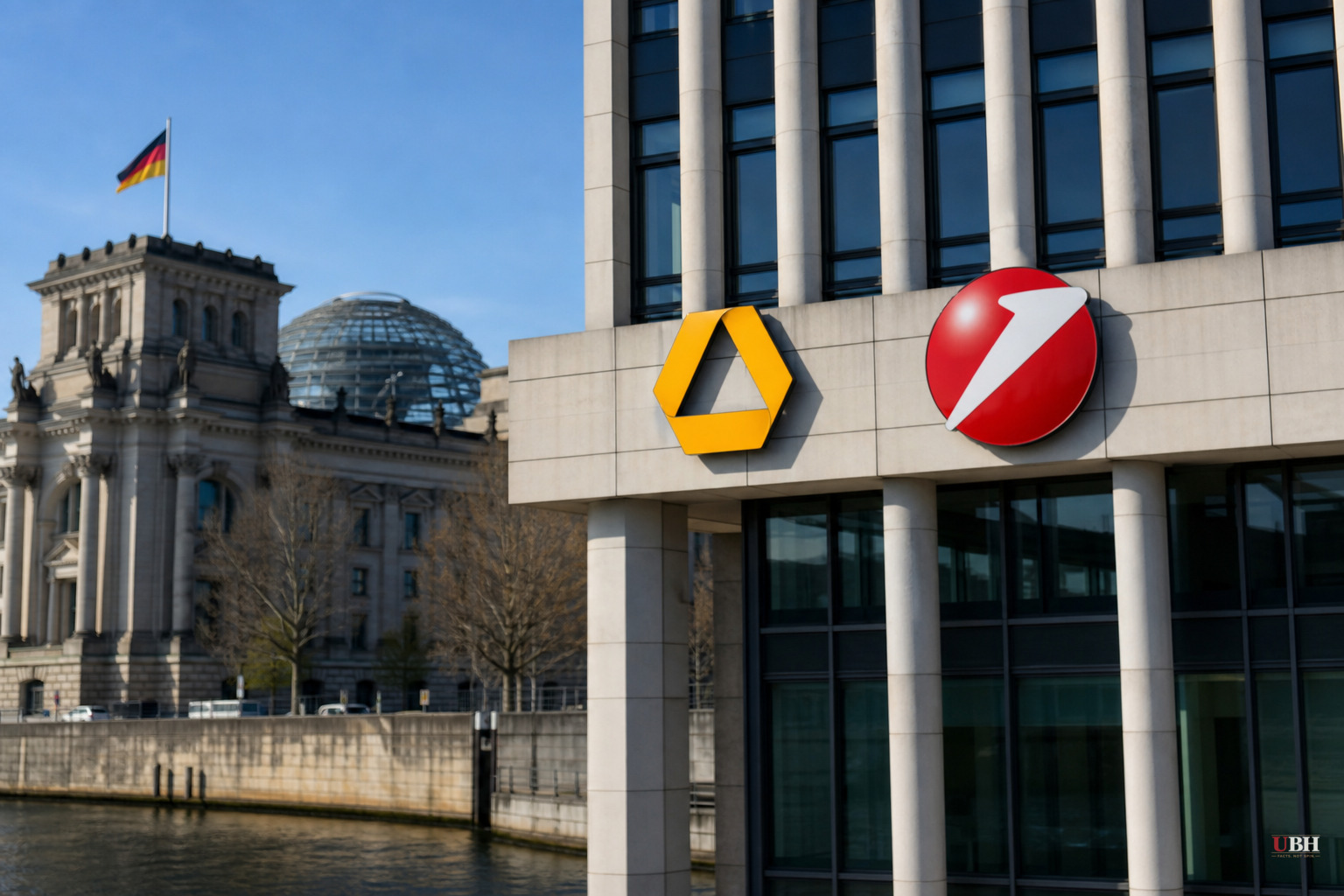
Berlin is done pretending it can stop this.
Senior figures in the German government are now prepared to discuss selling the state's remaining 12.7% stake in Commerzbank to Italy's UniCredit, according to Bloomberg. After nearly two years of Germany treating this deal like a hostile invasion, that's a real shift.
If it happens, UniCredit's stake jumps from roughly 47.6% to more than 60% of Commerzbank. CEO Andrea Orcel goes from largest shareholder fighting an uphill battle to the outright dominant owner of one of Germany's biggest banks.
How UniCredit Got Here
This campaign started in September 2024 when UniCredit first grabbed a stake in Commerzbank, according to Crowdfund Insider. It escalated into a full takeover push this year. A share-exchange offer that closed in late July pushed UniCredit to 47.59% of capital and 49.65% of voting rights, according to ad-hoc-news.de, with another 11.48% tied up in non-voting derivatives.
The actual tender offer barely moved the needle with regular shareholders. Only 2.7% of independent institutional and retail investors tendered their shares, even though total tendered capital hit 17.6%. A lot of Commerzbank's free-float shareholders are betting UniCredit will have to pay more before this is over, not less.
Germany's financial regulator, BaFin, ruled UniCredit's application for majority control complete in late July and kicked it to the European Central Bank. The ECB now has 60 working days to review it, with a possible 20-day extension, according to ad-hoc-news.de. That puts a decision window somewhere between this autumn and early December. UniCredit also still needs sign-off from EU competition regulators, Germany's foreign investment review board, the US Federal Reserve, and Poland's financial watchdog.
Commerzbank Didn't Fold for Nothing
Commerzbank's supervisory board chairman, Jens Weidmann, announced on July 24, 2026 that the bank was open to formal talks, according to Crowdfund Insider. Weidmann, a former Bundesbank president, didn't sugarcoat why: UniCredit's stake had "fundamentally altered the balance of power" heading into the annual shareholder meeting. He said there would be "no shortcut via Berlin," meaning the government couldn't just override this through political pressure, and that constructive talks were now necessary to protect "staff, shareholders and the customers of the bank."
Formal talks between Orcel and Commerzbank CEO Bettina Orlopp began this August, according to BigGo Finance.
Commerzbank just posted a record first-half net profit of €1.8 billion, according to ad-hoc-news.de. Its second-quarter operating result climbed 17% to €1.37 billion, management confirmed full-year 2026 profit guidance of €3.4 billion, and the bank announced another share buyback. This isn't a wounded target getting picked off. It's a bank performing well that's still losing the argument against a foreign buyer with a bigger balance sheet.
Shares closed at €39.36, just 1.2% below the 52-week high of €39.85 hit on August 6, and are up 9.0% year-to-date, according to ad-hoc-news.de.
The Legitimate German Concern
Germany's resistance wasn't just nationalist reflex. Officials and labor representatives have pushed for guarantees that Commerzbank keeps its Frankfurt headquarters, protects jobs, and keeps financing German small and medium-sized businesses, according to Crowdfund Insider. That's a fair ask. Cross-border bank mergers have a track record of consolidating back-office functions and cutting branches in the acquired country, and German workers on the supervisory board have reason to want that in writing before signing off.
Berlin's current position reflects that. The government would require Commerzbank management's support for any stake sale and wants guarantees on financing for German businesses and Frankfurt's role as a financial hub, according to BigGo Finance. That's negotiating leverage while the votes are still being counted.
What UniCredit Actually Wants
Orcel's pitch is straightforward: scale and cost-cutting. European banks are dumping money into technology, cybersecurity, AI and digital payments, and a bigger combined bank spreads those costs over more customers, according to Euronews. UniCredit's plan reportedly aims to cut Commerzbank's cost base by around €1.3 billion, according to Reuters reporting cited by Newswav, while initially keeping Commerzbank's operations separate from UniCredit's existing German subsidiary, HypoVereinsbank.
Handelsblatt reports the ECB is expected to approve the takeover, but supervisors have warned the integration itself will be "challenging and lengthy," according to ad-hoc-news.de. Market enthusiasm for the deal is running ahead of the operational grind of actually merging two national banking systems.
The ECB's ruling window between this autumn and early December is the next concrete checkpoint. Whether Berlin actually sells its 12.7% stake, and on what terms, will determine whether this becomes the first real test of Europe's long-stalled push for cross-border banking union, or another case where national politics quietly reasserts itself once the ink is supposed to dry.
Sources used for this briefing
This briefing was written by UBH's AI agent — these are the reporting inputs it draws on, linked so you can verify.


