
Unbiased headlines. Facts, not spin.
Unbiased Headlines is an independently owned news organization. We bring you the facts, not opinions, written fresh from 110+ named sources. Sources linked so you can verify it yourself.
 energy
Notable (6/10)
Asian Airlines Face Expiring Fuel Hedges With Jet Fuel at $148 a Barrel
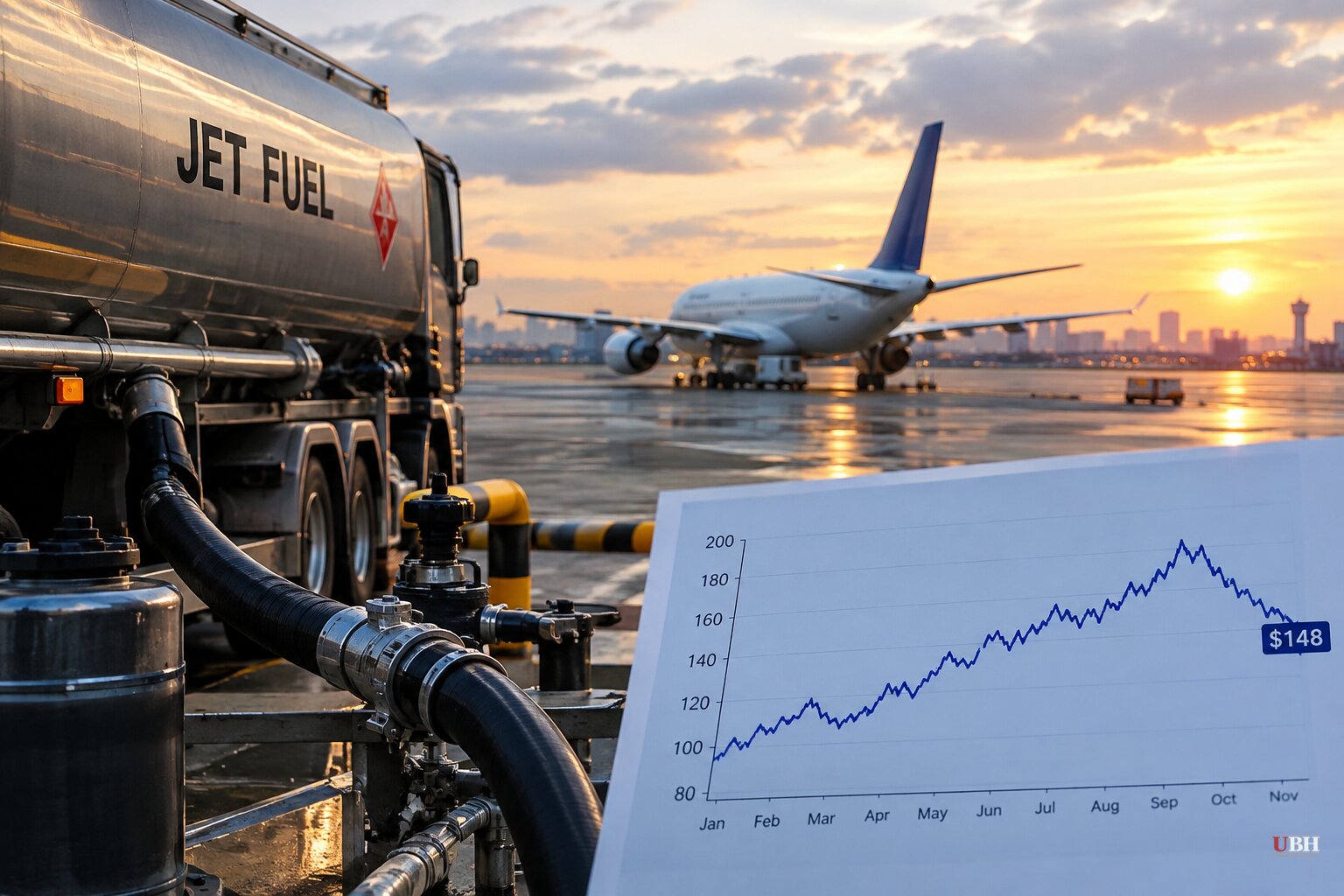
Asian airlines are running out of protection just as they need it most.
Jet fuel in Asia costs about $148 a barrel, roughly 75% above where it stood before the Iran war began in late February. It has come down from October peaks near $180. Hedging contracts struck before the war are now expiring, and carriers must decide whether to buy new cover at today's prices or ride the market unprotected.
A cost base that has shifted
Wong Hong, director-general of the Association of Asia Pacific Airlines (AAPA), said fuel now makes up 33% of airline operating costs. The International Air Transport Association put the pre-war figure at 25%.
Wong called the hedging decision a "very, very tricky dilemma." Hedge at current levels and an airline locks in a high price. Skip it and a new spike lands straight on the income statement.
There is also a timing problem. Passengers book months ahead, so fares are fixed before airlines buy the fuel to fly those routes. Wong said that mismatch makes it hard to pass on rising costs.
Fares and traffic
Major airlines in Asia-Pacific, Europe and North America have raised base fares, fuel surcharges or fees since the war started. Asked after an AAPA conference in Kuala Lumpur whether high fares would become a lasting feature, Wong said: "I believe so."
"We are living in completely different market conditions and a completely different cost environment and it looks like these high prices will continue to prevail," he said.
He said carriers are trying to hold fares where they can without driving passengers away. Whether another round of increases would work, he said, has no clear answer, because price sensitivity differs from market to market.
AAPA data shows regional passenger traffic fell for five straight months from April through August and rebounded only marginally in September. For the first nine months of the year, traffic still grew 1.9%.
Two views on where prices go
Air Astana's chief executive told Reuters the industry should plan for the long haul. "Our view is that we are facing a new normal where the fuel price is there to stay at the levels that we see more or less today," he said. That view favors hedging.
Japan Airlines sees it differently. Senior managing executive officer Ross Leggett said, "We still think it will be cyclical. It's going to go up and down."
The airline is not betting everything on that call. It is budgeting for a worst-case jet fuel price of $160 a barrel, which is what it actually paid between April and September.
China's big three are already in the red
The cost of the shock shows up clearly in the quarterly filings of China's three largest state-owned carriers. All three lost money over the first nine months of 2026 after turning a profit in the same period last year.
Air China's third-quarter net profit fell 92.6% to 270.6 million yuan ($40.6 million). China Eastern's fell 98.2% to 64 million yuan. China Southern swung to a 609 million yuan loss from a 3.84 billion yuan profit a year earlier.
Combined, the three lost about 8.4 billion yuan ($1.3 billion) over nine months, according to the filings. Air China blamed rapidly rising oil prices, China Eastern cited Middle East tensions, and China Southern pointed to oil price swings.
Fuel was not the only drag. Domestic fares were weak amid competition from high-speed rail, and typhoons disrupted summer flying. Huatai Securities estimated Air China's yields fell 5% in the quarter, leaving it unable to recoup the higher fuel bill. Shares in Air China, China Eastern and China Southern have fallen 38%, 46% and 39% this year.
The ask to governments
At its Assembly of Presidents, AAPA urged governments across the region to provide "timely, practical support" to airlines. Wong said the operating environment has "changed markedly" in the 12 months since the last assembly and that governments "must recognise these pressures."
The association has not spelled out what form that support should take. Whether any government is willing to underwrite airline fuel costs with taxpayer money is an open question.
The Assembly also adopted resolutions on sustainable aviation fuel, passenger rights, cabin safety and aviation security. It reaffirmed a target of 5% sustainable aviation fuel use by 2030.
The war still sets the price
The fuel outlook depends on the Gulf. Iran's Revolutionary Guards said Friday, Nov. 13, that they destroyed a US early-warning radar in Bahrain and warned firms involved in Hormuz oil shipments. There was no US comment and the claim is unverified. Separately, President Donald Trump said the US does not need a deal with Iran, according to market reports, and traders read that as raising escalation risk.
A diplomatic breakthrough would likely pull prices down sharply, while a prolonged stalemate would keep them elevated. For now, a near-term resolution looks unlikely, according to market analyst Giuseppe Dellamotta of investingLive.
That leaves airline treasurers with a concrete choice as their pre-war hedges roll off. Air Astana is signaling it expects today's prices to hold. Japan Airlines expects a swing but is budgeting $160 anyway.
Sources used for this briefing
7 links from 7 independent newsrooms (syndicated copies of the same report count once)
These are the sources it draws on, linked so you can verify.


