
Unbiased headlines. Facts, not spin.
Unbiased Headlines is an independently owned news organization. We bring you the facts, not opinions, written fresh from 110+ named sources. Sources linked so you can verify it yourself.
 energy
Major Story (8/10)
Event date: November 2, 2026 ·
Aramco Starts Engineering on East-West Pipeline Expansion to 10 Million bpd as UAE Weighs Third Hormuz Bypass
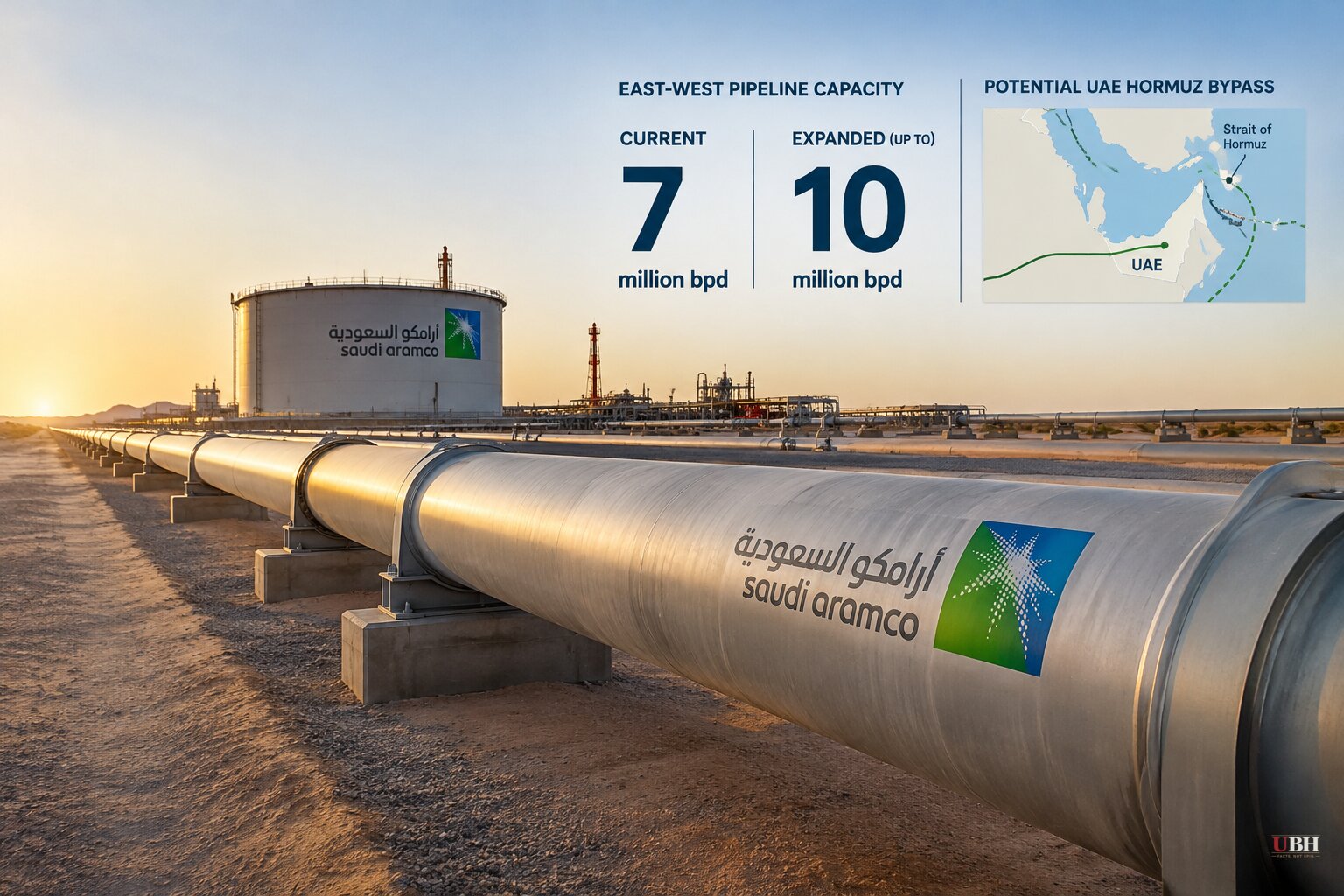
Saudi Aramco has started preliminary engineering on a bigger East-West pipeline, the line that lets Saudi crude reach the Red Sea without passing through the Strait of Hormuz. CEO Amin Nasser confirmed the work on Tuesday, Nov. 3, during the analyst call after third-quarter results.
"This work has already started," Nasser said of the expansion and the additional networks Aramco is building. Details will wait for final investment decisions. Aramco has disclosed no project cost.
What Aramco is building
The pipeline runs roughly 1,200 kilometres from Abqaiq in the Eastern Province to the Red Sea port of Yanbu. Nominal capacity is about 7 million barrels per day. Roughly 5 million has been available for export, and the rest feeds west-coast refineries.
The target is up to 10 million bpd, a 43 percent increase in throughput. Saudi Energy Minister Prince Abdulaziz bin Salman put the timeline at two to three years.
On Oct. 12, the minister also said the kingdom could temporarily add up to 1.2 million bpd of export capacity within seven to eight weeks by converting a domestic gas pipeline to carry crude. Counting from Oct. 12, that window runs from late November to early December.
Nasser said the conflict has brought more than 130 reported attacks on tankers. He said freight rates have climbed to more than 15 times year-earlier levels, and that Aramco's roughly 540-vessel supertanker fleet has lost effective capacity to vessel restrictions.
The bottleneck is at the port
Pipe is not the limiting factor. The intelligence firm Kpler says the main constraint is export infrastructure at Yanbu, where loading capacity caps how much crude can ship. Yanbu loadings surged toward 4 million bpd at peaks earlier in the crisis, but terminal capacity, tanker availability and insurance costs have limited sustained flows.
Kpler says Yanbu's facilities would need to expand before significantly larger volumes could bypass Hormuz. Oil leaving the Red Sea then faces its own risks: Houthi activity near the Bab al-Mandeb Strait and longer voyages to Asia.
Nasser has also referenced studies of further export routes and more overseas storage. One concept under discussion is a link toward Oman's Duqm or Ras Markaz complex on the Arabian Sea, which would reach Asian markets entirely outside Hormuz. No decision has been announced.
The UAE and Sharjah
The UAE is weighing a third crude export pipeline designed to bypass Hormuz, according to a market-wire post on X. It would add to the existing Abu Dhabi Crude Oil Pipeline. A route, cost and schedule for a third line have not surfaced.
A separate project is further along. Kpler estimates the UAE's current expansion of its bypass capacity is about 50 percent complete, with a startup targeted for early 2027. Kpler expects material export gains by mid-2027, because Fujairah's loading facilities also need expanding.
On Nov. 2, Khamis Al Mazrouei, CEO of the Sharjah National Oil Corporation, told Gulf News the emirate could build a roughly 100-kilometre corridor carrying crude and refined products from Al Hamriyah port to Kalba, Khor Fakkan or Fujairah on the Gulf of Oman. "We can have the shortest bypass to the Strait of Hormuz," he said. Discussions with partners, customers and suppliers are under way.
Iraq has no comparable option. Its main fields are around Basra, and almost all of its crude ships from terminals on the Persian Gulf.
Is Hormuz actually shut?
The two sides disagree on that. Iran's Islamic Revolutionary Guard Corps insists the strait is "closed." U.S. Central Command says it is "open" and put the number of merchant ships that transited in the week before Oct. 20 at about 400.
Kpler counted far fewer: about 20 known transits over ten days, against more than 100 a day before the war. Ships often run with transponders off to avoid being targeted, which could explain part of the gap. Bloomberg News reported that large tankers are moving in convoys and transferring cargo to other vessels once clear of the danger zone.
Total oil flows have nonetheless recovered. Kpler put exports at 24.5 million bpd in the week ending Oct. 18, against 24.4 million bpd on Feb. 22, a week before the conflict began. That figure includes crude moved by alternative routes such as the Red Sea and excludes Iranian oil, which has fallen to near zero under the U.S. blockade. Vortexa's estimate was lower at 18 million bpd, still only slightly below the prewar average.
The International Energy Agency said the UAE has been particularly successful at moving oil despite Iran's threats. Before the conflict, the Strait of Hormuz carried about one-fifth of the world's traded oil and gas.
Timing and next steps
Nothing announced this week adds barrels immediately. The Saudi gas-line conversion is the nearest milestone, with its seven-to-eight-week window closing between late November and early December. The UAE's expanded line is targeted for early 2027, and Aramco's 10 million bpd goal is two to three years out, pending final investment decisions that Nasser has not yet scheduled.
Sources used for this briefing
6 links from 6 independent newsrooms (syndicated copies of the same report count once)
These are the sources it draws on, linked so you can verify.


